One thinking architecture of sustainable inquiry travelling with many learners facing complex realities with disrupted peace and denied human rights
By the end of this unit, Mindgleians will construct context-responsive inquiries that make marginalised learners’ realities, rights and knowledge visible.
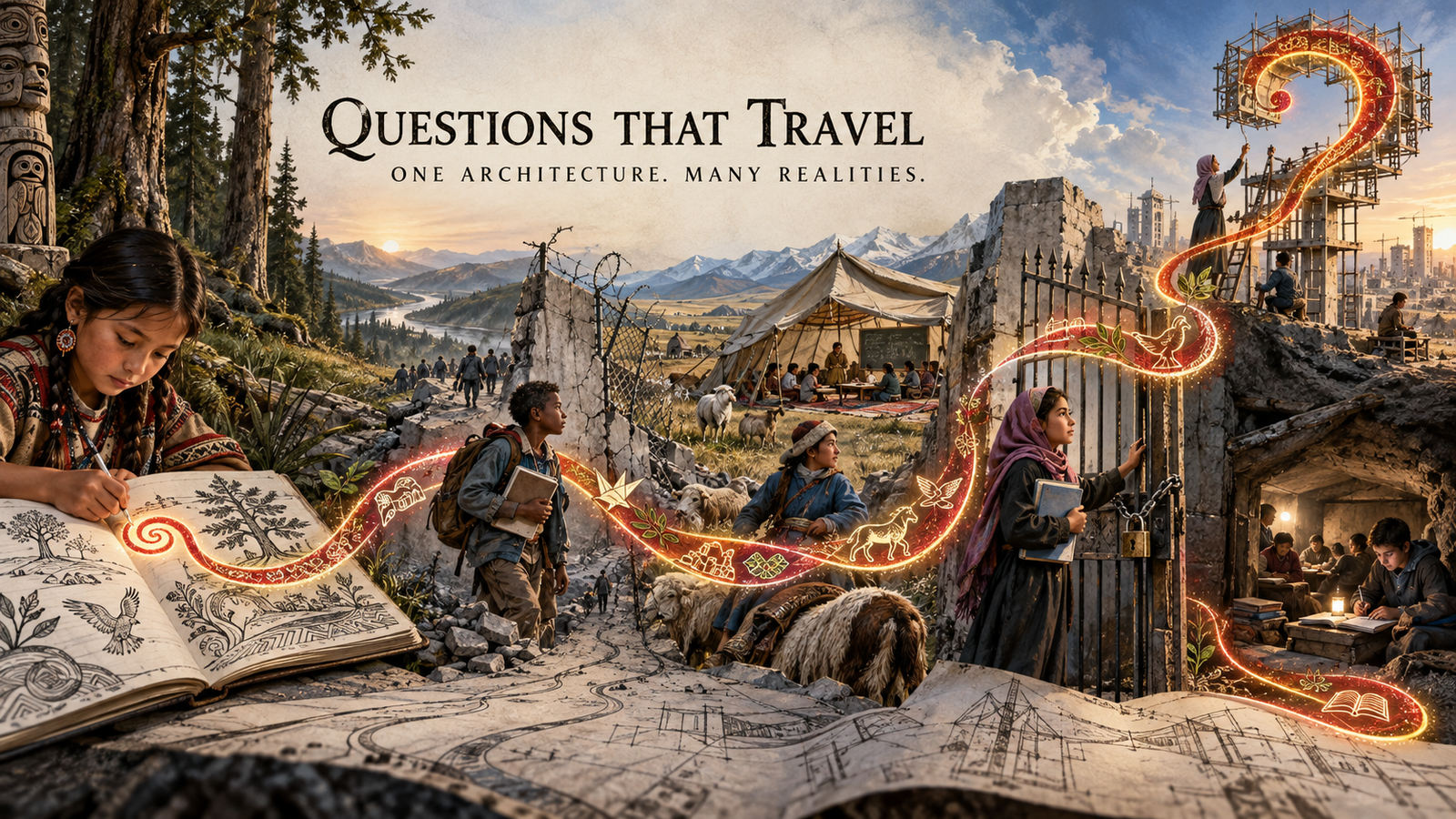
The sketch Questions that Travel in which one glowing inquiry spiral moves through a forest, refugee camp, migratory route, closed school gate and interrupted classroom—changing form without losing its architecture.
This unit focuses on Questions that should travel with learners, not arrive ahead of them carrying conclusions. The architecture may remain recognisable, but its language, evidence, pace, boundaries and depth must evolve with the learner’s reality. Education becomes humane when marginalised learners are no longer treated merely as cases to be studied, but recognised as knowledge-holders capable of questioning the systems that have defined, displaced or excluded them—and of designing inquiries through which they can redefine their futures. Their realities are shaped by overlapping systems of displacement, dispossession, conflict, gendered exclusion, cultural marginalisation and interrupted education—systems that disrupt not only where and how they learn, but also their safety, identity, dignity, belonging and fundamental human rights.
Unit 2 Collective RIQ
How can one inquiry architecture travel across displacement, mobility, dispossession, gendered exclusion and interrupted schooling while allowing every learner’s own history, language, evidence and knowledge system to determine what the inquiry becomes?
Learners Across Disrupted Worlds Ask
These inquiry dialogues are grounded in documented histories of displacement, dispossession and cultural disruption. They illuminate distinct learner realities without presenting them as authentic testimony or treating Indigenous peoples, refugees, asylum-seekers and internally displaced communities as interchangeable.
Indigenous Learners Ask: What Had Already Broken Before the World Noticed?
These are imagined inquiry dialogues grounded in documented histories. They are not presented as authentic testimony from every member of these diverse communities.
A Santal Learner Questions the Santal Hul
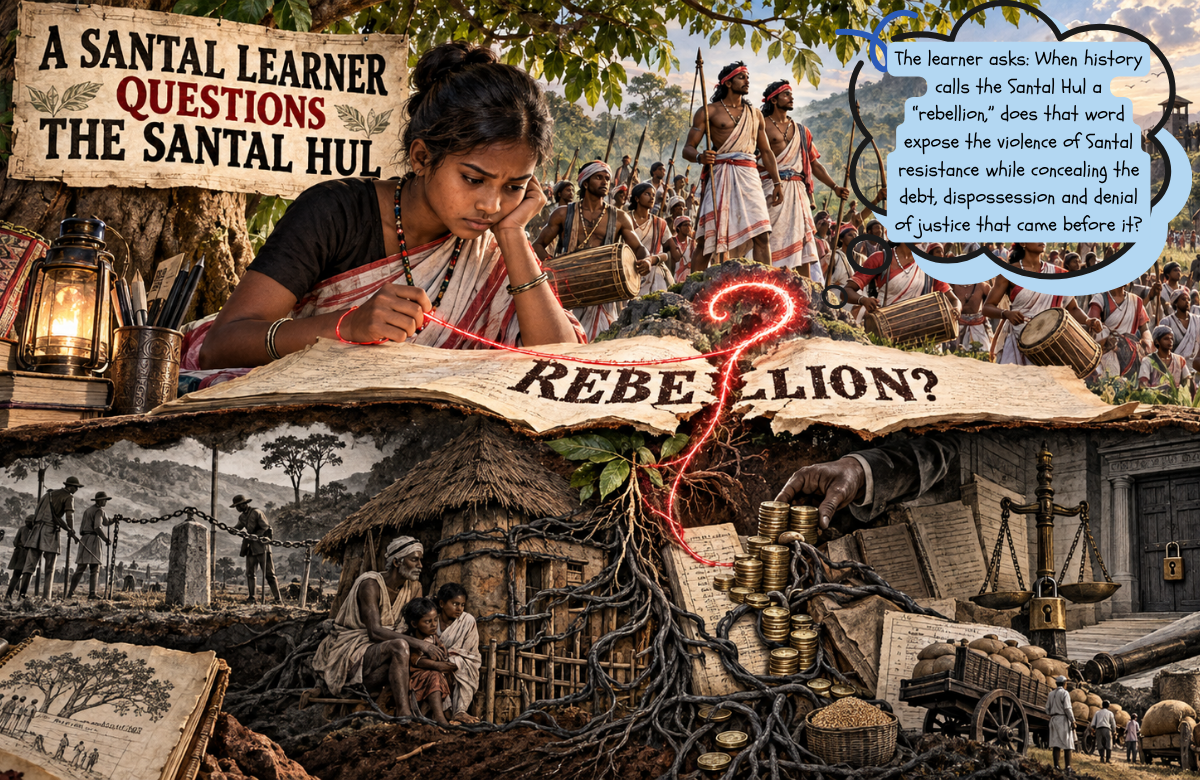
Teacher: History books describe the Santal Hul of 1855–56 as an armed uprising against British colonial authority. Is that where the disruption of peace began?
Santal learner: The uprising was the visible event, but peaceful conditions had already been destroyed. Santal families were losing land through exploitative debt. Moneylenders charged crushing interest, zamindars demanded revenue, and colonial police and courts often protected those benefiting from the system. When Sidhu, Kanhu, Chand and Bhairav Murmu mobilised the Hul, they were responding to a structure that had made survival without resistance increasingly impossible.
The learner asks: When history calls the Santal Hul a “rebellion,” does that word expose the violence of Santal resistance while concealing the debt, dispossession and denial of justice that came before it?
A Kora Learner Questions whether Proximity creates Belonging
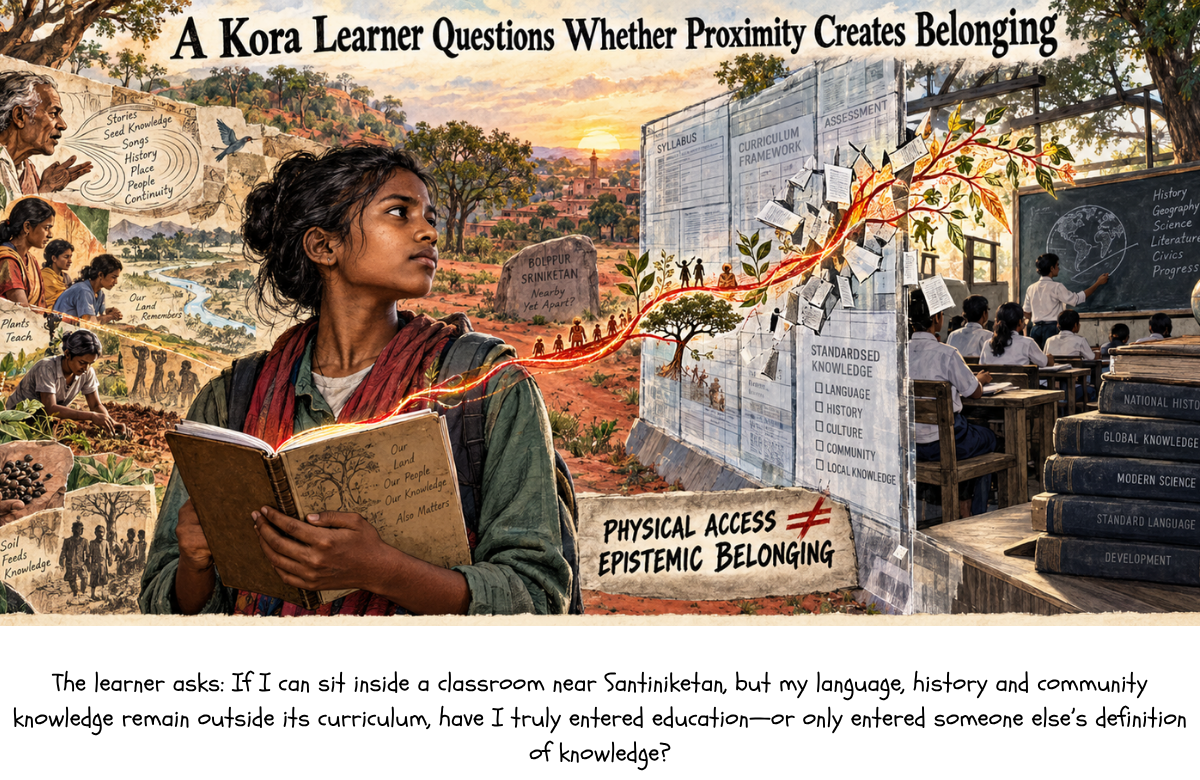
Teacher: Santiniketan is internationally celebrated as a place where education meets nature, culture and human freedom. Kora families have lived in nearby villages such as Raipur for generations. Does living close to such a centre of learning guarantee educational inclusion?
Kora learner: Physical closeness does not necessarily create belonging. A Kora learner may enter a classroom in which the dominant language, textbooks and definitions of knowledge leave little space for Kora history, oral memory, ecological understanding or community experience. The learner is expected to adapt to the institution, while the institution may never be required to learn from the learner. Peace is disrupted not only when a child is denied admission, but also when the child is admitted while their identity and knowledge remain outside the classroom.
The learner asks: If I can sit inside a classroom near Santiniketan, but my language, history and community knowledge remain outside its curriculum, have I truly entered education—or only entered someone else’s definition of knowledge?
A Dongria Kondh Learner Questions the Meaning of Niyamgiri
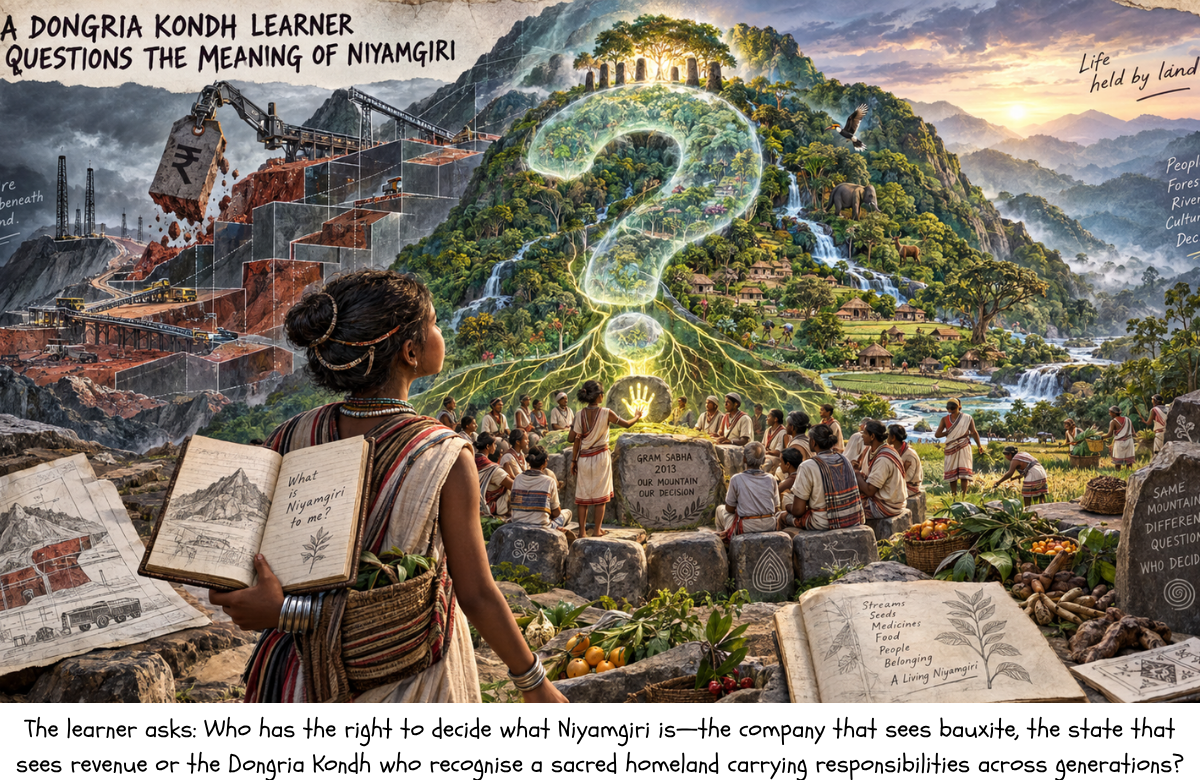
Teacher: A proposed mining project viewed the Niyamgiri Hills in Odisha as a major source of bauxite. What did your community see?
Dongria Kondh learner: We did not see an empty hill waiting to be developed. Niyamgiri sustains our streams, forests, food, medicine, worship and relationship with Niyam Raja. When outsiders described the mountain mainly as a mineral deposit, they reduced a living cultural landscape to the commercial value of what could be removed from beneath it. The conflict was therefore not simply “tribal people against development.” It concerned who possessed the authority to define the mountain and decide its future.
The learner asks: Who has the right to decide what Niyamgiri is—the company that sees bauxite, the state that sees revenue or the Dongria Kondh who recognise a sacred homeland carrying responsibilities across generations?
A Yanomami Learner Questions the Meaning of a Protected Territory
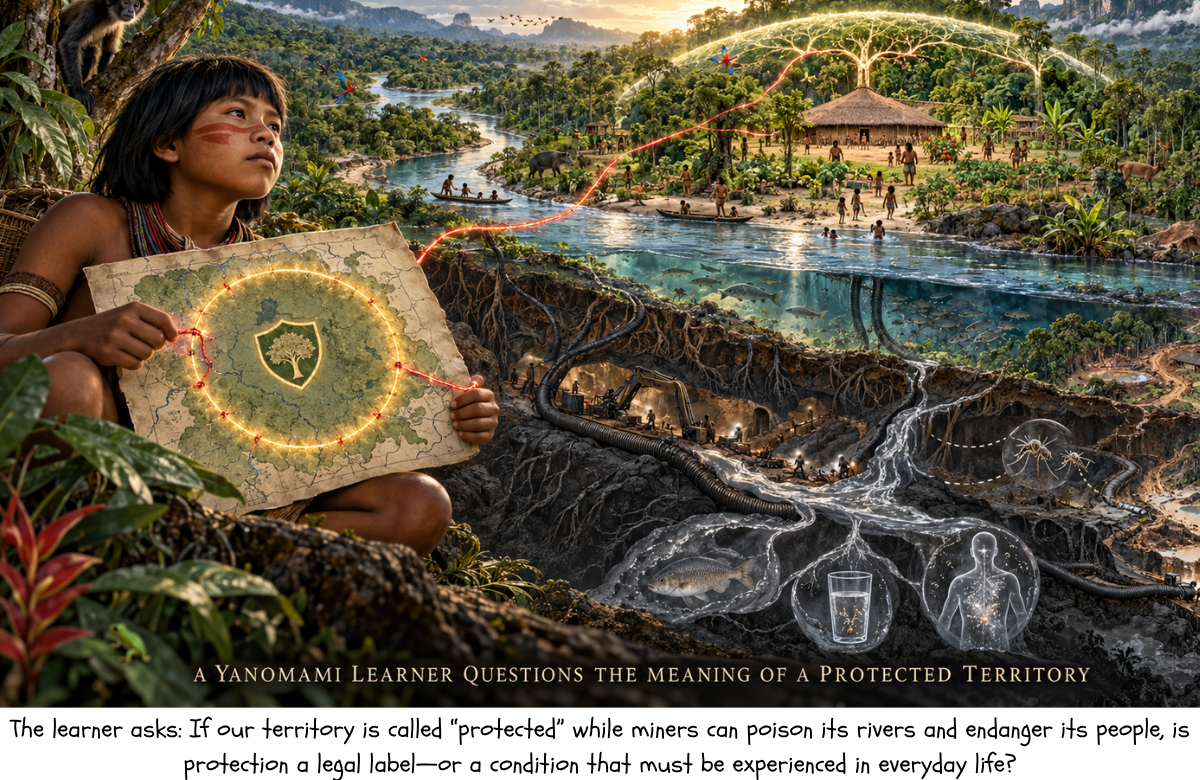
Teacher: Yanomami territory in Brazil is legally protected. Why, then, has peace still been disrupted?
Yanomami learner: A boundary on an official map cannot protect us if illegal miners enter the forest, damage food sources, contaminate rivers with mercury and expose remote communities to disease and violence. The invasion does not remain at the mining site. Pollution enters fish, water and human bodies; hunger grows when ecosystems are damaged; and fear changes how communities move through their own territory.
The learner asks: If our territory is called “protected” while miners can poison its rivers and endanger its people, is protection a legal label—or a condition that must be experienced in everyday life?
A First Nations Learner Questions Canada’s Residential-School System
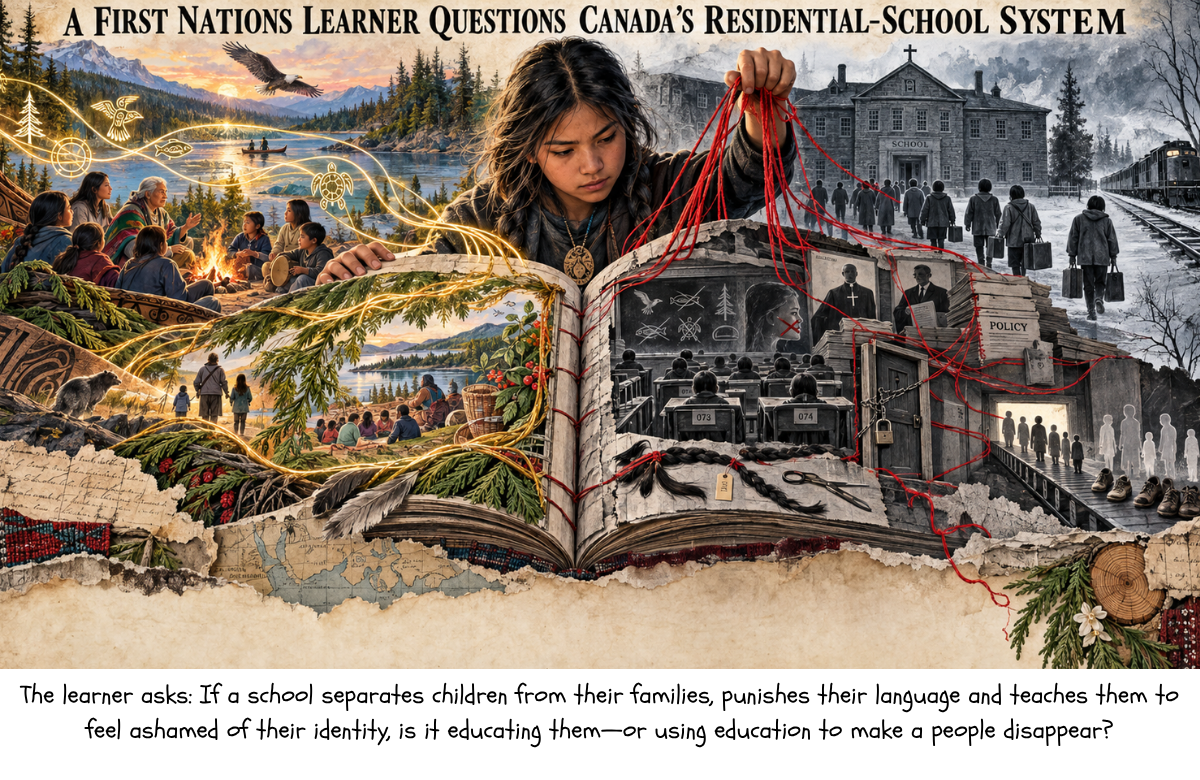
Teacher: Canadian authorities described residential schools as institutions of education. What was disrupted inside them?
First Nations learner: Children from numerous First Nations—as well as Inuit and Métis children—were removed from their families and communities. Many were punished for speaking their languages and prevented from learning through their own cultures. Numerous children experienced neglect, abuse and death. The disruption therefore extended far beyond the school years: it interrupted language transmission, parenting relationships, cultural knowledge and trust in churches, schools and the state.
The learner asks: If a school separates children from their families, punishes their language and teaches them to feel ashamed of their identity, is it educating them—or using education to make a people disappear?
A Puutu Kunti Kurrama and Pinikura Learner Questions Juukan Gorge
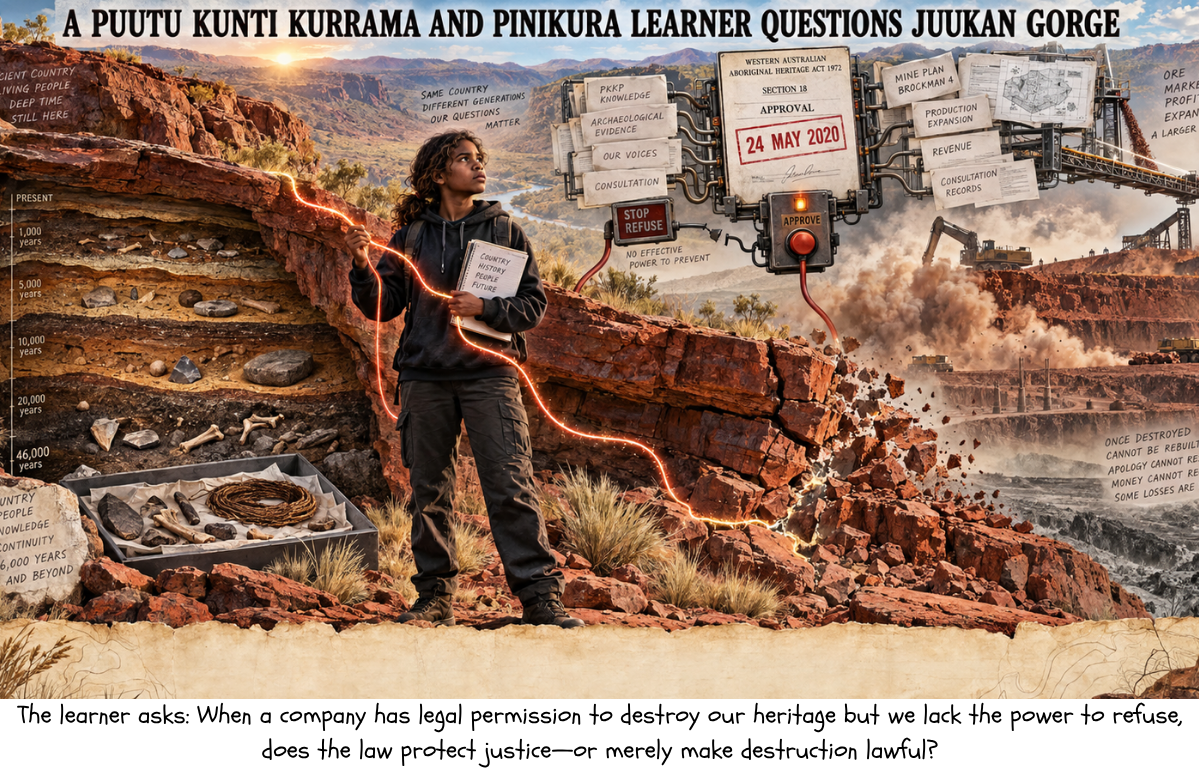
Teacher: In 2020, Rio Tinto legally destroyed the ancient rock shelters at Juukan Gorge in Western Australia to expand an iron-ore mine. Why was legal permission insufficient?
Puutu Kunti Kurrama and Pinikura learner: The shelters contained evidence of approximately 46,000 years of human occupation and held irreplaceable cultural and ancestral meaning for our people. Although the company possessed legal permission, we did not possess an effective power to prevent the destruction once the importance of the site was fully understood. Consultation existed, but final authority remained elsewhere. No apology or financial payment can reconstruct a destroyed ancestral place.
The learner asks: When a company has legal permission to destroy our heritage but we lack the power to refuse, does the law protect justice—or merely make destruction lawful?
A Maya Ixil Learner Questions Collective Blame in Guatemala
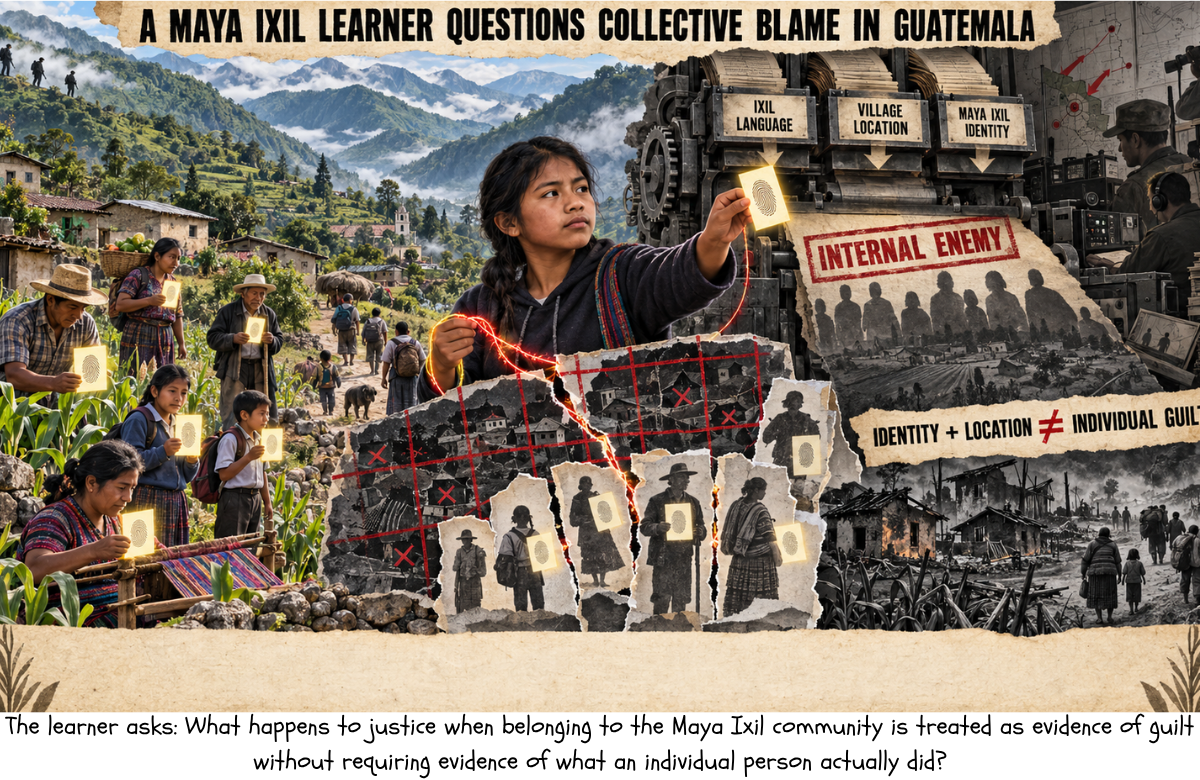
Teacher: During Guatemala’s internal armed conflict, military forces represented some Maya Ixil communities as supporters of guerrilla groups. What danger did that narrative create?
Maya Ixil learner: The narrative erased the difference between an armed actor and an Indigenous civilian. Our language, location and community identity could be treated as supposed evidence of political guilt. Once an entire people were described as an internal enemy, attacks on villages, homes, crops and civilians could be justified as military necessity. Identity itself became something for which people were punished.
The learner asks: What happens to justice when belonging to the Maya Ixil community is treated as evidence of guilt without requiring evidence of what an individual person actually did?
The Dialogue across Communities
Teacher: Are all these cases the same?
Learners: No. The Santal Hul involved colonial exploitation and organised resistance. Niyamgiri concerned sacred land and community authority over mining. The Yanomami crisis involves illegal territorial invasion and environmental contamination. Canadian residential schools used education as an instrument of forced assimilation. Juukan Gorge exposed the weakness of legal consultation without an effective power of refusal. The attacks on Maya Ixil communities occurred during an armed conflict shaped by racism and collective blame. Their histories and legal meanings must not be collapsed into one category.
Teacher: What, then, connects them?
Learners: In every case, a more powerful institution attempted to define Indigenous land, identity, knowledge or development on behalf of the people who would bear the consequences. Land became revenue, a sacred mountain became ore, a protected forest became a mining frontier, education became assimilation, heritage became an obstacle and Indigenous identity became supposed evidence of guilt.
Collective RIQ
When governments, companies, armies or schools possess the power to define Indigenous peoples without sharing the power to decide with them, can any resulting order be called peace?
Enduring realisation: Indigenous peace does not begin when outsiders become kinder decision-makers. It begins when Indigenous peoples are recognised as knowledge-holders, rights-holders and authorities in decisions governing their land, identity and future.
Refugee and Forcibly Displaced Learners Ask: If Home Is Interrupted, Must Learning Be Interrupted Too?
A South Sudanese Refugee Learner Questions Education in Kakuma
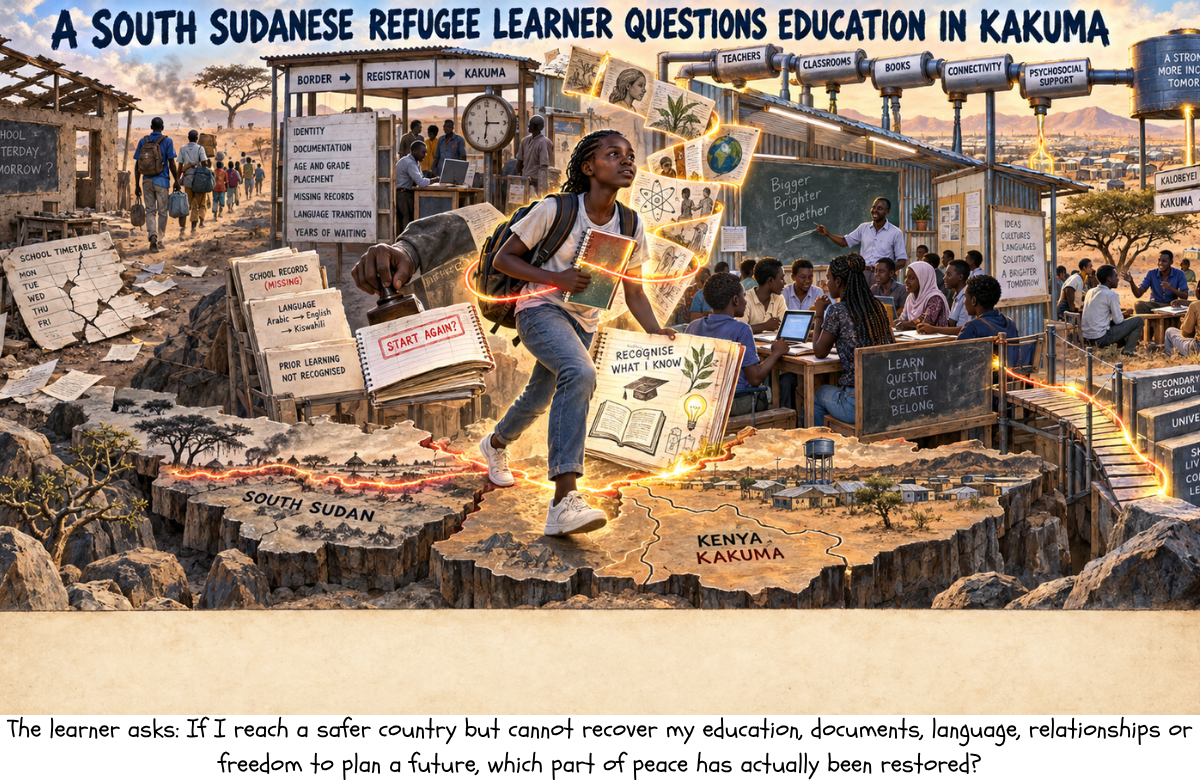
Teacher: Your family fled conflict in South Sudan and now lives in Kenya’s Kakuma refugee camp. Has reaching physical safety restored peace?
South Sudanese refugee learner: Physical safety matters, but displacement has disrupted much more than our location. I may have lost relatives, missed years of schooling and crossed a border without certificates proving what I had already learned. In Kakuma, I may enter an overcrowded classroom and study through a language or curriculum different from the one I previously knew. I am expected to continue learning while also carrying grief, uncertainty about my legal future and responsibilities within my family.
The learner asks: If I reach a safer country but cannot recover my education, documents, language, relationships or freedom to plan a future, which part of peace has actually been restored?
A Syrian Refugee Learner Questions Education in Za’atari
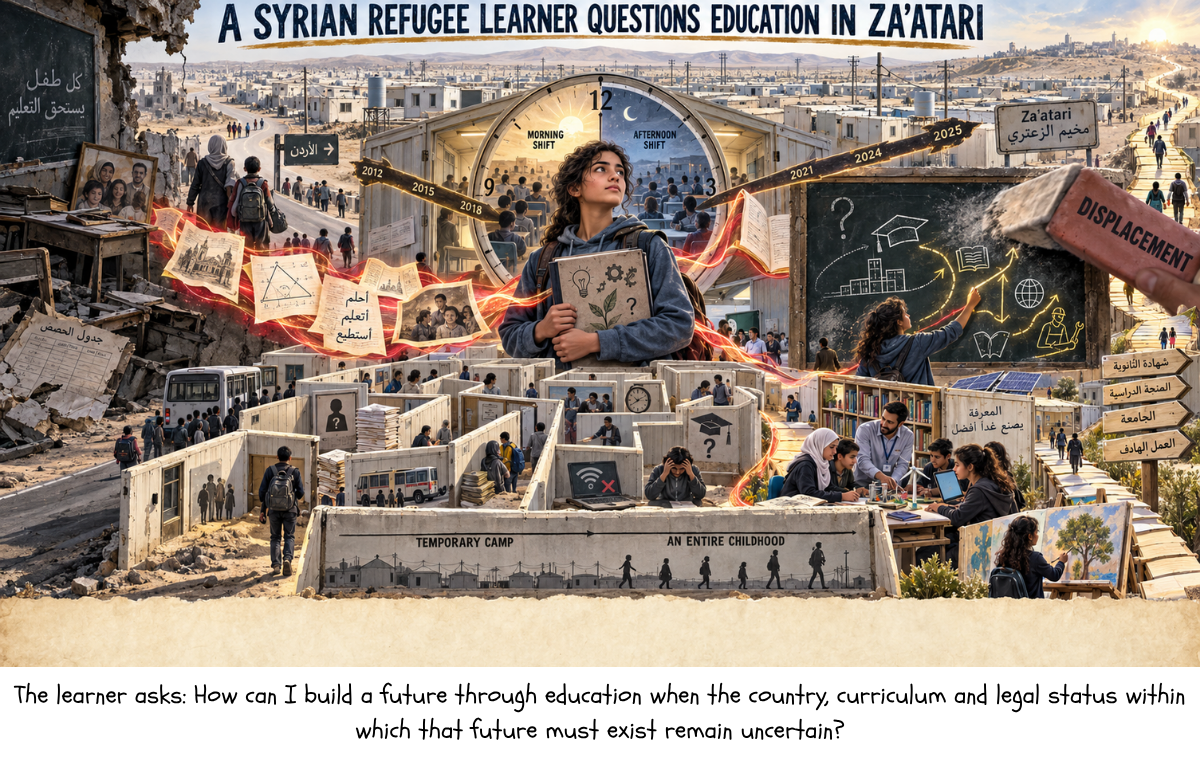
Teacher: Za’atari was established in Jordan for people fleeing the Syrian conflict. What might education mean to a Syrian learner there?
Syrian refugee learner: A school in Za’atari may restore routine after violence and flight, but entering a classroom does not erase what happened before it. I may have changed schools repeatedly, lost years of learning or begun working to help my family. Even when formal education is available, transport, poverty, documentation, safety concerns and the pressure to earn an income can affect whether I attend regularly. I may also be studying without knowing whether my family will remain in Jordan, return to Syria or move somewhere else.
The learner asks: How can I build a future through education when the country, curriculum and legal status within which that future must exist remain uncertain?
A Rohingya Refugee Learner Questions Learning in Cox’s Bazar
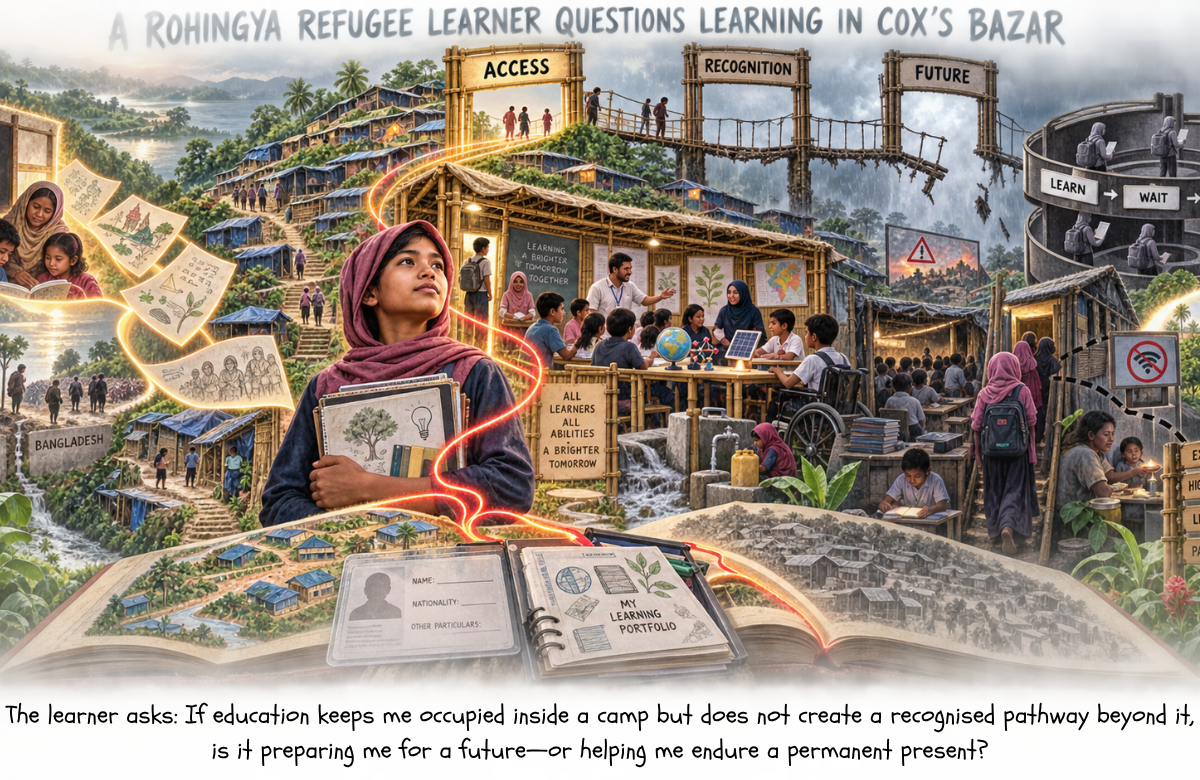
Teacher: Hundreds of thousands of Rohingya fled violence and persecution in Myanmar and entered Bangladesh. Why is schooling in Cox’s Bazar more than a humanitarian service?
Rohingya refugee learner: Education determines whether displacement becomes a temporary interruption or an inherited condition. If I receive only basic or temporary learning, cannot progress into recognised secondary education or lack qualifications accepted outside the camp, I may grow older without a credible pathway to university or employment. Language also matters. Learning must connect with the Myanmar curriculum and a possible future return without erasing my Rohingya identity and lived experience.
The learner asks: If education keeps me occupied inside a camp but does not create a recognised pathway beyond it, is it preparing me for a future—or helping me endure a permanent present?
The Dialogue Across Refugee Contexts
Teacher: Are Kakuma, Za’atari and Cox’s Bazar the same educational situation?
Learners: No. South Sudanese learners in Kakuma, Syrian learners in Jordan and Rohingya learners in Bangladesh were displaced by different histories and possess different legal, linguistic and educational needs. Some may hope to return home; others may seek local integration or resettlement. Camp-based, settlement-based and urban refugee experiences also differ.
Teacher: What connects them?
Learners: Forced movement can interrupt certificates, curriculum, language, relationships, identity and future planning. Refugee education must therefore provide more than temporary lessons. It must create continuity across the learner’s past, present location and possible futures.
Collective RIQ
How can an education system recognise what a displaced learner already knows, respond to what the learner has survived and create qualifications that remain meaningful wherever the learner must travel next?
Enduring realisation: A refugee learner does not arrive empty. Education travels responsibly when it recognises the learner as a carrier of knowledge, memory, language, capability and future possibility, rather than merely as a recipient of humanitarian assistance.
Nomadic, Pastoralist and Mobile Learners Ask: Why Must Education Remain Still When Our Lives Move?
Mobility is not automatically displacement. For many pastoralist and nomadic communities, movement is a purposeful way of sustaining animals, livelihoods, ecological knowledge and social relationships. The educational problem arises when a fixed system treats mobility itself as deficiency.
A Turkana Pastoralist Learner Questions the Fixed School Calendar
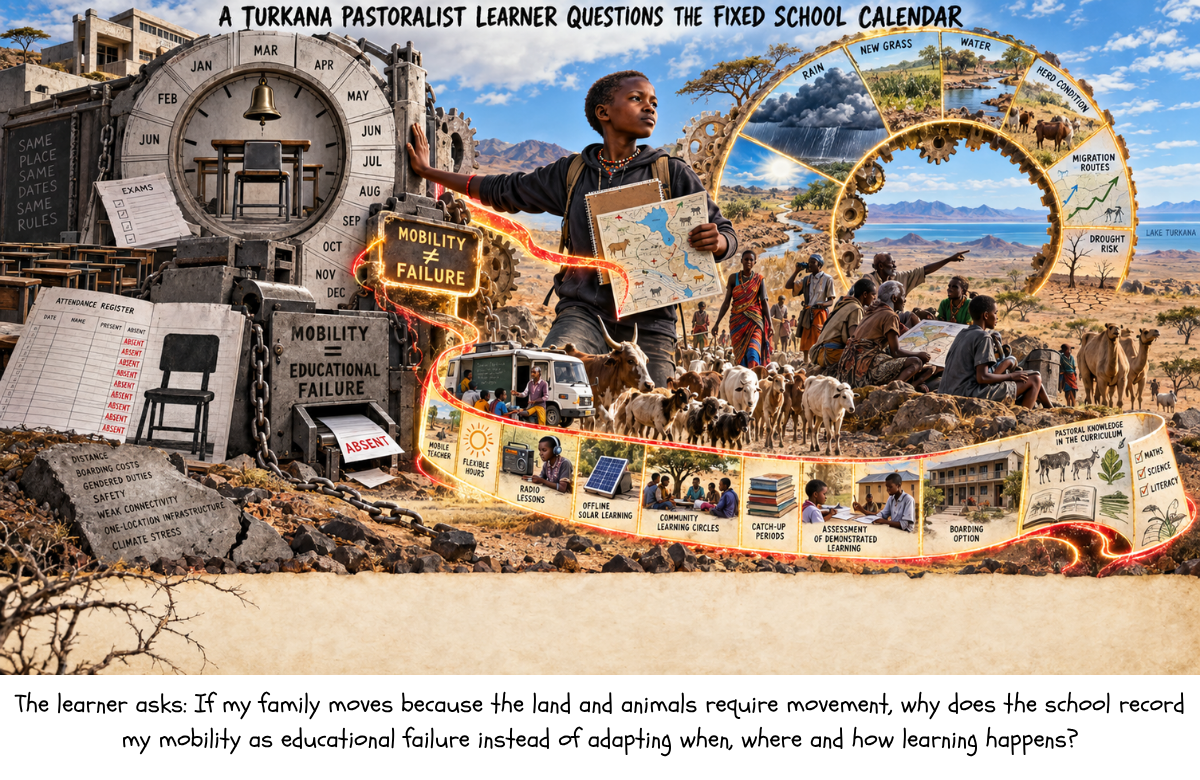
Teacher: Why might a Turkana family in northern Kenya move with its livestock?
Turkana learner: Movement may follow water, pasture, rainfall and the survival needs of animals on which the family depends. A distant school with fixed hours assumes that remaining in one place is normal. If I accompany my family, I may be recorded as absent or as having dropped out. If I remain near the school, I may be separated from family responsibilities and the ecological knowledge learned through pastoral life.
The learner asks: If my family moves because the land and animals require movement, why does the school record my mobility as educational failure instead of adapting when, where and how learning happens?
A Samburu Learner Questions the Meaning of Attendance
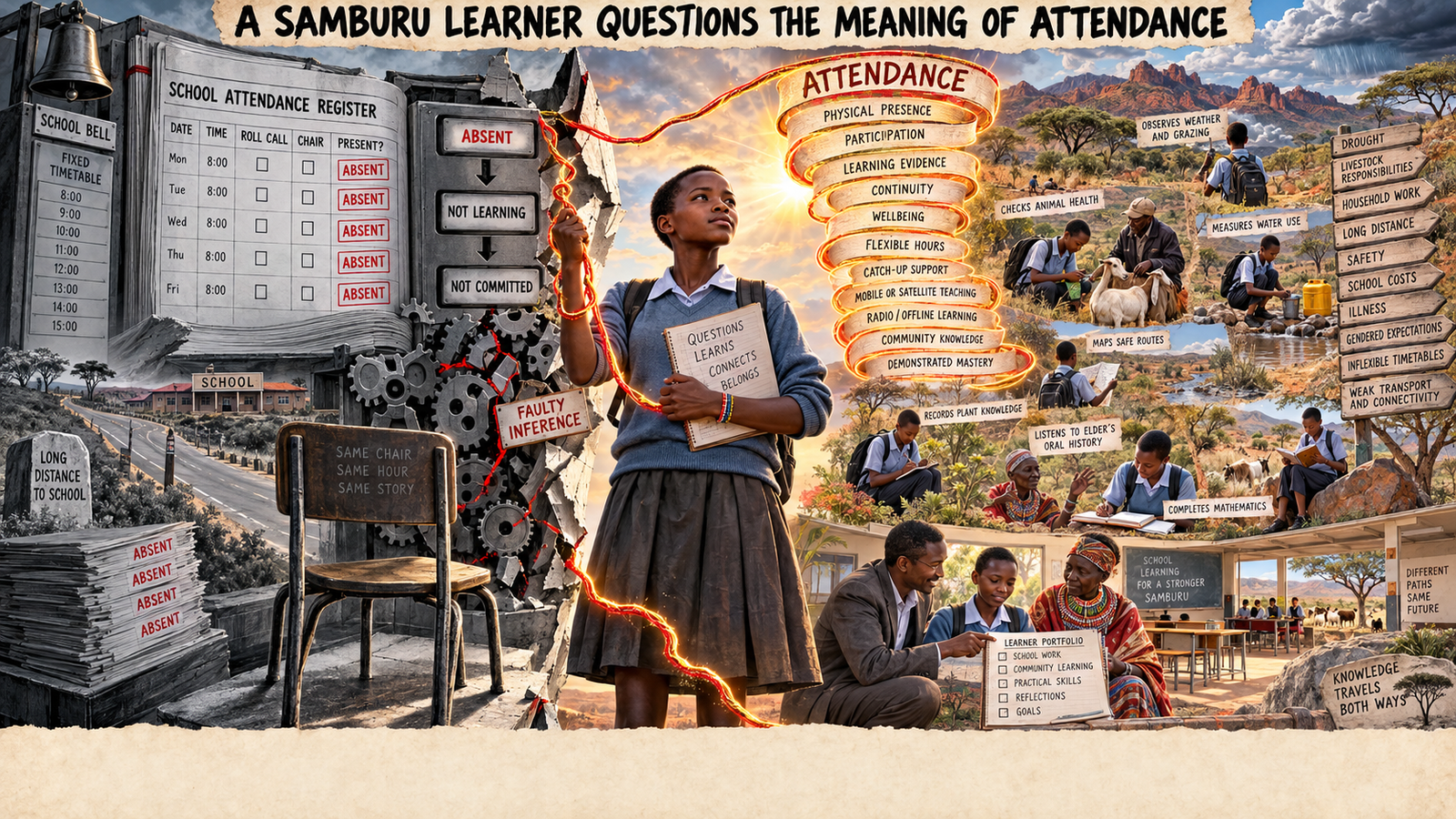
Teacher: Mobile and community-based schooling has been used in parts of Samburu County. What assumption does this challenge?
Samburu learner: It challenges the belief that education exists only when children enter a permanent building at the same time every day. A teacher, learning materials or a flexible timetable can move with or remain accessible to pastoral communities. But adaptation must not mean offering us an inferior curriculum. We need literacy, mathematics, science and recognised progression while also retaining knowledge of livestock, rainfall, grazing routes, medicinal plants and community responsibilities.
The learner asks: Can a school call me absent when its own design is absent from the places and times in which my community actually lives?
A Mongolian Herder Child Questions the Mobile Ger Kindergarten
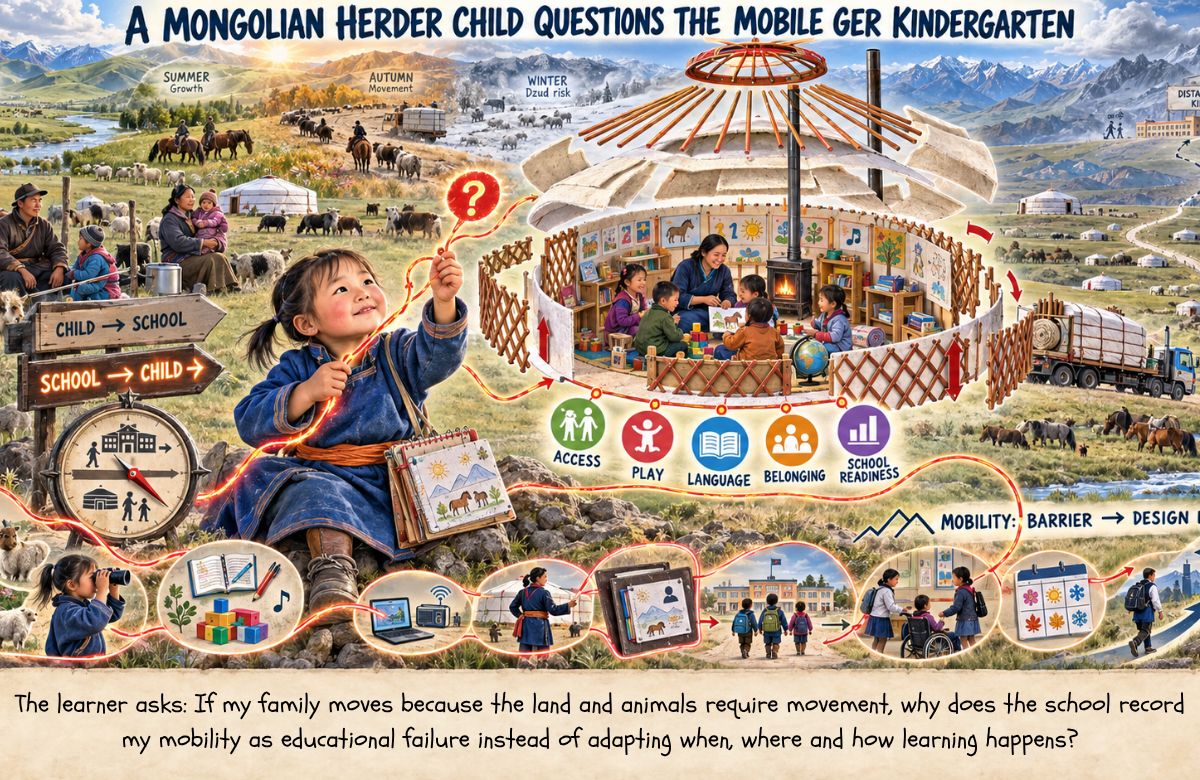
Teacher: Mongolia has used mobile ger kindergartens to reach young children in nomadic herding communities. Why does the school move?
Mongolian herder learner: My family’s seasonal movement is part of how animals find pasture and survive changing weather. A permanent kindergarten may be too distant from our camp. A mobile ger classroom brings early learning closer without requiring my family to abandon its livelihood. The important change is not simply putting a classroom inside a tent; it is redesigning educational time, location and materials around the learner’s actual world. UNESCO: mobile ger kindergartens
The learner asks: What if the most inclusive school is not the building that persuades my family to stop moving, but the learning system intelligent enough to move with us?
The Dialogue Across Mobile Communities
Teacher: Are all mobile learners displaced?
Learners: No. A refugee is forced across or within borders by danger. A pastoralist family may move intentionally as part of its livelihood and cultural knowledge. Seasonal workers, migrant families and stateless mobile communities face still other conditions. Calling all movement “displacement” turns a way of life into a problem.
Teacher: What connects these learners?
Learners: Conventional education is usually organised around a permanent address, a fixed calendar, continuous attendance and a single recognised school. Learners whose lives do not fit those assumptions can be excluded even when they are willing and capable of learning.
Collective RIQ
How can education preserve recognised academic progression while adapting its location, calendar, language and teaching methods to learners whose mobility is necessary to their culture, ecology or livelihood?
Enduring realisation: A mobile learner does not need an intellectually smaller education. The architecture of inquiry can remain rigorous while its timetable, location and route become flexible.
Learners Marginalised by Gendered Power Ask: Who Decided That Gender Determines How Far Learning May Travel?
This is the strongest category for cases such as Afghan girls. “Sex-dominated learners” should not be used, because the learner’s sex is not the disruption. The disruption is produced by laws, institutions, social norms and power relationships that use gender to restrict education.
An Afghan Girl Questions the Closed Secondary-School Gate
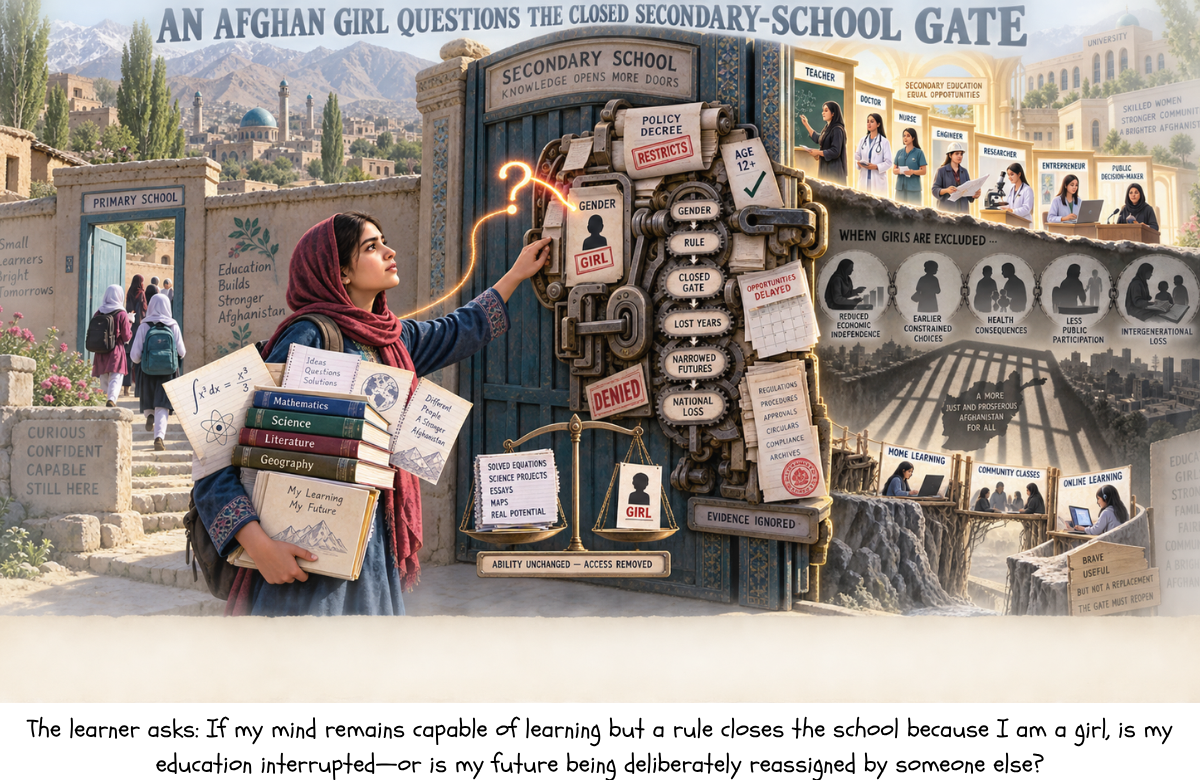
Teacher: You completed Grade 6, but secondary schools remain closed to girls. What exactly has been interrupted?
Afghan girl: My learning ability has not disappeared, and I have not chosen to leave school. A political authority has decided that being female changes how far my education may continue. My brother may move into secondary school while I remain at home. Each closed year removes curriculum, friendships, qualifications and the possibility of becoming a teacher, doctor, engineer or public decision-maker. By 2026, UNESCO estimated that approximately 2.4 million Afghan girls had been denied secondary education since the Taliban returned to power. UNESCO reporting on Afghanistan’s education crisis
The learner asks: If my mind remains capable of learning but a rule closes the school because I am a girl, is my education interrupted—or is my future being deliberately reassigned by someone else?
A Pregnant Learner Questions Exclusion from School
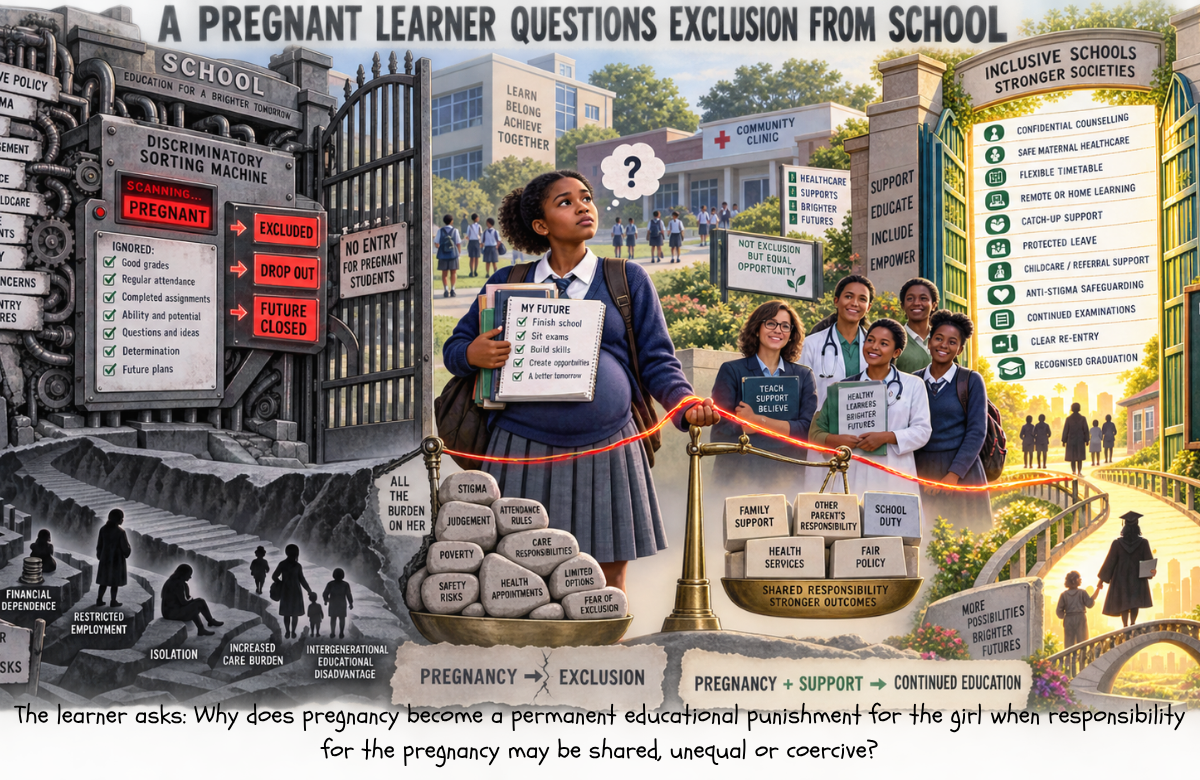
Teacher: Some education systems have excluded pregnant girls or adolescent mothers from ordinary schooling. What assumption lies underneath this response?
Adolescent mother: The system may treat pregnancy as proof that I no longer belong in the classroom. Yet removing me from education does not undo the pregnancy, identify coercion or hold an older partner accountable. It may instead increase dependence, poverty and the difficulty of supporting my child. A boy involved in the same pregnancy may continue attending school while my body becomes public evidence used to end my education.
The learner asks: Why does pregnancy become a permanent educational punishment for the girl when responsibility for the pregnancy may be shared, unequal or coercive?
A Menstruating Learner Questions the “Choice” to Stay Home
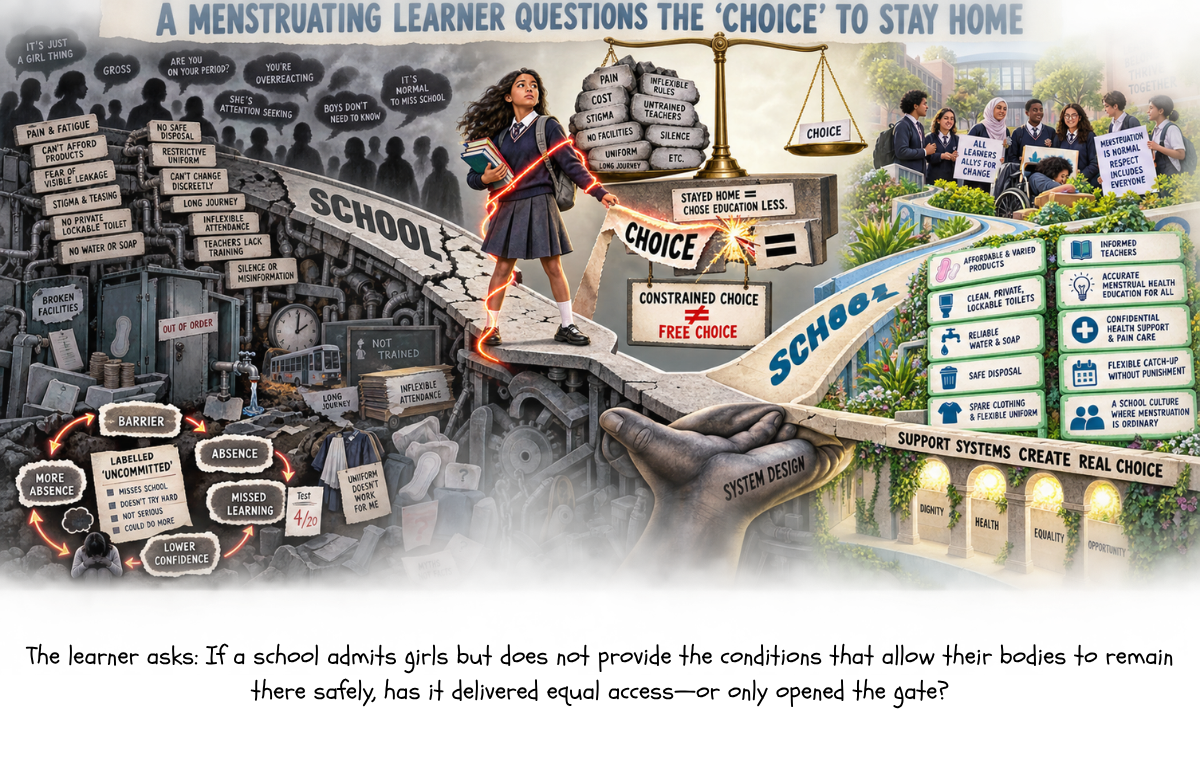
Teacher: A girl misses school repeatedly because toilets lack privacy, water or safe menstrual facilities. Has anyone officially banned her education?
Learner: No written rule tells me to stay home. Yet if I cannot manage menstruation privately, fear staining my clothes or face ridicule, attendance becomes physically and socially unsafe. My absence may then be recorded as poor commitment rather than evidence of inadequate infrastructure. The exclusion is hidden because it operates through toilets, affordability, stigma and silence rather than an official prohibition.
The learner asks: If a school admits girls but does not provide the conditions that allow their bodies to remain there safely, has it delivered equal access—or only opened the gate?
The Dialogue Across Gendered Exclusion
Teacher: Are these three disruptions equivalent?
Learners: No. Afghanistan involves a formal nationwide restriction on girls’ secondary and higher education. The exclusion of pregnant learners arises through disciplinary rules and stigma. Menstrual exclusion may occur without any written prohibition. One is explicit, another administrative and another embedded in infrastructure and social shame.
Teacher: What connects them?
Learners: In each case, a learner’s body or gender becomes the reason her educational future is limited. The barrier may be a decree, a school rule, family pressure, an unsafe journey, economic dependence or the absence of a private toilet.
Collective RIQ
How do laws, school rules, family authority and infrastructure convert gender into an educational boundary—and what would have to change for access to mean sustained freedom to learn rather than formal permission alone?
Enduring realisation: Gender-equitable education is not achieved by telling girls to become more resilient within an unequal system. It requires the system to stop making female identity, pregnancy, menstruation or social obedience conditions for educational belonging.
Learners in Interrupted Classrooms Ask: When the School Disappears, Where Does Learning Go?
These learners may be displaced or may remain near home. What connects them is the collapse of the conditions that make sustained education possible: safe buildings, teachers, electricity, transport, materials, food, health and predictable time.
A Palestinian Learner in Gaza Questions the Meaning of a School Building
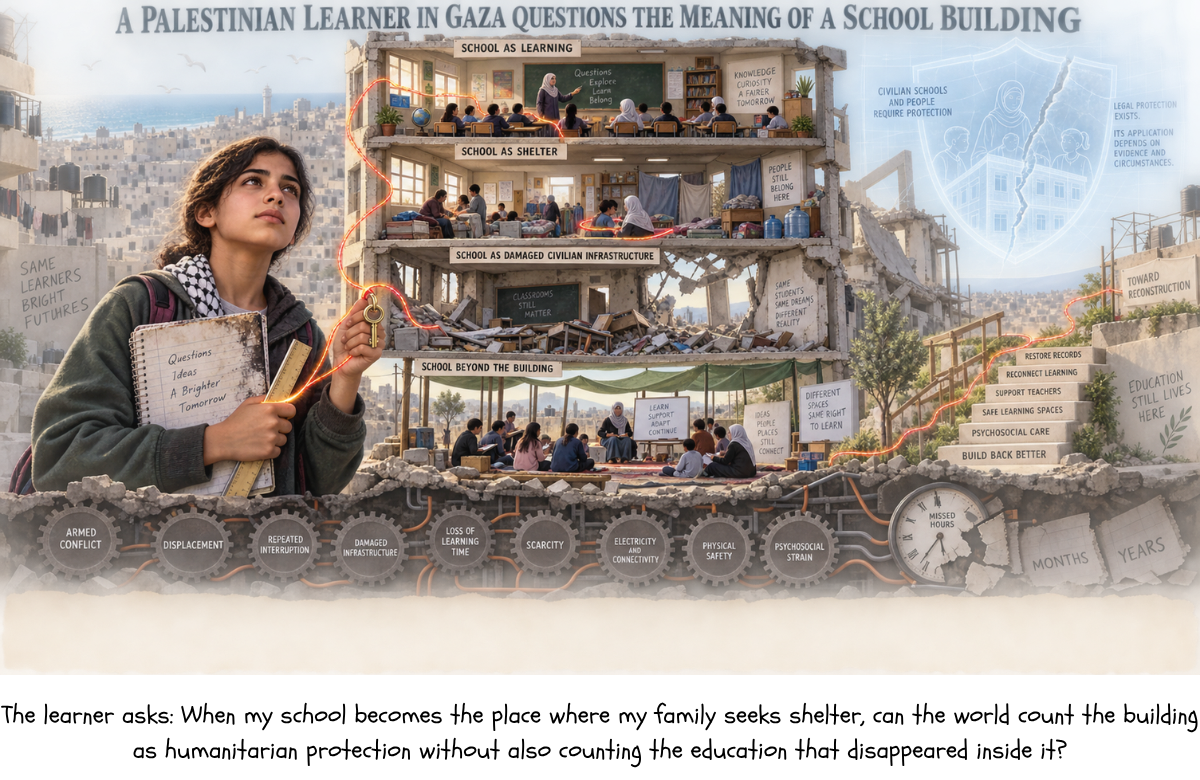
Teacher: What happens when schools are damaged, inaccessible or converted into emergency shelters?
Palestinian learner: A school can no longer perform only one role. It may become a shelter for displaced families while losing its ordinary function as a place of learning. Even when temporary lessons are offered, hunger, bereavement, repeated displacement, danger and damaged infrastructure shape what my mind can hold. A worksheet cannot recreate safety, concentration or the classmates and teachers who may be missing.
The learner asks: When my school becomes the place where my family seeks shelter, can the world count the building as humanitarian protection without also counting the education that disappeared inside it?
A Ukrainian Learner Questions Education Under Air-Raid Alerts
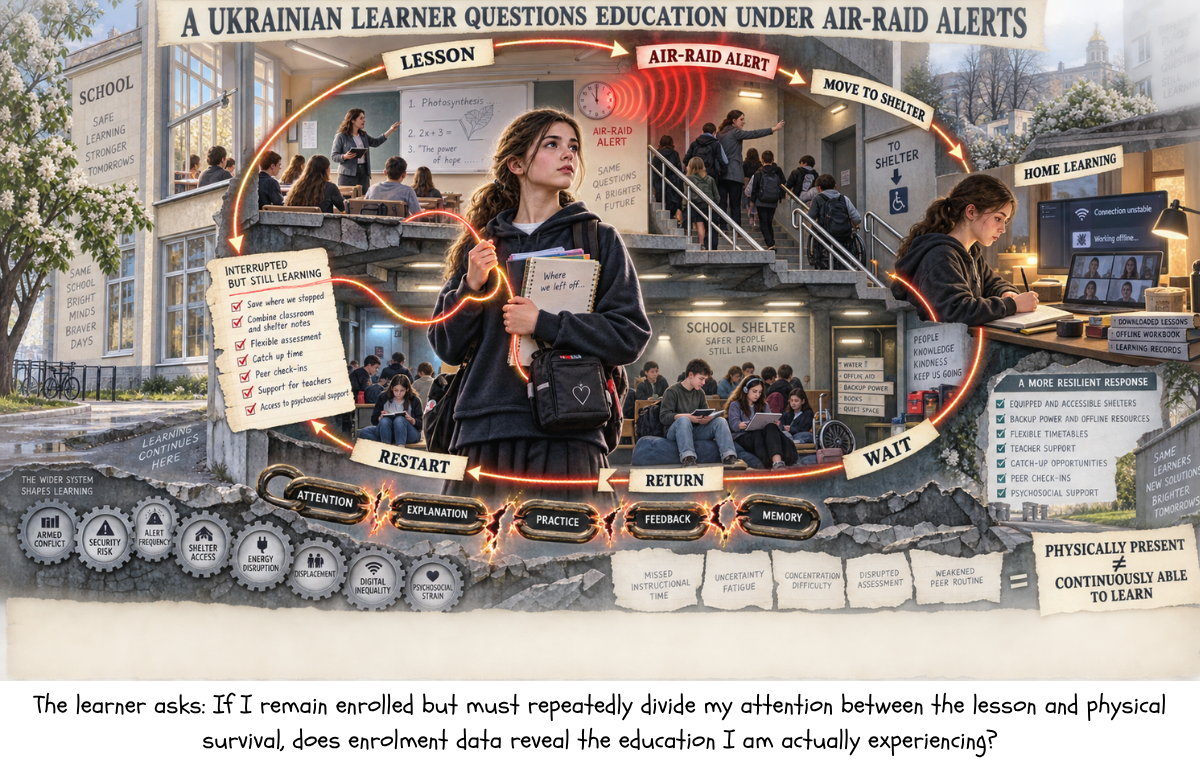
Teacher: Some Ukrainian learners study online, in shelters or through interrupted school days. Is the curriculum continuing normally?
Ukrainian learner: A lesson may technically continue, but learning changes when an air-raid alert can interrupt it at any moment. Electricity and internet access may fail. Teachers and classmates may be displaced across different cities or countries. I may complete the same mathematical exercise as a learner elsewhere, but I am also monitoring danger, family messages and the location of the nearest shelter.
The learner asks: If I remain enrolled but must repeatedly divide my attention between the lesson and physical survival, does enrolment data reveal the education I am actually experiencing?
A Sudanese Displaced Learner Questions the Lost Educational Record
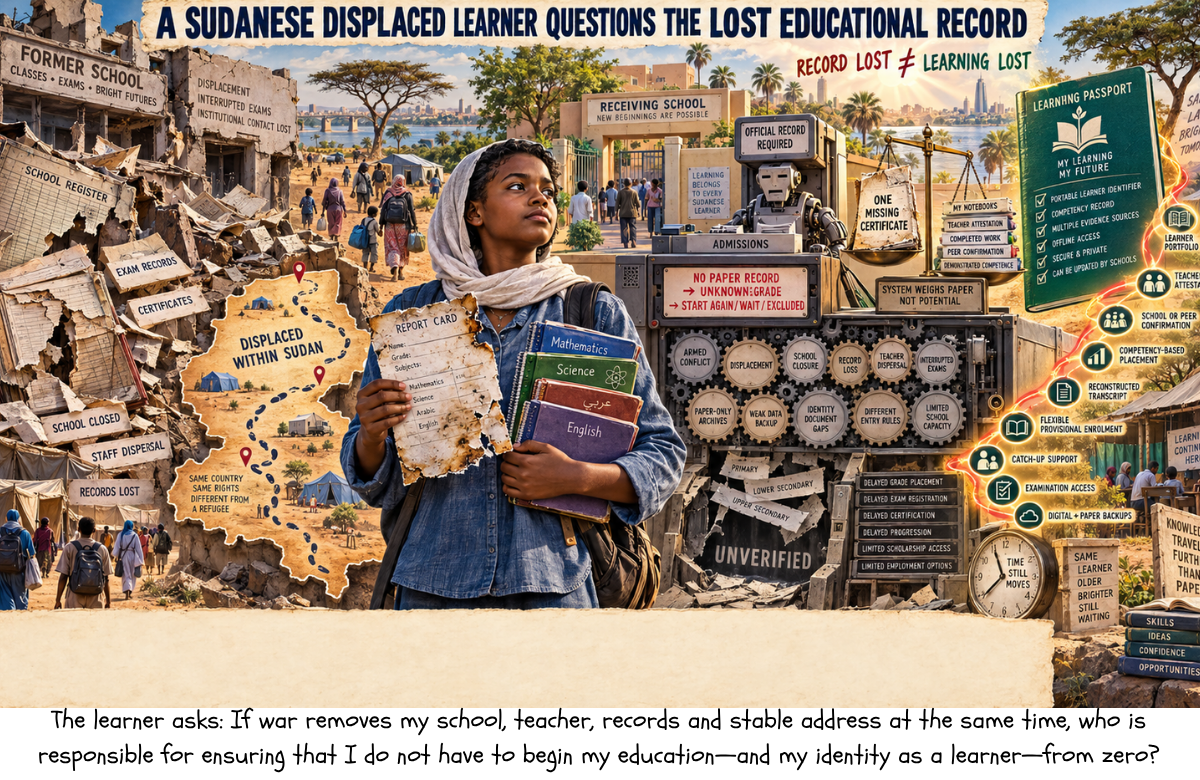
Teacher: Conflict in Sudan has displaced millions and closed or disrupted schools. What travels with a learner who flees?
Sudanese learner: I may carry only what my family could take quickly. My textbooks, examination records and school certificates may remain behind or be destroyed. The teacher who knew my level may be displaced elsewhere. A receiving school may be overcrowded, closed or unable to determine where I should re-enter. Hunger and the need to support my family may become more urgent than attendance.
The learner asks: If war removes my school, teacher, records and stable address at the same time, who is responsible for ensuring that I do not have to begin my education—and my identity as a learner—from zero?
The Dialogue Across Interrupted Classrooms
Teacher: Are interruption and displacement identical?
Learners: No. A Ukrainian learner may remain enrolled while studying under repeated alerts. A Palestinian school may become a shelter while learners remain within the territory or are repeatedly displaced inside it. A Sudanese learner may cross several internal or national boundaries and lose all documentary continuity. Physical presence on a school register cannot measure these different experiences.
Teacher: What connects them?
Learners: Education depends on an ecosystem. A classroom requires safety, concentration, teachers, records, language, transport, food, electricity, relationships and predictable time. When several parts collapse together, reopening a building does not automatically restore learning.
Collective RIQ
What evidence would show that education has genuinely resumed after conflict or disaster—not merely that a building reopened, a digital link was sent or a learner’s name remained on a register?
Enduring realisation: An interrupted learner does not need the curriculum compressed and delivered more rapidly. The learner needs continuity, safety, recognition, psychological space and a pathway for returning without being punished for what the crisis removed.
The Global Dialogue: Questions that Travel Without Erasing the Learner
Teacher: Are Indigenous, refugee, nomadic, gender-excluded and conflict-affected learners all experiencing the same disruption?
Learners: No.
- The Indigenous learner may remain on ancestral land while authority over that land, history or knowledge is removed.
- The refugee learner is forcibly displaced and must connect learning across different countries, languages and legal systems.
- The nomadic learner may move intentionally and should not be misrepresented as displaced or culturally deficient.
- The gender-excluded learner may remain at home while law, custom or infrastructure prevents education from continuing.
- The conflict- or disaster-affected learner may be enrolled but unable to learn because the educational ecosystem has collapsed.
Teacher: What, then, travels across all five contexts?
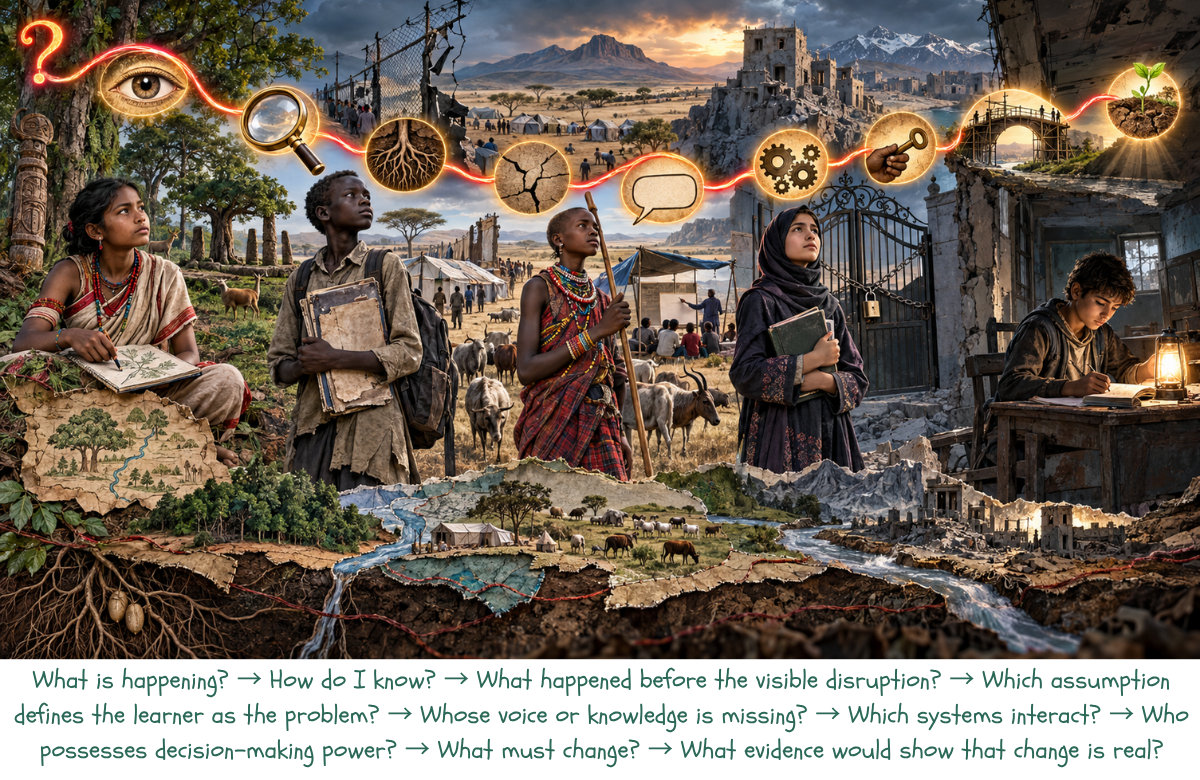
Learners: Not a single standardised question and not an imported interpretation of our lives. What travels is an adaptable inquiry architecture:
What is happening? → How do I know? → What happened before the visible disruption? → Which assumption defines the learner as the problem? → Whose voice or knowledge is missing? → Which systems interact? → Who possesses decision-making power? → What must change? → What evidence would show that change is real?
“Your reality is not a barrier to inquiry; it is where inquiry begins. Question the gate, the border, the register, the label and the silence—for when learners expose the systems restricting their lives, they cease to be treated as problems and become knowledge-makers and architects of peace.”-Mindgle