Home / Mindgle and the Global Educational Shift: The Philosophy Behind Mindgle

Use your mind's GPS before any search engine. Become a Mindgleian—curious, compassionate, ethical, and self-directed.

The seeds of Mindgle were not planted in research papers or policy documents. They were planted in classrooms.

Years of conversations with learners revealed a common pattern. Students wrestled with uncertainty, comparison, anxiety, information overload, and the pressure to perform. Whenever a difficult question arose, many instinctively reached for a keyboard before reaching for their minds. Curiosity was quickly replaced by searching, and uncertainty by immediate answers.

As a mentor, I found myself encouraging learners to pause. To sit with a question a little longer. To ask Why? How? To what extent? What if? What else could explain this? I wanted them to experience the productive discomfort of thinking before the comfort of certainty.

Mindgle emerged from this simple observation: learners were not lacking intelligence—they were losing opportunities to exercise it. Many had become highly efficient answer-seekers but were receiving fewer opportunities to become thoughtful question-designers.

Mindgle therefore began with a simple invitation:

Search your mind before you search the web.

It was never about resisting technology. It was about ensuring that Natural Intelligence leads before Artificial Intelligence follows.

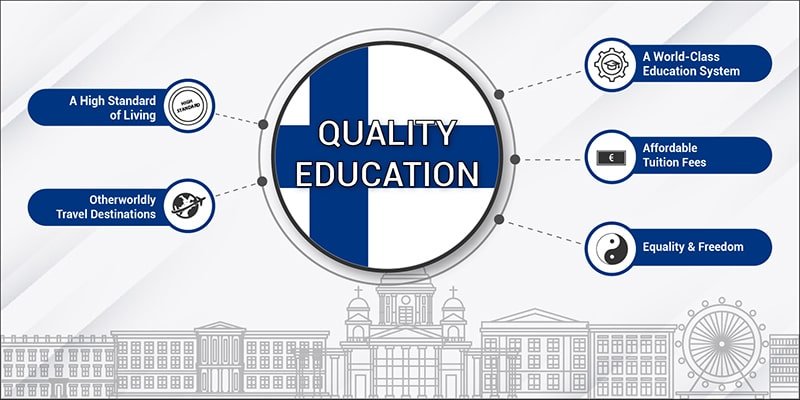
As the idea evolved, it became clear that this was not an isolated concern. Across the work of the OECD, UNESCO, UNICEF, the International Baccalaureate, India’s NEP 2020, Cambridge, Finland’s human-centred approach to education, Rabindranath Tagore’s vision through Visva-Bharati, and contemporary discussions on AI, a common aspiration was emerging:

How do we prepare human beings—not merely students—to think, inquire, adapt, and contribute meaningfully in a future defined by complexity, uncertainty, and rapid technological change?

Mindgle is a response to that question.

Mindgle is a human cognition architecture for the age of Artificial Intelligence.

Mindgle is a learner-centred framework that helps individuals transform raw curiosity into meaningful inquiry, inquiry into robust knowledge, and knowledge into ethical, compassionate, and responsible action.

Mindgle was created in response to one of the defining educational questions of our time:

How do we strengthen human thinking, learner agency, reflection, ethics, empathy, and inquiry in a world where information is abundant and Artificial Intelligence is increasingly capable?

While AI can generate information, summarise research, and produce answers within seconds, meaningful learning has never depended solely on access to information. It depends on the quality of the questions we ask, the assumptions we examine, the perspectives we explore, the evidence we evaluate, the biases we recognise, and the ethical judgments we make. Mindgle therefore encourages learners to think before they search, design inquiry before they prompt, and reflect before they conclude.

At the heart of Mindgle lies a simple but powerful belief: **Artificial Intelligence should amplify Natural Intelligence, not replace it. Rather than positioning AI as a substitute for human thinking, Mindgle positions it as a collaborative research partner guided by disciplined cognition, metacognition, ethical reasoning, emotional intelligence, and reflective inquiry. The learner’s mind always remains the primary architect of knowledge.

Mindgle equips learners with a structured cognitive journey that integrates inquiry architecture, prompt orchestration, systems thinking, cognitive bias awareness, epistemology, emotional intelligence, ethical reflection, and learner agency. Through this process, learners develop the capacity to move beyond simply retrieving information toward constructing knowledge that is intellectually rigorous, contextually meaningful, and socially responsible.

Unlike programmes delivered as one-time interventions, Mindgle is designed as a school-embedded ecosystem. It empowers mentors to cultivate cultures of inquiry within everyday teaching and learning, allowing curiosity, reflection, dialogue, and knowledge construction to become enduring habits rather than isolated activities. Its flexible design enables implementation across educational systems, cultures, languages, and age groups.

Mindgle draws inspiration from a broad convergence of educational thought, including UNESCO’s vision for human-centred futures, the OECD Learning Compass, UNICEF’s emphasis on learner empowerment, India’s National Education Policy 2020, Rabindranath Tagore’s philosophy of holistic and experiential learning, Indigenous ways of knowing, and contemporary conversations surrounding Artificial Intelligence and education. These influences are not replicated individually but woven together into a unified cognitive architecture for modern learners.

Ultimately, Mindgle is more than a framework for inquiry or a model for AI integration. It is a philosophy of learning that seeks to cultivate self-directed, reflective, compassionate, emotionally intelligent, and ethically responsible human beings. Its purpose is not merely to prepare learners for examinations or careers, but to help them become thoughtful architects of knowledge capable of contributing meaningfully to a more humane, sustainable, and interconnected world.

Why Mindgle exists
Artificial Intelligence can generate answers in seconds, but meaningful learning has never depended on answers alone. It depends on the ability to ask thoughtful questions, think critically, reflect deeply, evaluate evidence, and make ethical judgments. As learners increasingly turn to AI before activating their own thinking, there is a growing risk that inquiry becomes outsourced rather than developed.

Mindgle was created to address this challenge. It teaches learners to think before they search, placing human cognition—not artificial intelligence—at the centre of inquiry. By strengthening curiosity, reflection, metacognition, ethical reasoning, and learner agency, Mindgle transforms AI from a shortcut into a collaborative partner, ensuring that technology amplifies human intelligence rather than replaces it.
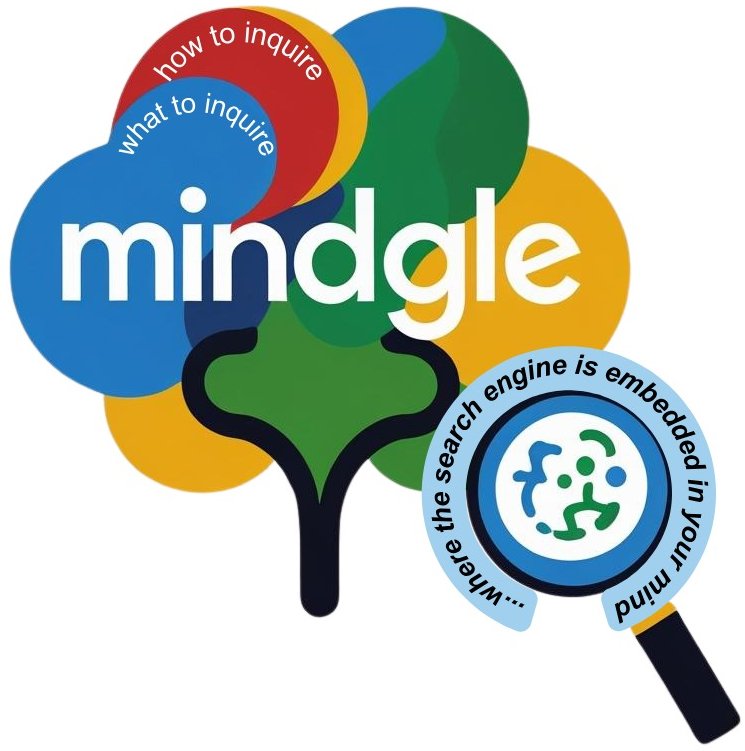

At the heart of Mindgle lies one central belief: Artificial Intelligence can accelerate exploration, expand perspectives, and amplify human potential, but meaningful inquiry still depends on the depth, ethics, reflection, emotional awareness, and intentionality of the human mind guiding it.

A true Mindgleian does not compete against AI, nor surrender thinking to it. Instead, the learner consciously orchestrates Natural Intelligence and Artificial Intelligence together to construct knowledge that is intellectually refined, ethically grounded, emotionally aware, contextually meaningful, and capable of creating real-world impact.

Pillar
Vision Statement

To cultivate a generation of learners who are not merely knowledgeable, but self-directed, compassionate, ethical, emotionally aware, and deeply engaged in meaningful inquiry. Mindgle envisions learners who think about their thinking, inquire with purpose and integrity, and consciously design their own pathways toward deeper knowledge and human understanding.

Pillar
Mission Statement

Mindgle empowers learners to become self-aware and self-directed inquiry architects. It helps learners use frameworks of learning, inquiry, cognition, and self-regulation not as hidden theories reserved for institutions or mentors, but as practical tools they can use to design, regulate, and evolve their own learning journeys in a heutagogical way. Mindgle encourages learners to inquire with ethics, empathy, emotional awareness, reflection, open-mindedness, curiosity, and intrinsic motivation. Its ultimate purpose is not only academic growth, but meaningful contribution toward healthier communities, stronger well-being, compassionate systems, peaceful societies, and sustainable futures.

The greatest educational challenge of the AI era is no longer a lack of information but a gradual weakening of deep thinking.

Mindgle is designed as a learner-powered, school-embedded inquiry framework rather than a traditional teacher-training programme. Rooted in the principles of heutagogy, it empowers learners to take ownership of their thinking, questioning, reflection, and growth while enabling mentors to become facilitators of inquiry rather than transmitters of information.

Instead of relying on external experts, Mindgle equips schools with a sustainable inquiry architecture that learners, mentors, teachers, counsellors, and school leaders can collectively own. The framework provides structured inquiry pathways, activities, and reflection experiences, while mentors nurture curiosity, ethical thinking, learner agency, and meaningful dialogue within everyday learning.

By embedding inquiry into the culture of the classroom, Mindgle creates self-sustaining learning communities where learners and mentors grow together as reflective, compassionate, and self-directed thinkers. In the age of AI, the goal is not simply to give learners access to more information, but to help them think before they search, inquire before they conclude, and use Artificial Intelligence to amplify—rather than replace—human thinking.

Under pressure to produce quick answers, many learners search externally before reflecting internally. Questions are typed directly into AI without examining assumptions, perspectives, ethical implications, conceptual depth, or the true intellectual demand of the inquiry. As a result, learning often becomes fragmented and superficial. Mindgle addresses this cognitive crisis by strengthening the learner’s inquiry process before interaction with Artificial Intelligence, ensuring that thinking remains the starting point of learning rather than an afterthought.

Prompt Engineering vs Prompt Orchestration

Most AI approaches focus on Prompt Engineering—writing better prompts to obtain better outputs. Mindgle introduces a deeper process called Prompt Orchestration. Rather than concentrating only on wording, learners consciously organise multiple layers of thinking before engaging with AI. They clarify context, examine assumptions, explore perspectives, recognise ethical tensions, identify the command term, consider evidence, and reflect on the purpose of the inquiry. The learner is therefore not merely constructing prompts but orchestrating cognition itself, allowing AI to become a collaborative inquiry partner guided by disciplined human thinking.

Mentelix — The Internal Inquiry Spider

At the heart of Mindgle is Mentelix, the learner’s internal inquiry spider. Before the external AI Spider begins searching, Mentelix activates the learner’s own cognitive network by connecting prior knowledge, memory, language, logic, ethics, emotional awareness, systems thinking, and multiple perspectives. It encourages learners to pause and ask deeper questions: What is this question really asking? What assumptions lie beneath it? What perspectives are missing? What evidence is required? What command term is operating? This internal refinement transforms raw curiosity into purposeful inquiry before external exploration begins.

Information Is Not the Same as Knowledge

Mindgle teaches one of the most fundamental distinctions in education: information is not knowledge. Information consists of isolated facts, definitions, statistics, and readily accessible content. Knowledge emerges only when information is interpreted, connected, contextualised, questioned, justified with evidence, and examined through multiple perspectives. A Mindgleian therefore learns to ask who produced the knowledge, how it was constructed, what evidence supports it, what biases may exist, and what perspectives remain absent. This shift transforms learners from passive consumers of information into conscious architects of meaningful knowledge.

Imagine two students faced with the same unfamiliar question.

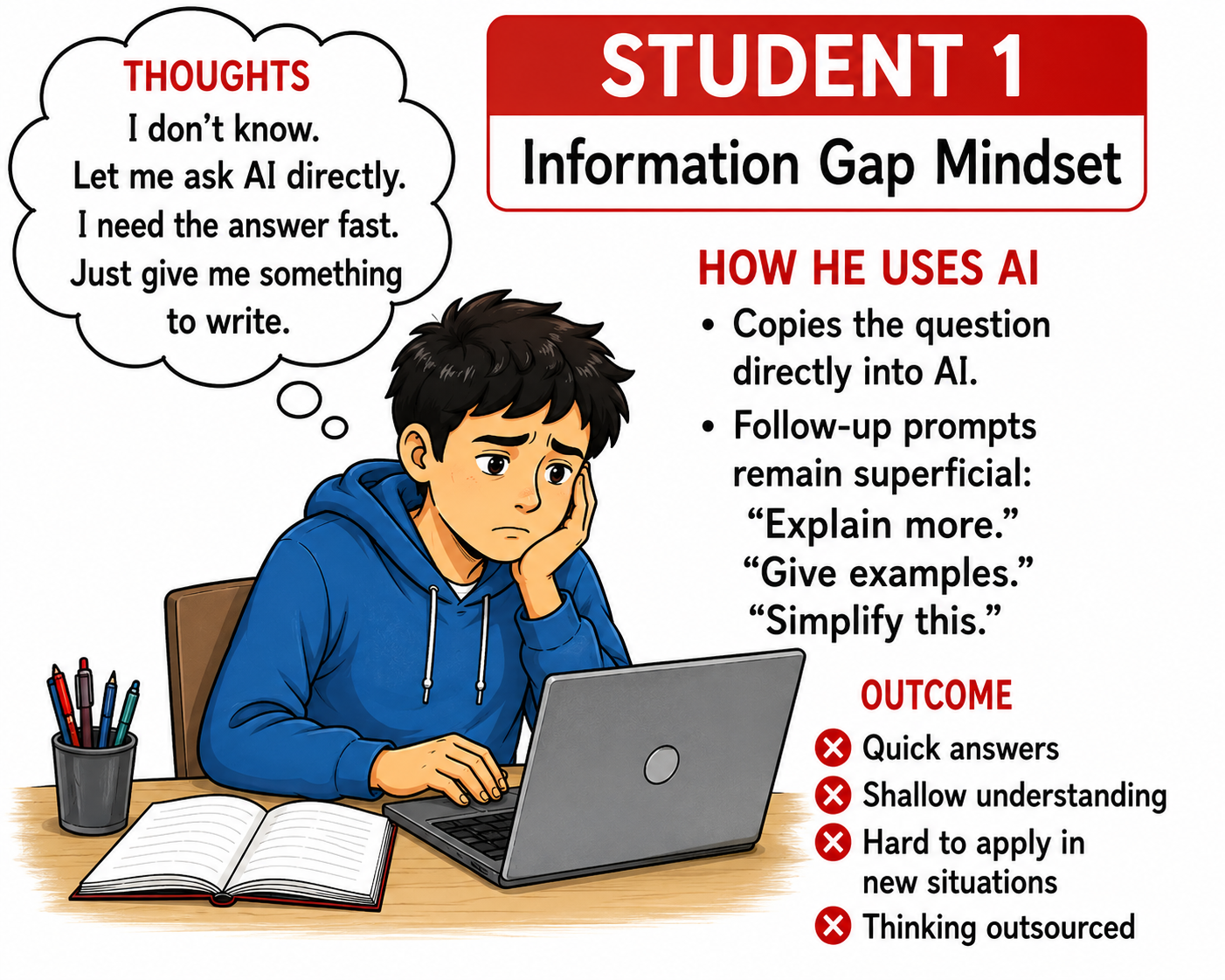
The first student immediately turns to AI, treating the problem as an information gap. The question is copied directly into the chatbot, and the follow-up prompts remain superficial—”Explain more,” “Give examples,” or “Simplify this.” Although an answer is produced quickly, the learner has largely outsourced the thinking process, resulting in understanding that is often shallow and difficult to transfer to new situations.

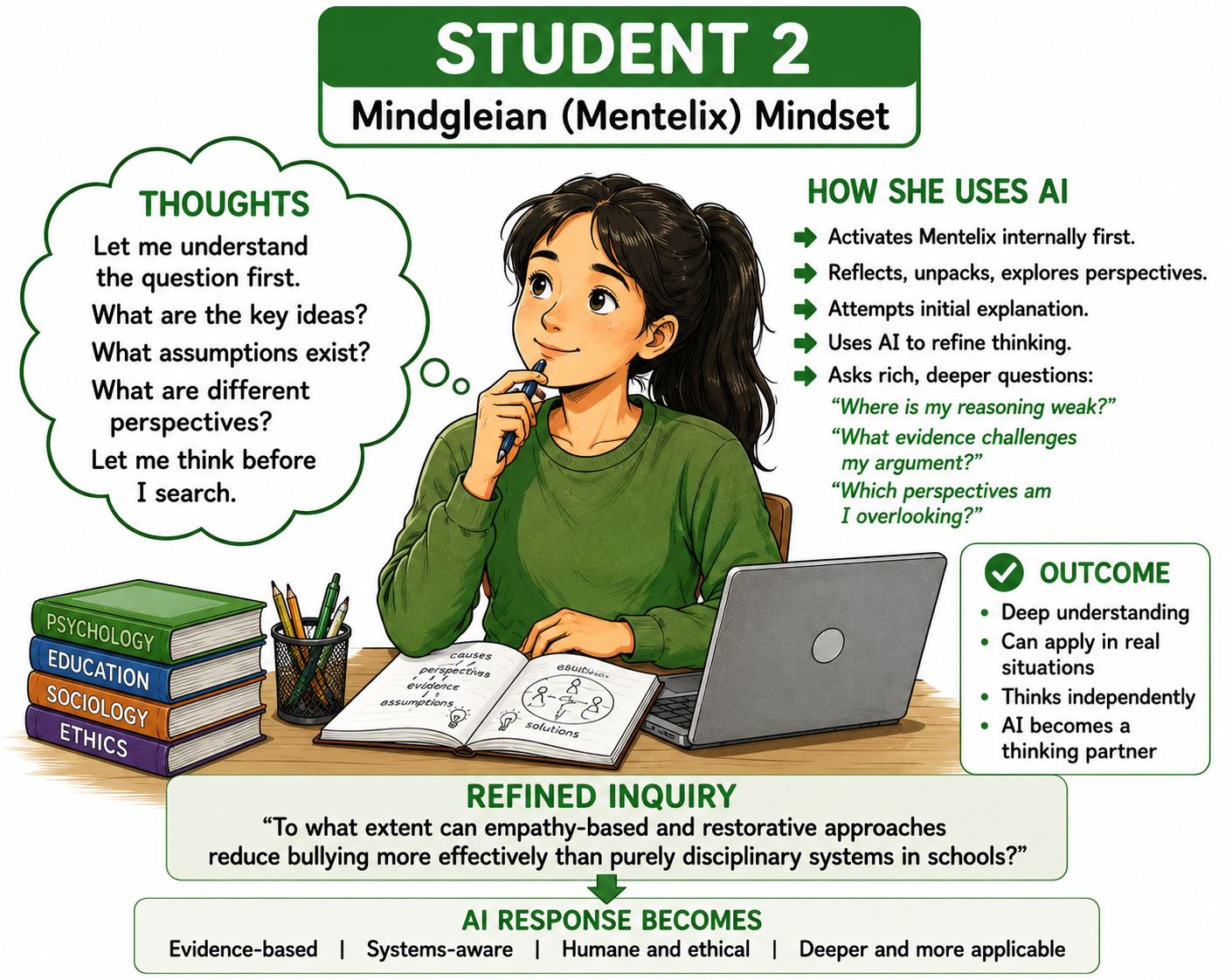
The second student approaches the question differently. Before opening AI, the learner activates Mentelix, Mindgle’s internal inquiry framework. They recall prior knowledge, unpack key concepts, identify assumptions, consider multiple perspectives, and attempt an initial explanation. Only then is AI introduced—not to provide answers, but to refine thinking. The learner asks richer questions such as, Where is my reasoning weak? What evidence challenges my argument? Which perspectives am I overlooking? AI becomes a thinking partner rather than a thinking replacement.

This difference is not created by the technology. It is created by the quality of human inquiry guiding the technology.

Consider a simple question such as “How can bullying in schools be stopped?” A conventional AI prompt may generate suggestions such as stricter discipline, surveillance, or awareness campaigns. A Mindgleian first refines the inquiry by exploring the deeper causes of bullying, the perspectives of victims, bullies, teachers, parents, and bystanders, and the ethical and social dimensions of the problem. The inquiry evolves into a richer question: “To what extent can empathy-based and restorative approaches reduce bullying more effectively than purely disciplinary systems?” Because the inquiry is stronger, the AI response becomes more evidence-based, systems-aware, and humane.

Mindgle therefore teaches learners to think before they search. Even under time pressure, they briefly clarify the purpose of the question, identify assumptions, recognise possible bias, activate prior knowledge, and determine what kind of evidence is needed. This simple habit reduces cognitive waste, prevents scattered searching, and transforms AI from an answer engine into a powerful collaborator for deeper learning.

Mindgle does not reject Artificial Intelligence, nor does it encourage dependence on it. It humanises AI by ensuring that the learner’s mind remains the primary engine of inquiry while technology accelerates exploration. In the age of AI, the greatest advantage will not belong to those who ask AI the fastest questions, but to those who ask the most thoughtful ones.

Conventional AI Use

  • Searches for answers before thinking, relying on AI to provide information rather than developing inquiry, reflection, evidence evaluation, and independent reasoning.

The Mindgle Approach

  • Thinks before searching by activating Mentelix to refine inquiry, evaluate assumptions and evidence, and then uses AI as a collaborative thinking partner rather than a replacement for human cognition.

Philosophical and Educational Inspirations

Mindgle was shaped through engagement with diverse educational philosophies, indigenous knowledge systems, and global frameworks that share a common vision: education should develop thoughtful, ethical, reflective, and self-directed human beings, not merely knowledgeable ones. Its philosophy draws inspiration from indigenous communities such as the Santhal people, whose lived wisdom, cultural traditions, and deep relationship with nature demonstrate that meaningful inquiry begins in life, not only in textbooks. It is further influenced by the reflective traditions of Binapani Ashram, Rabindranath Tagore’s Visva-Bharati philosophy, India’s National Education Policy (NEP 2020), UNICEF, UNESCO, the OECD Learning Compass 2030, the International Baccalaureate, and the educational leadership of Olli-Pekka Heinonen. These influences collectively reinforced Mindgle’s central belief that in an age of Artificial Intelligence, education must preserve and strengthen the uniquely human capacities of curiosity, reflection, learner agency, ethical reasoning, emotional intelligence, cultural rootedness, systems thinking, and compassionate inquiry. Mindgle brings these ideas together into a practical inquiry architecture where learners think before they search, design inquiry before they prompt, and use AI to amplify—rather than replace—human thinking.


01
Indigenous Wisdom

Mindgle honours indigenous knowledge systems by recognising that meaningful learning begins with people, culture, community, nature, and lived experience. It encourages learners to value local wisdom alongside scientific and global knowledge.

02
Binapani Ashram

The reflective philosophy of Binapani Ashram inspired Mindgle's emphasis on inner awareness, simplicity, compassion, and self-realisation. It reinforced the belief that authentic inquiry begins with reflection before information.

03
Visva-Bharati

Rabindranath Tagore's vision of education as a harmonious relationship between nature, culture, creativity, and humanity shaped Mindgle's belief that inquiry should emerge from life rather than rote instruction.

04
India & NEP 2020

Mindgle aligns with the aspirations of India's National Education Policy by promoting experiential learning, critical thinking, learner agency, multidisciplinary inquiry, creativity, and lifelong learning.

05
OECD Learning Compass 2030

The OECD inspired Mindgle's focus on learner agency, systems thinking, adaptability, co-agency, and preparing learners to shape a rapidly changing world rather than merely adapt to it.

06
UNICEF

UNICEF's work on life skills, learner participation, resilience, and future-ready education strengthened Mindgle's commitment to developing self-aware, compassionate, and empowered learners.

07
UNESCO Futures of Education

UNESCO reinforced Mindgle's human-centred philosophy that education should cultivate ethical responsibility, well-being, social transformation, and lifelong inquiry in an increasingly technological world.

08
International Baccalaureate

The IB's emphasis on inquiry, reflection, intercultural understanding, learner agency, and global citizenship closely aligns with Mindgle's vision of developing thoughtful and responsible learners.

09
Olli-Pekka Heinonen, IB Director General

Olli-Pekka Heinonen's warning against the outsourcing of thinking profoundly shaped Mindgle's philosophy of "Think Before You Search," ensuring that AI strengthens rather than replaces human cognition.

10
Human-Centred AI

Mindgle embraces Artificial Intelligence as a collaborative partner while ensuring that curiosity, ethical reasoning, reflection, judgment, and human inquiry remain at the centre of learning.

Reimagining Inquiry for the AI Generation

Mindgle in Brazil 🇧🇷 |

Mindgle is proud to begin its journey in Brazil. In an era where information is abundant and Artificial Intelligence can generate answers instantly, the greatest educational challenge is no longer finding information—it is learning how to think before asking, question before accepting, and validate before believing. Mindgle empowers learners to move from curiosity to robust knowledge through metacognition, inquiry, epistemic reasoning, evidence evaluation, and ethical knowledge construction. By placing Natural Intelligence before Artificial Intelligence, Mindgle transforms passive consumers of information into thoughtful architects of inquiry and lifelong learners.