One thinking architecture of inquiry across disciplines
By the end of this module, Mindgleians will learn to revisit primary-level wonders through an increasingly sophisticated spiral of inquiry—unpacking deeper layers of explanation, strengthening conceptual connections, and progressively weaving separate ideas into richer, more connected threads of thought across grades.
Mindgle’s 4C–Q Inquiry Compass
A programme-neutral architecture that brings together four dimensions already central to inquiry learning—Content, Concept, Context and Connection—with the Quotient Mirror at the centre.
It captures exactly what happens: a child’s small observation in nature expands into disciplinary knowledge, transferable concepts, local and global contexts, interdisciplinary connections, and finally reflection on the learner.
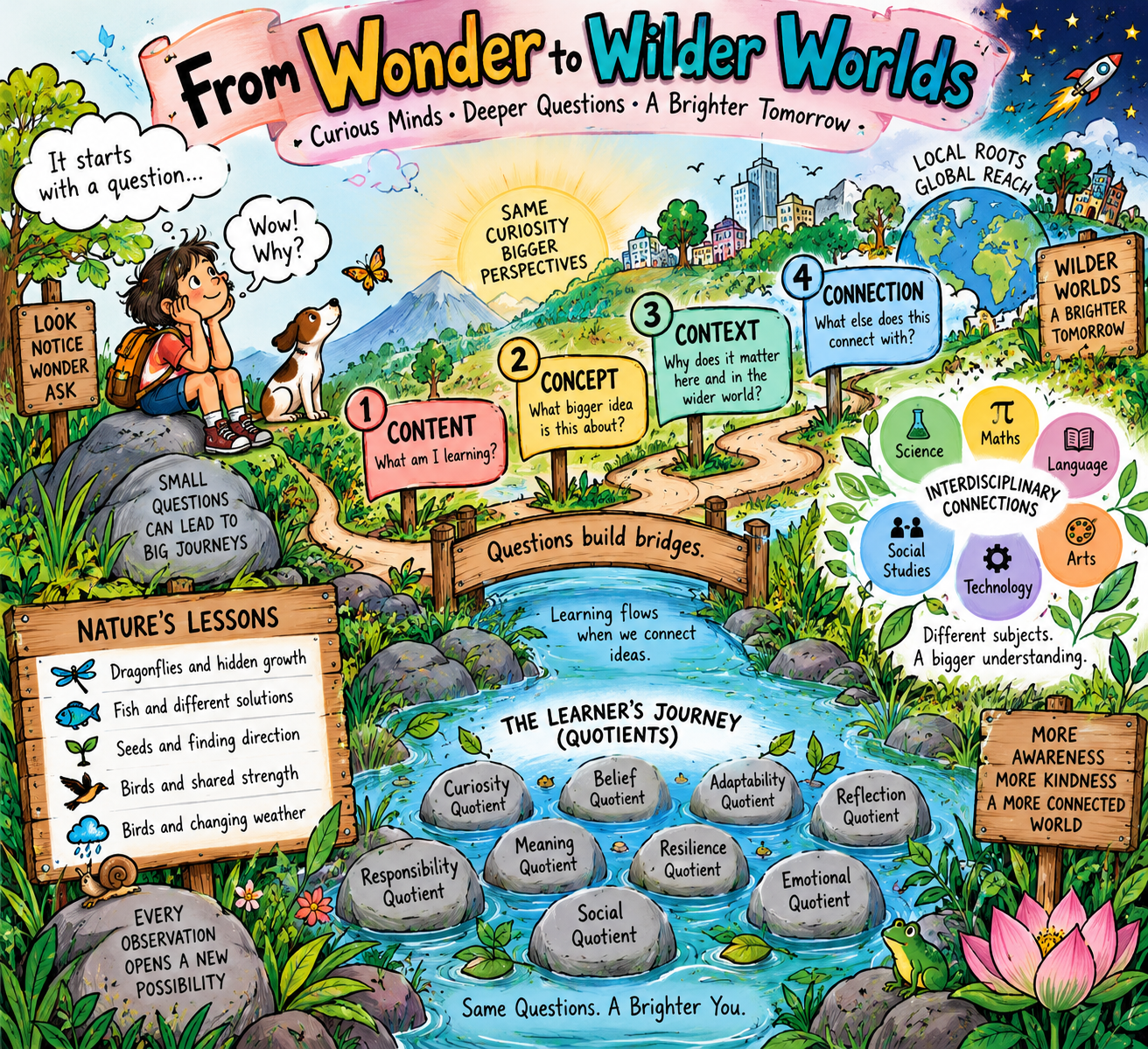
The sketch, “From Wonder to Wilder Worlds,” visually represents how a child’s simple observation can expand into deep, connected learning. It begins on the left with a learner sitting in nature and asking, “Why?”—showing that inquiry starts with noticing something ordinary and becoming curious about it. The path then moves through the four thinking stages: Content — What am I learning? Concept — What bigger idea is this about? Context — Why does it matter here and in the wider world? Connection — What else does this connect with?
Nature stays at the centre of the journey. Dragonflies, fish, seeds, birds, rain, trees and water represent the kinds of everyday phenomena from which children can begin asking questions. These are not treated as isolated science facts; each becomes a doorway into broader thinking. The bridge marked “Questions build bridges” shows how inquiry connects subjects, experiences and ideas instead of keeping learning in separate boxes.
On the right, the interdisciplinary circle shows how one question can travel through the Language, Mathematics, Science, Social Studies, Arts, and Personal, Social and Physical Education (PSPE)—with learning designed to connect across and beyond these subjects rather than remain isolated. The message is that the same phenomenon can be measured, explained, narrated, mapped, designed around and interpreted differently depending on the disciplinary lens.
The river running through the image represents the learner’s growth. The stepping stones show the learning quotients—Curiosity, Belief, Adaptability, Reflection, Meaning, Resilience, Social and Emotional Regulation—to communicate that inquiry changes not only what the learner knows, but also how the learner thinks, adapts, collaborates and manages themselves.
The movement from “Local Roots” to “Global Reach” shows how inquiry begins in the child’s immediate world—home, school, neighbourhood, nature—and gradually expands into wider human and global contexts.
Nine Powers that turn Questions into Growth
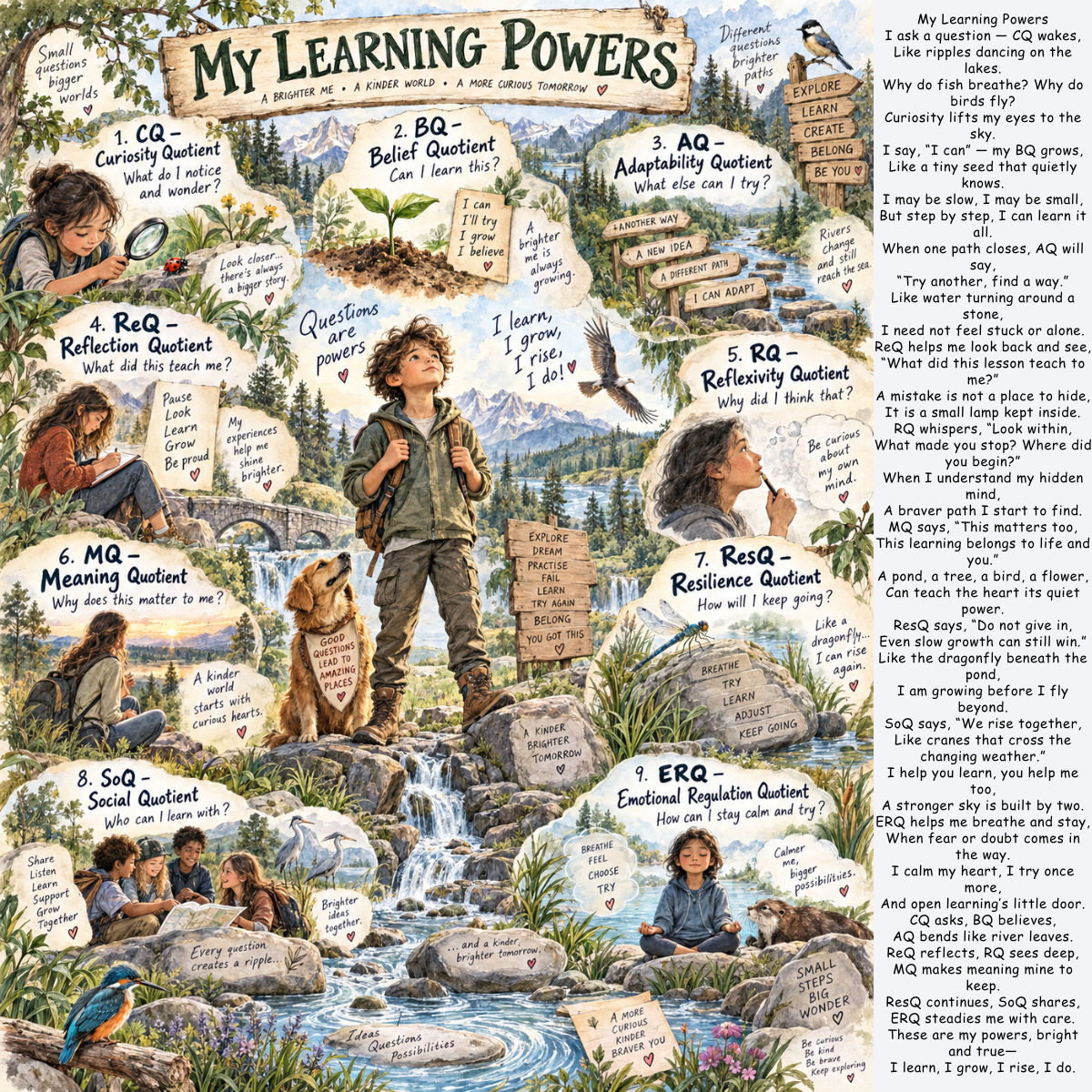
These questions are not simply prompts for finding answers; they are the learner’s Learning Powers in action. Each question activates a different way of growing. CQ begins with wonder—What do I notice? What do I want to know? BQ asks the learner to trust that understanding is possible—Can I learn this if I keep trying? AQ appears when the first approach fails—What other way could I try? ReQ looks back at the learning—What changed in what I know?—while RQ goes deeper into the learner’s own thinking—Why did I think, stop, avoid, assume or react that way? MQ asks, Why does this matter to my life and the world around me? ResQ asks, How will I continue when learning becomes difficult or slow? SoQ reminds the learner that understanding can grow through others—Who can I listen to, help, question or learn with?—and ERQ asks, How can I steady myself when fear, confusion or frustration appears? Together, these questions transform inquiry from simply knowing more into becoming a more curious, confident, adaptable, reflective, resilient, connected and self-aware learner.
1. Curiosity Quotient — CQ
Curiosity Quotient means how much a child wants to ask, explore, notice, and find out more. It begins when a child does not just look at something, but wonders why it happens.
Simple example:
When a child sees a fish in the pond and asks, “How can it breathe underwater?” that is Curiosity Quotient.
Child-friendly line:
CQ is my question power.
2. Belief Quotient — BQ
Belief Quotient means how much a child believes, “I can learn this. I can improve. I may not know it yet, but I can try.” It is confidence in one’s own learning ability.
Simple example:
When a child says, “I cannot read this word now, but if I practise slowly, I can learn it,” that is Belief Quotient.
Child-friendly line:
BQ is my “I can learn” power.
3. Adaptability Quotient — AQ
Adaptability Quotient means how well a child changes their method when one way does not work. It is the ability to try another path instead of staying stuck.
Simple example:
If a child cannot understand a lesson by reading, they may draw it, act it out, ask a friend, or listen to the teacher again. That is Adaptability Quotient.
Child-friendly line:
AQ is my “try another way” power.
4. Reflection Quotient — ReQ
Reflection Quotient means how well a child thinks back on learning and asks, “What did I understand? What confused me? What mistake did I make? What can I do better next time?”
Simple example:
After learning how fish breathe, a child says, “Earlier I thought fish breathe water, but now I understand they take oxygen from water.” That is Reflection Quotient.
Child-friendly line:
ReQ is my “think back and learn” power.
5. Reflexivity Quotient — RQ
Reflexivity Quotient is deeper than reflection. It means noticing one’s own thinking patterns, assumptions, reactions, and choices. The child begins to ask, “Why did I think that? Why did I react like that? What belief was hiding inside me?”
Simple example:
A child may think, “I stayed quiet because I was afraid my answer would be wrong.” When the child notices this pattern, that is Reflexivity Quotient.
Child-friendly line:
RQ is my “understand my own mind” power.
6. Meaning Quotient — MQ
Meaning Quotient means how strongly a child connects learning to their own life, village, nature, family, feelings, or future. Learning becomes meaningful, not just something to memorise.
Simple example:
When a child learns that clean water helps fish breathe and then thinks, “So keeping our pond clean protects life,” that is Meaning Quotient.
Child-friendly line:
MQ is my “this matters to my life” power.
7. Resilience Quotient — ResQ
Resilience Quotient means how well a child continues through difficulty and recovers after struggle. It does not mean never feeling stuck. It means not giving up when learning becomes hard.
Simple example:
If a child cannot understand a question the first time but tries again, asks for help, and keeps going, that is Resilience Quotient.
Child-friendly line:
ResQ is my “I will keep going” power.
8. Social Quotient — SoQ
Social Quotient means how well a child learns with others. It includes listening, helping, sharing, taking turns, explaining, cooperating, and growing as part of a group.
Simple example:
When one child explains a story to another child, or when students take turns leading a group activity like cranes flying in a V shape, that is Social Quotient.
Child-friendly line:
SoQ is my “we learn together” power.
9. Emotional Regulation Quotient — ERQ
Emotional Regulation Quotient means how well a child stays calm, steady, and focused when learning feels difficult, confusing, or stressful. It helps children manage fear, shame, anger, or nervousness.
Simple example:
When a child feels scared to answer but takes a breath and still tries one sentence, that is Emotional Regulation Quotient.
Child-friendly line:
ERQ is my “stay calm and try” power.
“Every question I ask strengthens a power within me—to wonder, believe, adapt, reflect, persist, connect and grow.”-Mindgle
The 4Cs of Connected Learning
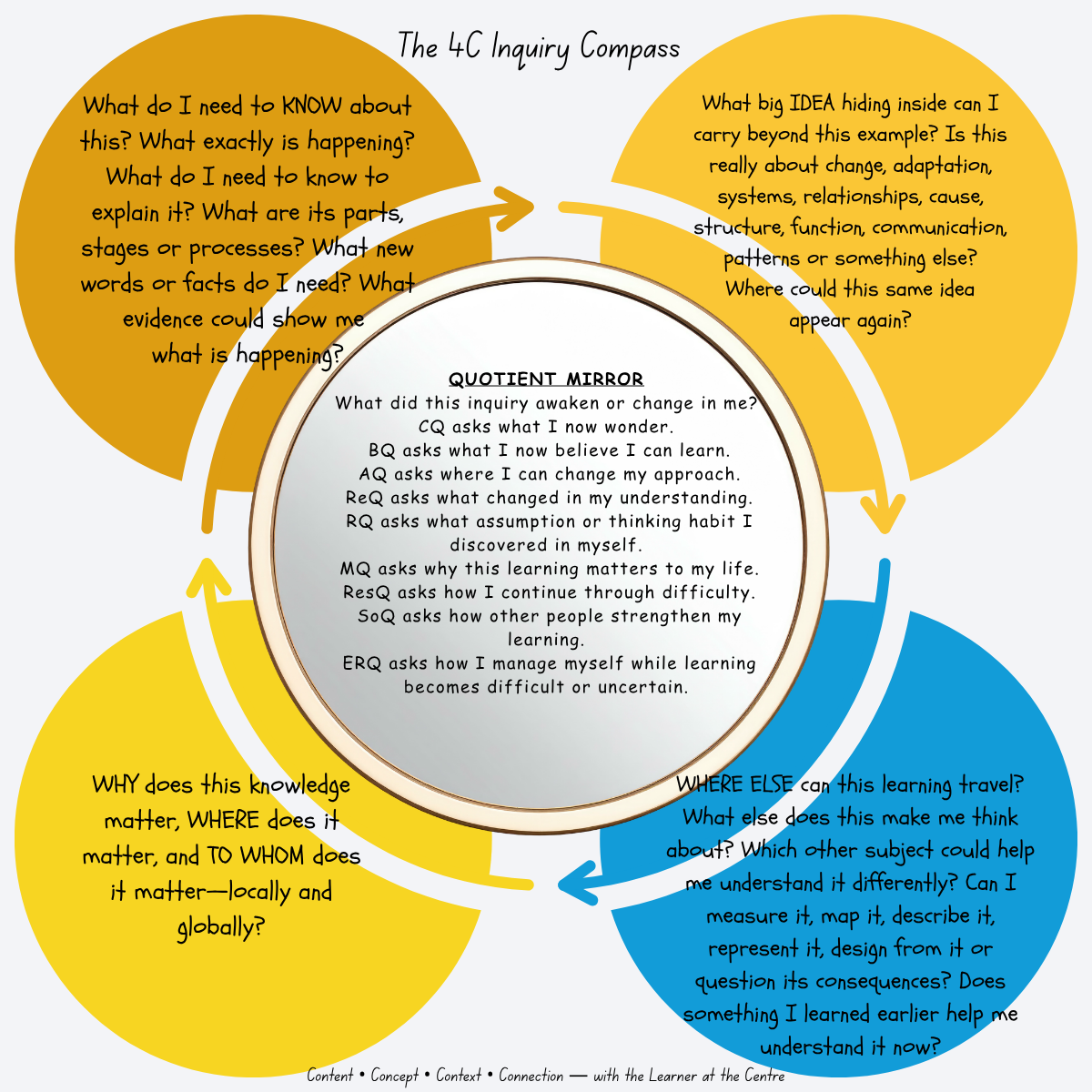
A question becomes deeper when a learner does not stop after finding an answer. The learner asks four different kinds of questions about the same phenomenon.
1. CONTENT — What am I learning?
Content is the specific knowledge, facts, processes, vocabulary and explanations I need in order to understand what is happening.
The learner asks:
What exactly is happening? What do I need to know to explain it? What are its parts, stages or processes? What new words or facts do I need? What evidence could show me what is happening?
For example:
Why does a seed know which way to grow?
Content tells me about germination, roots, shoots, gravity, gravitropism, light and phototropism.
Content answers:
What do I need to KNOW about this?
2. CONCEPT — What bigger idea am I learning?
A concept is the transferable idea hidden underneath the particular example. It allows learning to travel.
The learner asks:
What bigger idea is hiding inside what I have learned? Is this really about change, adaptation, systems, relationships, cause, structure, function, communication, patterns or something else? Where could this same idea appear again?
The seed is content.
Adaptation and response are concepts.
A child therefore moves from:
“A seed changes its direction.”
to:
“Living things can respond to changing conditions.”
Concept answers:
What big IDEA can I carry beyond this example?
3. CONTEXT — Why does this learning matter here and in the wider world?
Context places knowledge inside a real situation. It asks the learner to understand that knowledge does not happen in a vacuum.
The learner deliberately investigates two scales.
Local context:
Where can I see this around me? Who or what around me is affected by it? Why does it matter in my home, school, neighbourhood or community?
Global context:
Where else in the world does this matter? Does the same issue look different elsewhere? What larger environmental, social, technological or human issue does it connect to?
For the seed:
Local: Which plants grow successfully in the conditions around my home or school?
Global: How might plants respond when temperature, rainfall or growing conditions change?
Context answers:
WHY does this knowledge matter, WHERE does it matter, and TO WHOM does it matter?
4. CONNECTION — What does this connect with?
Connection is where disciplinary walls begin to disappear.
The learner asks:
What else does this make me think about? Which other subject could help me understand it differently? Can I measure it, map it, describe it, represent it, design from it or question its consequences? Does something I learned earlier help me understand it now?
For the seed:
Science explains the response.
Mathematics measures growth.
Language communicates the journey.
Geography examines environmental conditions.
Art represents transformation.
Design asks how humans might create better growing conditions.
Connection answers:
WHERE ELSE can this learning travel?
“Inquiry becomes powerful when knowledge travels outward through content, concept, context and connection—and inward through reflection on who the learner is becoming.”-Mindgle
What Messy Reality Teaches Us—and What We Owe the World
Growing emotional resilience, intellectual humility and responsible agency through real-life inquiry
Nature’s Lesson 1 — Why do dragonflies fly near water?
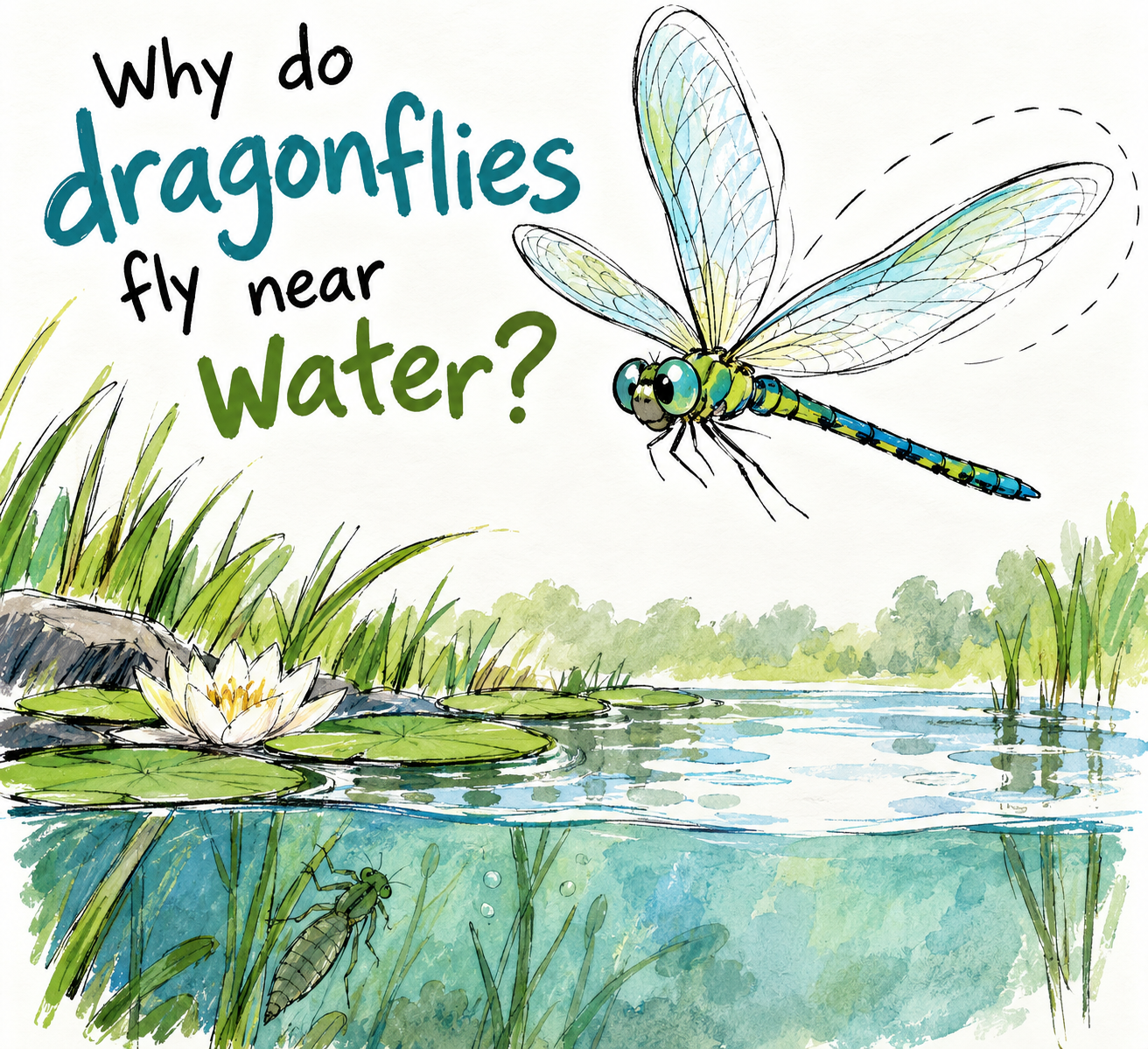
Why would water be a safer place for a baby dragonfly than open air? What would happen if ponds disappeared? When you see someone doing something well, do you also think about the practice and struggle behind it?
CONTENT — What am I learning?
Dragonfly life cycle, aquatic nymph, metamorphosis, habitat, emergence and adaptation.
Prompt:
What happens before the dragonfly we see flying becomes an adult? Which stages of its life depend on water, and why?
CONCEPT — What bigger idea am I discovering?
Transformation + Development + Interdependence
Prompt:
What does the dragonfly reveal about growth that happens before the final result becomes visible?
The child discovers:
Visible achievement can depend upon invisible development.
CONTEXT — Why and where does this matter?
Local context:
Where around my neighbourhood could a dragonfly complete its life cycle? What would happen if those small water habitats disappeared?
Global context:
What happens to species around the world when wetlands and freshwater habitats are altered or lost?
CONNECTION — Where else can this learning travel?
Science: metamorphosis and ecosystems
Mathematics: measure and graph stages/time/growth
Language: “Before I Had Wings”—first-person narrative
Geography: wetlands and land use
Art: visible versus invisible transformation
Human development: practice before performance
Connection prompt:
Where else in nature or human life do we notice the result but fail to notice the process that produced it?
Quotients triggered
CQ: What is happening beneath the water that I cannot see?
BQ: Can growth be real even when nobody notices it yet?
AQ: How does the dragonfly change when its environment and needs change?
ReQ: Do I sometimes judge my progress only by visible results?
RQ: Why do I assume that somebody who performs well has always found it easy?
MQ: What does hidden growth mean in my own learning?
ResQ: Can I continue when my progress is not yet visible?
SoQ: Who supports my growth before others see the result?
ERQ: Can I remain patient while I am still in my own “nymph stage”?
Nature’s Lesson 2 — Why can fish breathe underwater while we cannot?
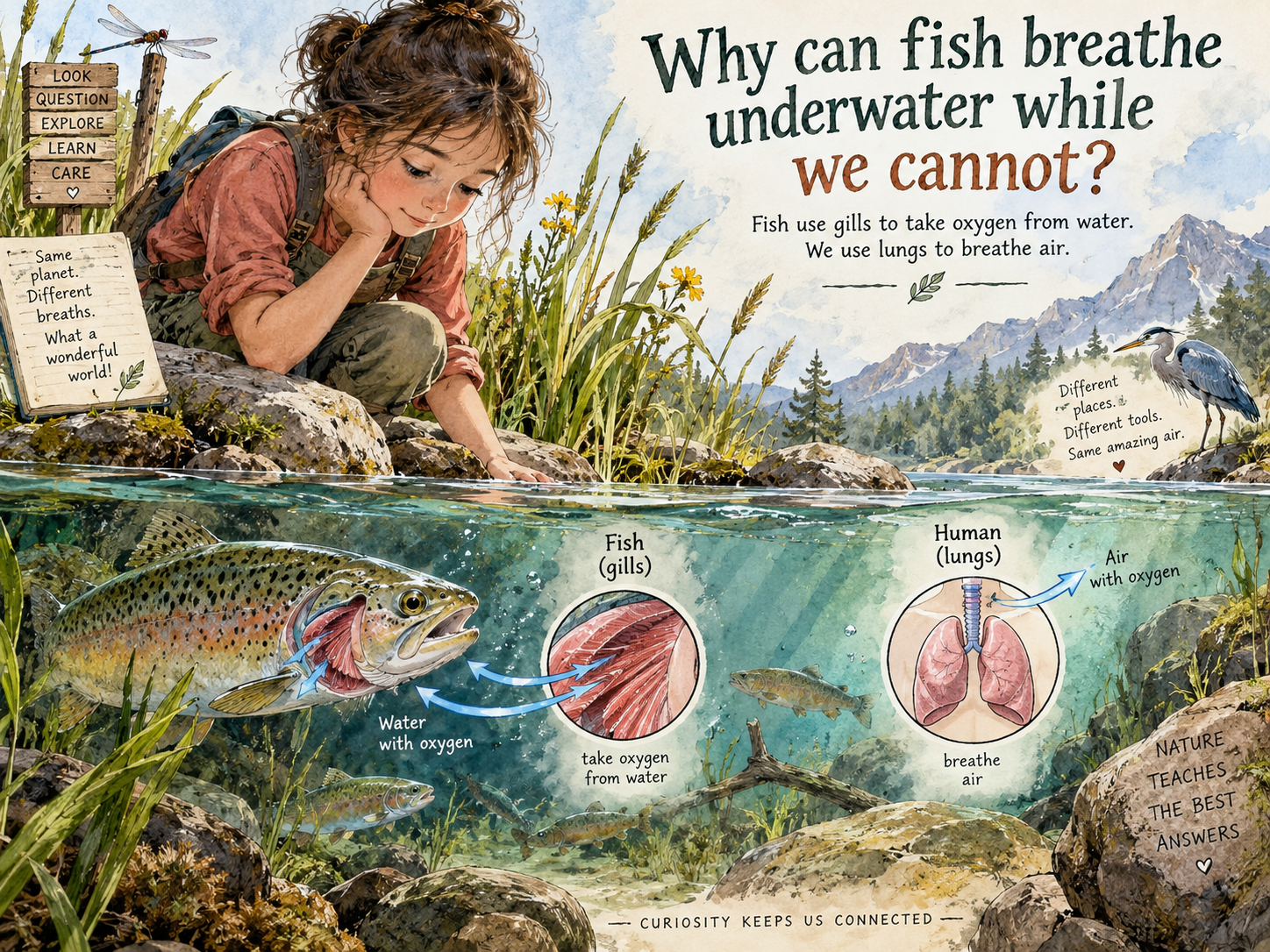
If the pond water becomes dirty or has less oxygen, what might happen to the fish? If fish need oxygen from water, why should we care about keeping ponds clean? What does this teach us about the connection between water, life, and responsibility?
CONTENT
Oxygen, respiration, gills, lungs, water, habitat and adaptation.
Prompt:
What do fish and humans both need to survive, and how does each body obtain that same thing differently?
CONCEPT
Adaptation + Structure and Function
Prompt:
How can the same need be solved in different ways?
The transferable understanding becomes:
Different structures can perform similar functions because organisms are adapted to different environments.
CONTEXT
Local:
What is the condition of the ponds, lakes, streams or drains around us, and how might water quality affect the organisms living there?
Global:
How can pollution, warming water or changing aquatic environments affect organisms that depend upon dissolved oxygen?
CONNECTION
Science: respiration and adaptation
Chemistry: dissolved oxygen and water quality
Mathematics: compare oxygen measurements
Geography: freshwater systems
Language: explain “same need, different solution”
Design: filtration/aeration solutions
Connection prompt:
If fish and humans solve the same biological need differently, where else do different solutions successfully meet the same need?
Quotients
CQ: Why can fish obtain oxygen where I cannot?
BQ: Can different ways of doing something be equally successful?
AQ: How does environment shape the solution an organism needs?
ReQ: Did I previously think fish actually “breathed water”?
RQ: Why might I assume my way of doing something is the normal or best way?
MQ: What does adaptation teach me about differences between learners?
ResQ: How can I find another route when one method does not work?
SoQ: How can different strengths help a group?
ERQ: Can I feel comfortable needing a different way to learn?
Nature’s Lesson 3 — Why does a seed know which way to grow?
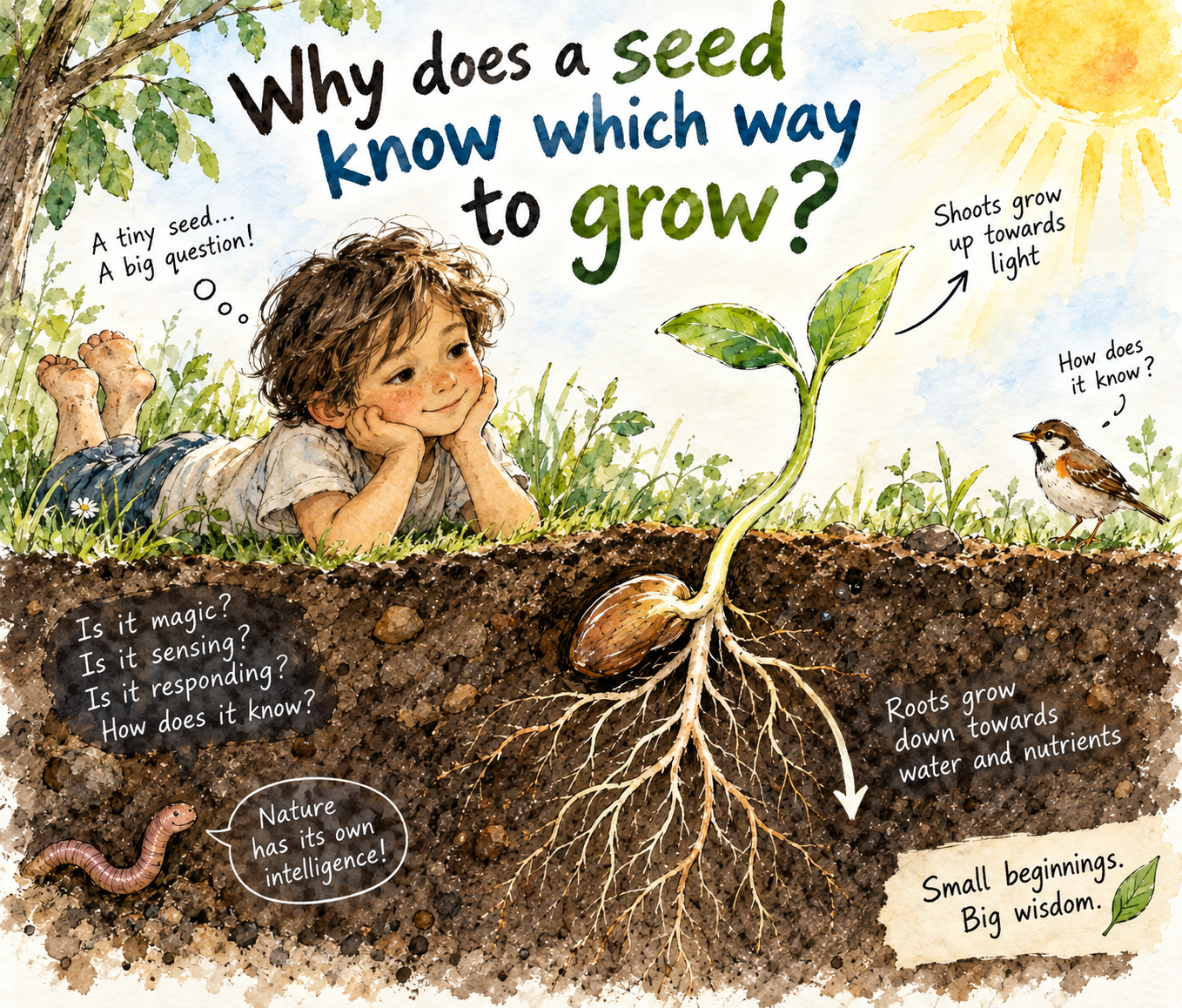
How does the seed know where water may be? Why does the shoot need sunlight? If a seed can grow even when placed wrongly, what does that teach us about correcting our direction?
CONTENT
Germination, roots, shoots, gravity, gravitropism, light and phototropism.
Prompt:
What physical signals does a growing seed respond to, and what happens to its root and shoot?
CONCEPT
Response + Change + Adaptation
Prompt:
Is changing direction a failure—or can changing direction be an intelligent response to new conditions?
CONTEXT
Local:
What conditions help plants around my home or school grow successfully?
Global:
What happens when plants have to grow under changing rainfall, temperature, soil or light conditions?
CONNECTION
Science: plant responses
Physics: gravity and light
Mathematics: growth rate and graphs
Geography: climate and vegetation
Language: direction as literal and metaphorical
Art: roots unseen/shoots seen
Connection prompt:
Where else does changing direction help something continue towards its larger purpose?
Quotients
CQ: How does a seed respond without eyes or a brain like ours?
BQ: Can I still find a way forward if I begin wrongly?
AQ: What tells me that my present strategy needs changing?
ReQ: When did changing my approach improve my learning?
RQ: Why do I sometimes continue with a method even when it is not working?
MQ: What does “finding direction” mean in my life?
ResQ: Can I keep growing after a wrong beginning?
SoQ: Who helps me recognise a better direction?
ERQ: Can I change direction without feeling that I have failed?
Nature’s Lesson 4 — Why do cranes and big birds fly together?
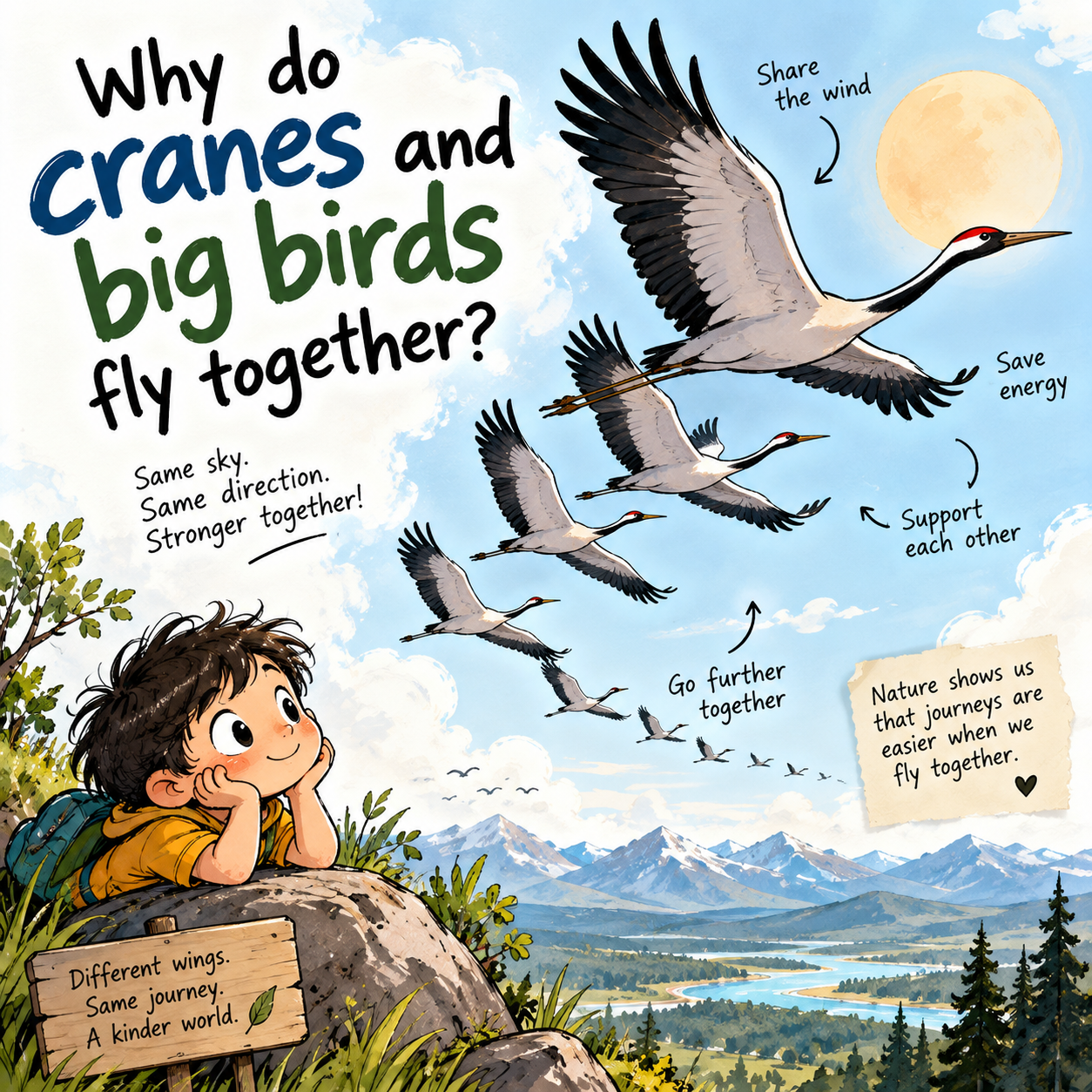
Why does the front bird change after some time? What would happen if every bird wanted only the easiest place? In a family, classroom, or community, who creates “lift” for others?
CONTENT
Flight, air resistance, lift, energy, migration and V formation.
Prompt:
What happens to the air behind the leading bird, and how does that affect the birds following it?
CONCEPT
Cooperation + Systems + Interdependence
Prompt:
How can the actions of one member change what becomes possible for the whole group?
CONTEXT
Local:
Where in our classroom, family or team is responsibility shared—and where is one person carrying too much?
Global:
What large human problems require countries, organisations or communities to cooperate rather than act alone?
CONNECTION
Physics: lift
Mathematics: distance, energy, formation
Biology: migration
Language: metaphor of “creating lift”
Social studies: leadership and shared responsibility
PHE: teamwork
Connection prompt:
What changes when leadership becomes something we take turns carrying rather than something one person owns?
Quotients
CQ: Why a V?
BQ: What becomes possible with support?
AQ: Can I move from leader to supporter when the situation requires it?
ReQ: When have I created lift for someone else?
RQ: Do I prefer the easiest position while expecting somebody else to lead?
MQ: What does shared responsibility mean in my life?
ResQ: How does support help people continue?
SoQ: How do we make one another stronger?
ERQ: Can I ask for help when I become tired?
Nature’s Lesson 5 — Why do birds become quiet before rain?
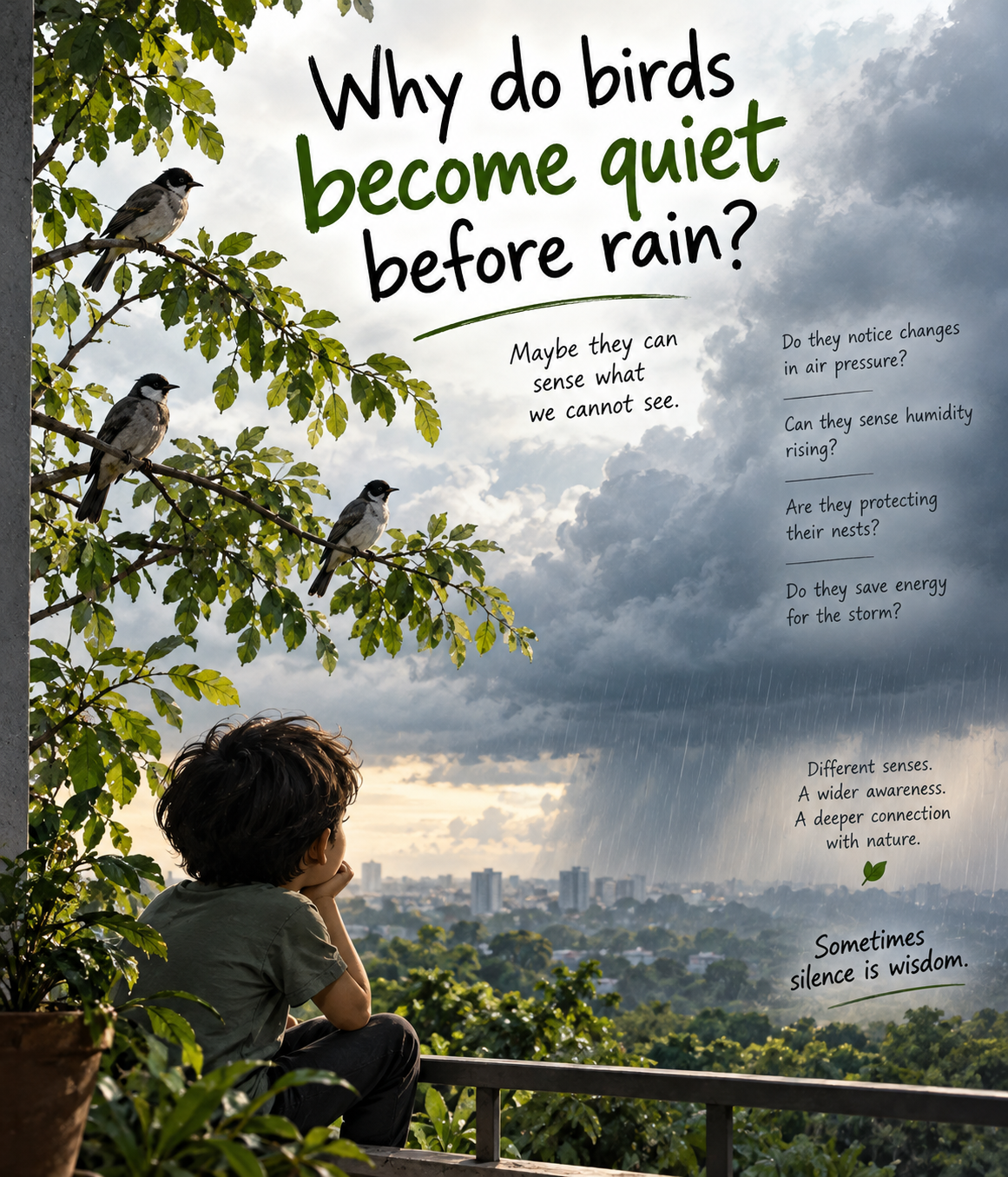
Do birds know rain is coming, or do they read clues from nature? What signs do ants, frogs, trees, or clouds give before rain? What could you predict if you watched nature carefully for one full month?
CONTENT
Weather conditions, air pressure, wind, clouds, animal behaviour, observation and patterns.
Prompt:
What environmental changes occur before rain, and which of them might birds be responding to?
CONCEPT
Pattern + Evidence + Prediction
Prompt:
When does something I repeatedly notice become strong enough to support a prediction?
CONTEXT
Local:
What signs of changing weather can I observe around my own home or school for seven days?
Global:
How do people in different environments observe, measure and predict dangerous weather?
CONNECTION
Science: weather
Mathematics: data and frequency
Geography: climate
Language: observation versus claim
Technology: weather forecasting
History: traditional weather knowledge
Connection prompt:
What can technology measure that our senses cannot—and what might careful human observation notice before we look at technology?
Quotients
CQ: What clues am I missing?
BQ: Can I become a better observer?
AQ: How should I respond when conditions change?
ReQ: Was my prediction supported by what actually happened?
RQ: Am I seeing a genuine pattern or only remembering the occasions when I was right?
MQ: How can prediction help everyday life?
ResQ: How does preparation help us handle uncertainty?
SoQ: Does combining observations improve our prediction?
ERQ: Can better information help me respond calmly rather than panic?
Nature’s Lesson 6 — Why does a plant near a window bend toward the light?
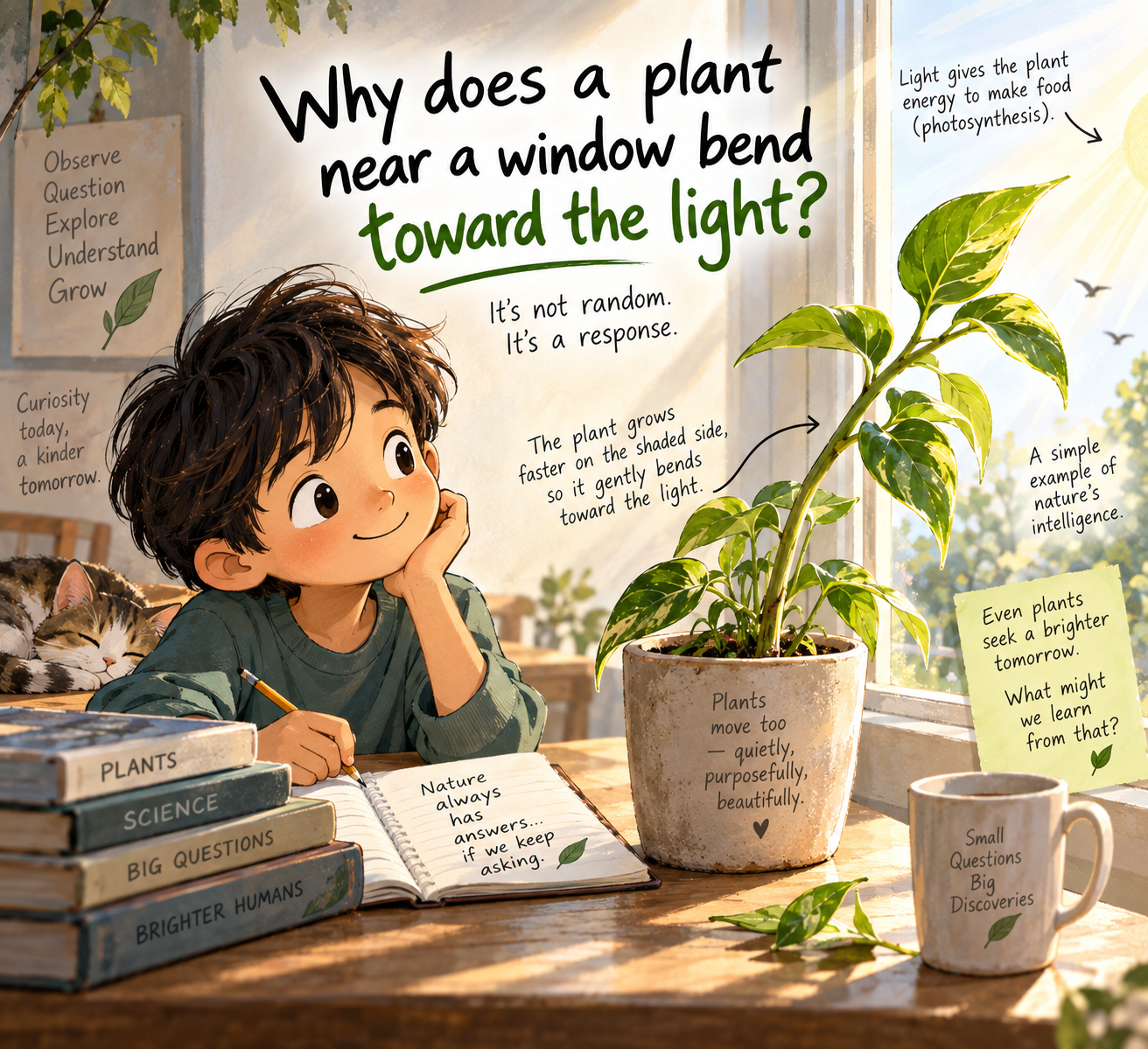
A child may notice that a plant kept near a window slowly leans in one direction.
Aha moment: The plant is not simply growing; its growth is responding to information from its environment.
The deeper question remains:
Does growth simply mean getting bigger, or does growth also mean responding intelligently to where we are?
CONTENT — What am I learning?
Light, plant growth, shoots, phototropism, plant hormones, direction and environmental response.
Prompt:
What changes inside a growing shoot when light comes mainly from one direction, and how does that change the direction in which the plant grows?
CONCEPT — What bigger idea am I discovering?
Response + Adaptation + Change
Prompt:
What does the bending plant reveal about the difference between simply growing and responding while we grow?
The child discovers:
Growth is not always straight; sometimes growth requires changing direction in response to conditions.
CONTEXT — Why and where does this matter?
Local context:
Which plants around my home, classroom, balcony or garden appear to grow toward light? How might buildings, windows or shade influence their growth?
Global context:
How do differences in light, climate, forests, farming systems and built environments influence how plants grow in different parts of the world?
CONNECTION — Where else can this learning travel?
Science: plant responses and photosynthesis
Mathematics: measure growth angle and height over time
Geography: sunlight, climate and vegetation
Language: literal and metaphorical meanings of “turning toward the light”
Art: observe and sketch changing plant forms
Human development: adapting without losing direction
Connection prompt:
Where else in nature or life does changing direction help something continue growing rather than prevent its growth?
Quotients triggered
CQ: How does a plant know where the light is?
BQ: Can I still grow when my starting conditions are not ideal?
AQ: When should I change direction instead of continuing in the same way?
ReQ: When has changing my approach helped me learn better?
RQ: Why do I sometimes think changing direction means I was wrong?
MQ: What does responsive growth mean in my own life?
ResQ: Can I keep growing even when I must bend around an obstacle?
SoQ: Who helps me recognise where new possibilities lie?
ERQ: Can I change course calmly without feeling that I have failed?
Nature’s Lesson 7 — Why does a puddle disappear even when nobody wipes it away?
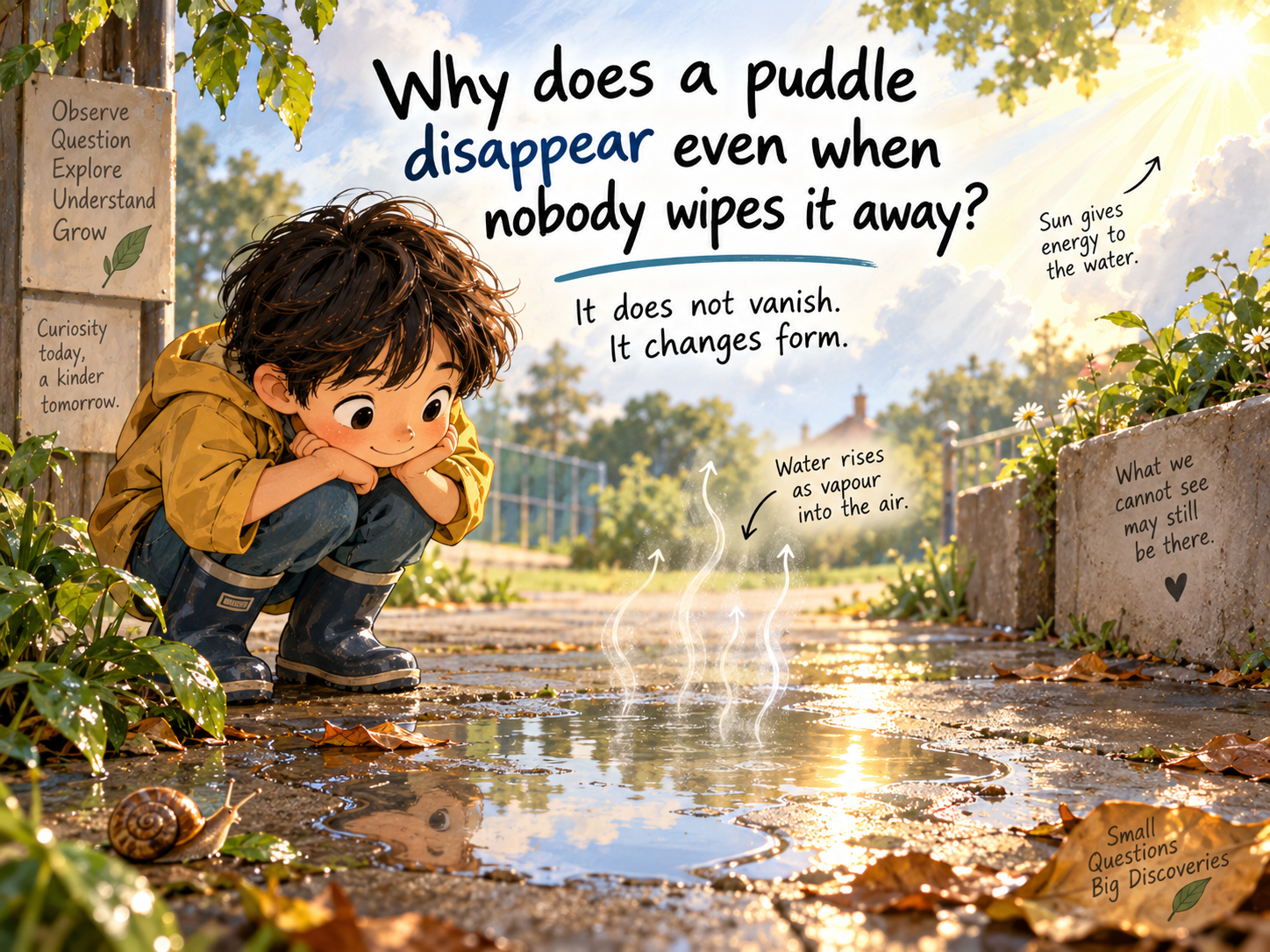
The puddle was there in the morning. By afternoon, it is gone.
Aha moment: Water can leave our sight without ceasing to exist.
The deeper inquiry remains:
Can something leave our sight without ceasing to exist?
CONTENT — What am I learning?
Evaporation, heat energy, water particles, liquid and gas, temperature, weather and the water cycle.
Prompt:
What happens to water particles when a puddle receives energy from its surroundings, and where does the water go when the puddle disappears?
CONCEPT — What bigger idea am I discovering?
Change + Transformation + Conservation
Prompt:
Can something change its form so completely that we mistakenly think it has disappeared?
The child discovers:
Not seeing something is not evidence that it no longer exists.
CONTEXT — Why and where does this matter?
Local context:
Which puddles around my school or neighbourhood disappear fastest? What differences in sunlight, wind, surface and temperature might explain this?
Global context:
How does evaporation contribute to weather, rainfall, drought, water availability and the movement of water around Earth?
CONNECTION — Where else can this learning travel?
Science: states of matter and water cycle
Mathematics: measure puddle size over time
Geography: rainfall, drought and climate
Language: visible versus invisible
Art: represent one substance through changing forms
Philosophical thinking: absence versus disappearance
Connection prompt:
Where else might something become invisible while continuing to exist in another form or place?
Quotients triggered
CQ: Where did the water go?
BQ: Can I investigate something even when I cannot see it directly?
AQ: What other evidence can I use when observation alone is insufficient?
ReQ: Did I once think disappearing meant ceasing to exist?
RQ: Why do I trust visible evidence more easily than invisible processes?
MQ: Why does understanding evaporation matter to water in my life?
ResQ: Can I keep investigating when the answer is not immediately visible?
SoQ: What might other people notice about the same puddle that I missed?
ERQ: Can I remain comfortable with a question whose answer I cannot immediately see?
Nature’s Lesson 8 — Why does my shadow change even though I have not changed?
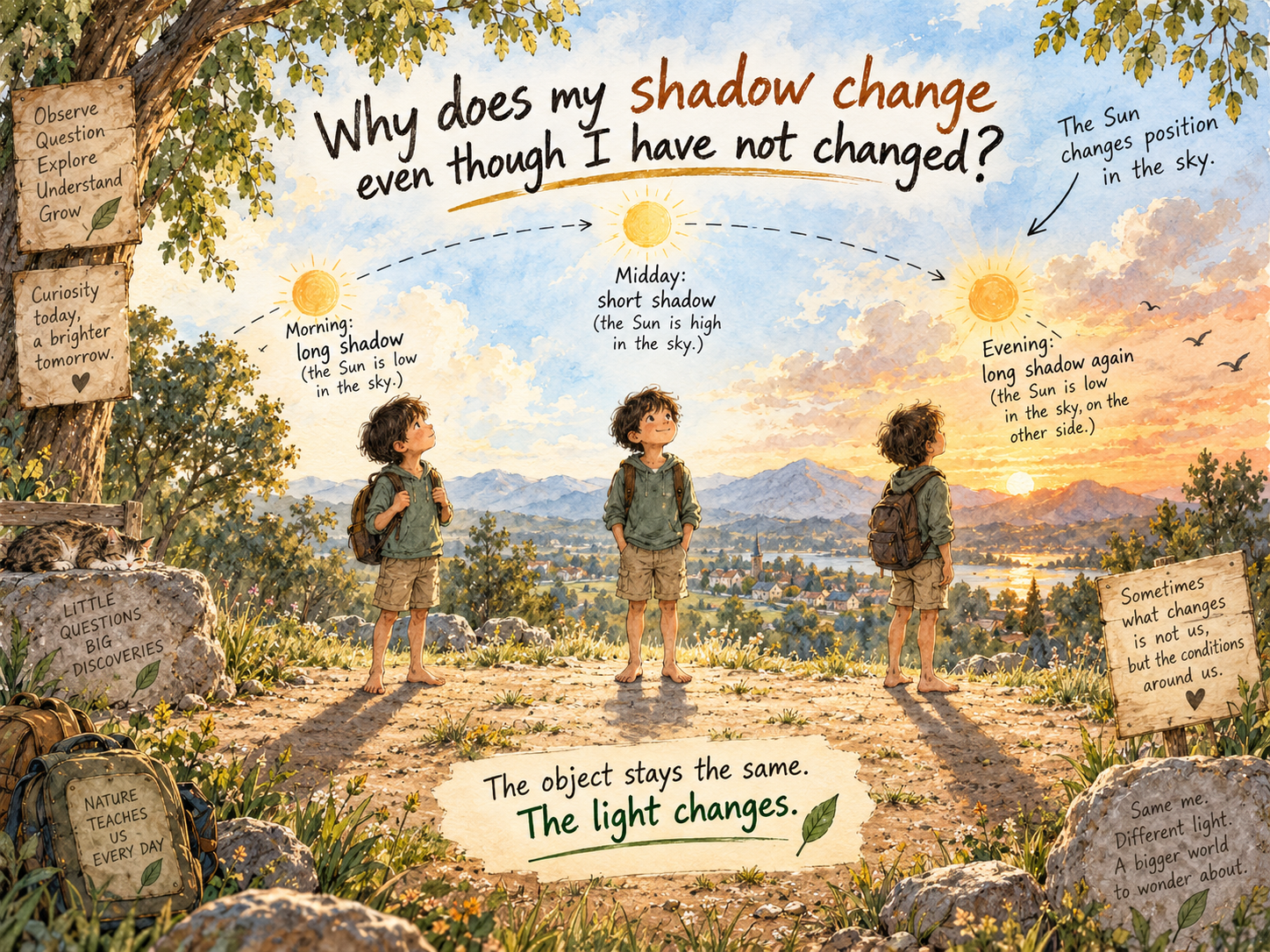
A child’s shadow may be long in the morning, shorter around midday and long again later.
Aha moment: The object has remained the same; the relationship between the object and the light source has changed.
The deeper inquiry remains:
Can the same object appear different simply because the conditions around it have changed?
CONTENT — What am I learning?
Light, shadows, position of the Sun, angles, direction, measurement, time and Earth’s rotation.
Prompt:
How does the changing position of the Sun in our sky change the direction and length of a shadow?
CONCEPT — What bigger idea am I discovering?
Perspective + Relationship + Change
Prompt:
How can something appear to change even when the thing itself has not changed?
The child discovers:
What we observe can depend on relationships and conditions, not only on the object being observed.
CONTEXT — Why and where does this matter?
Local context:
How does my shadow change at the same place at different times of the school day?
Global context:
How have people in different places and times used sunlight and shadows to understand direction, time, seasons and Earth’s movement?
CONNECTION — Where else can this learning travel?
Science: light and Earth’s movement
Mathematics: angles, length and ratios
Geography: direction and position
History: sundials and timekeeping
Art: shadow, proportion and perspective
Language: appearance versus reality
Connection prompt:
Where else might changing the conditions around something change the way we see it?
Quotients triggered
CQ: Why does my shadow change when I do not?
BQ: Can I discover a pattern by observing repeatedly?
AQ: Can I change my explanation when new observations challenge it?
ReQ: What did I initially think caused the shadow to change?
RQ: Do I sometimes assume that a changed appearance means the object itself changed?
MQ: How did humans use this ordinary phenomenon to understand time?
ResQ: Can I observe patiently across an entire day?
SoQ: Can combining our shadow measurements reveal a stronger pattern?
ERQ: Can I accept uncertainty until enough evidence appears?
Nature’s Lesson 9 — Why is the ground under a tree cooler than the pavement beside it?
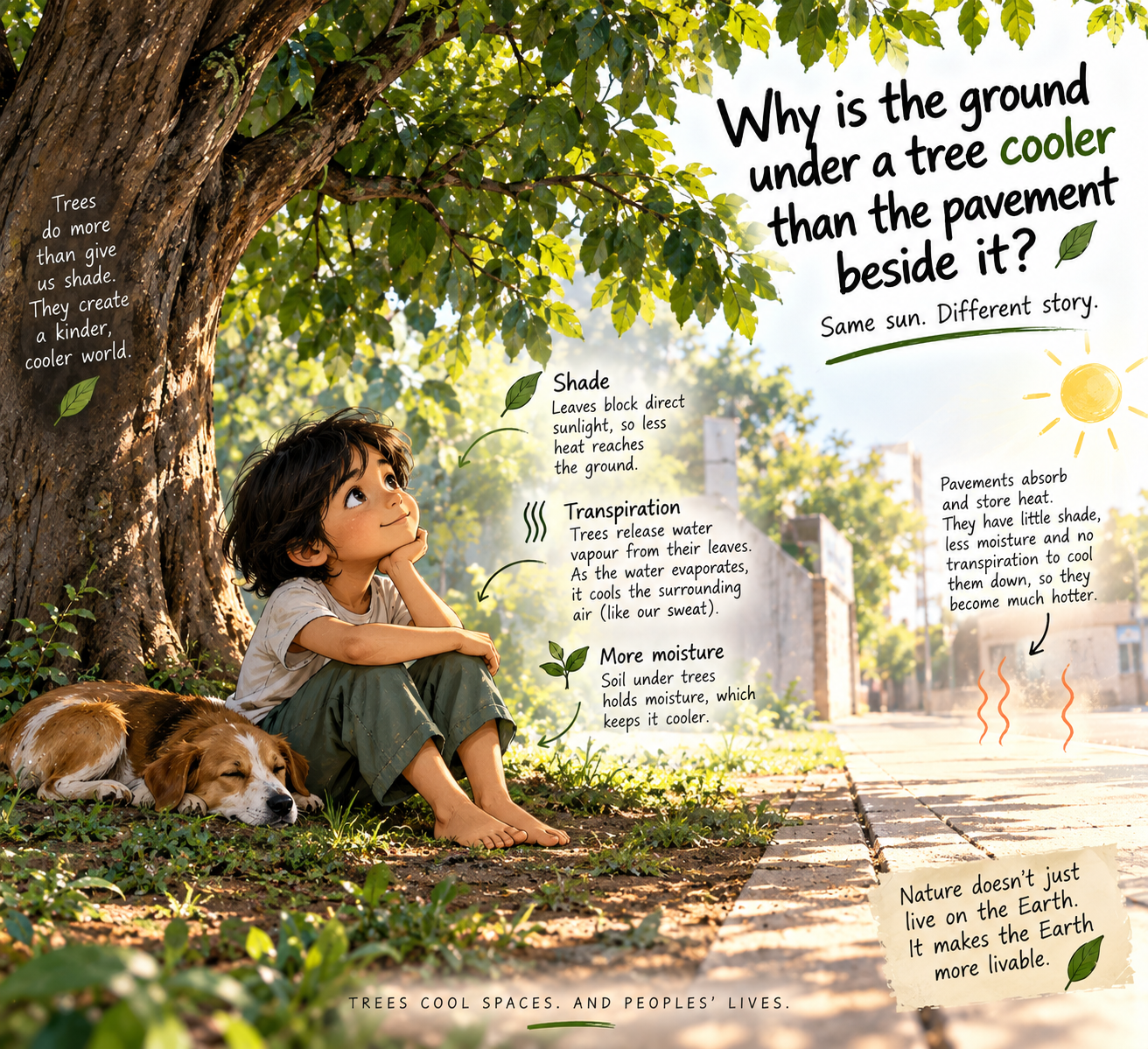
Two places may be only a few metres apart yet feel very different.
Aha moment: A tree does not merely occupy an environment; it can change the conditions around it.
The deeper question becomes:
Why are some neighbourhoods hotter than others?
CONTENT — What am I learning?
Shade, solar radiation, heat absorption, surface materials, evapotranspiration, temperature, trees and urban environments.
Prompt:
How do shade, plant water loss and different surface materials contribute to temperature differences between a tree-covered area and exposed pavement?
CONCEPT — What bigger idea am I discovering?
Interaction + Environment + Systems
Prompt:
How can one part of an environment change the conditions experienced by everything around it?
The child discovers:
Environments are produced through interactions between living things, materials and energy.
CONTEXT — Why and where does this matter?
Local context:
Where are the hottest and coolest places around my school or neighbourhood, and what features might explain the difference?
Global context:
Why are urban heat and access to shade becoming important questions for cities experiencing hotter temperatures?
CONNECTION — Where else can this learning travel?
Science: heat transfer and evapotranspiration
Mathematics: temperature collection and graphs
Geography: urban heat patterns
Design: shade and climate-sensitive buildings
Social Studies: access to green spaces
Health: heat and human wellbeing
Connection prompt:
How can choices about trees, buildings and surfaces change who experiences heat in a city?
Quotients triggered
CQ: Why can two places metres apart have different temperatures?
BQ: Can my measurements reveal something important about my surroundings?
AQ: How could spaces be redesigned to respond to heat?
ReQ: Which explanation did my evidence support?
RQ: Do I usually notice trees as decoration or as part of a functioning system?
MQ: How does shade affect my own comfort and wellbeing?
ResQ: Can communities adapt to increasingly hot conditions?
SoQ: Who benefits when shared spaces become cooler?
ERQ: How can understanding environmental conditions help us respond rather than feel helpless?
Nature’s Lesson 10 — Why does the same rain create a puddle in one place and disappear into the ground in another?
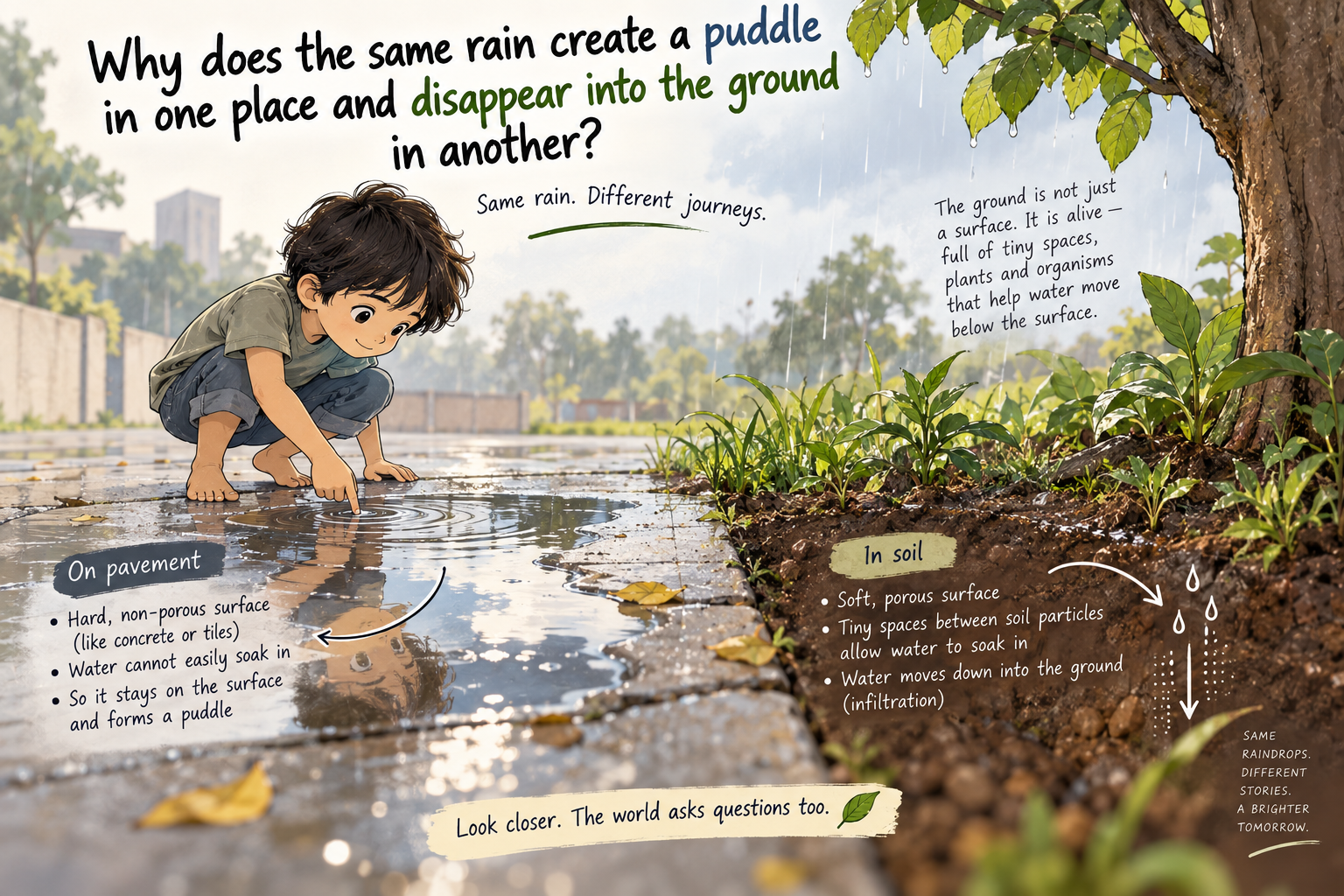
One surface absorbs water. Another sends it rushing away.
Aha moment: The rain may be the same, but the surface changes what happens next.
The conceptual question remains:
How can the material we build with change what nature is able to do?
CONTENT — What am I learning?
Permeability, infiltration, runoff, soil, concrete, drainage, groundwater and flooding.
Prompt:
Why does rainwater enter some surfaces but flow across others, and where does the water travel afterwards?
CONCEPT — What bigger idea am I discovering?
Cause + Systems + Human–environment interaction
Prompt:
How can changing one part of a natural system alter the movement of something through the entire system?
The child discovers:
Human choices about surfaces can change the natural pathways of water.
CONTEXT — Why and where does this matter?
Local context:
Where does rainwater go around my school, apartment or street? Which surfaces absorb it and which create runoff?
Global context:
Why do rapidly built cities around the world need to rethink drainage, flooding, groundwater recharge and permeable spaces?
CONNECTION — Where else can this learning travel?
Science: soil and water
Mathematics: area, rainfall and volume
Geography: drainage and flooding
Design: permeable pavements and rain gardens
Social Studies: urban planning
Environmental studies: groundwater
Connection prompt:
When humans redesign the surface of a place, what hidden natural processes might also be redesigned?
Quotients triggered
CQ: Why does rain behave differently on different surfaces?
BQ: Can I understand a city by following where its water goes?
AQ: How could we redesign a surface when the current design creates problems?
ReQ: What did I overlook about the ground beneath my feet?
RQ: Why did I assume flooding is caused only by “too much rain”?
MQ: Where does water from my own street eventually go?
ResQ: How can cities learn from repeated flooding and improve?
SoQ: Whose homes and journeys are affected when drainage fails?
ERQ: How can knowledge help us prepare calmly for heavy rainfall?
Nature’s Lesson 11 — Why do birds visit some balconies, trees or gardens but ignore others?
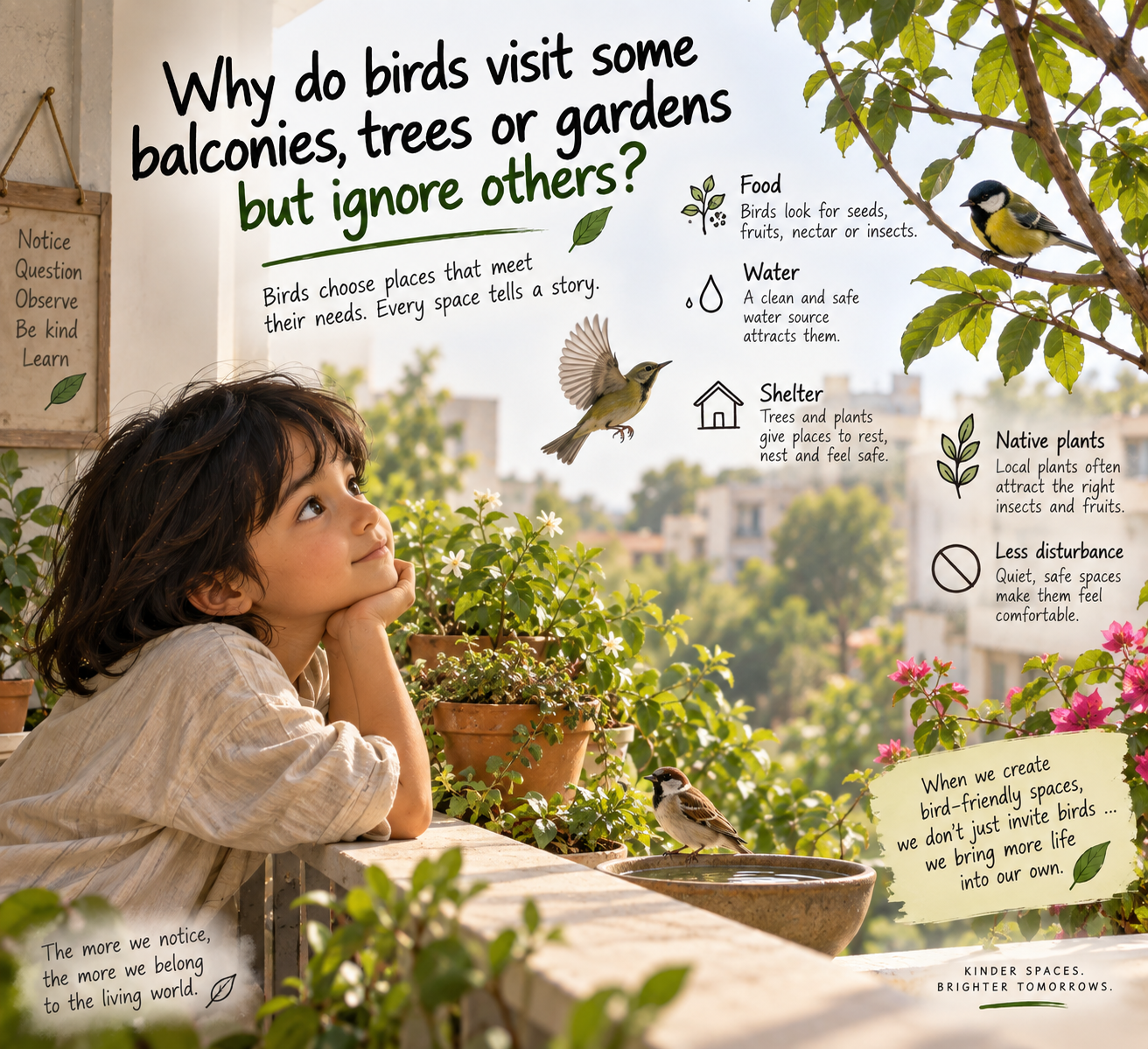
Birds do not simply choose places randomly; they respond to conditions.
Aha moment: A space that looks attractive to humans may not provide what another species needs.
The larger inquiries remain:
What makes a place livable for another species?
Is a space designed only for humans really a successful environment?
CONTENT — What am I learning?
Food, water, shelter, nesting, biodiversity, habitats, predators and human influence.
Prompt:
What resources and conditions make one small urban space more suitable for birds than another?
CONCEPT — What bigger idea am I discovering?
Habitat + Interdependence + Perspective
Prompt:
What changes when we judge a place from the needs of another living thing rather than only from our own?
The child discovers:
A successful environment depends on whose needs we use to evaluate it.
CONTEXT — Why and where does this matter?
Local context:
Which birds visit my school, balcony, garden or neighbourhood, and what features seem to attract or discourage them?
Global context:
How are cities around the world changing habitats for birds and other wildlife?
CONNECTION — Where else can this learning travel?
Science: habitats and biodiversity
Mathematics: bird counts and frequency
Geography: urban ecosystems
Design: wildlife-friendly spaces
Art: observational drawing
Ethics: sharing human spaces with other species
Connection prompt:
How would our neighbourhood look different if we designed it for more than one species?
Quotients triggered
CQ: Why do birds choose one place and avoid another?
BQ: Can my observations help improve a habitat?
AQ: How can humans modify spaces to accommodate other species?
ReQ: What feature did I initially overlook?
RQ: Do I automatically judge a space only from a human perspective?
MQ: What other lives share the places I call home?
ResQ: How can species and communities respond when habitats change?
SoQ: How can people cooperate to create shared habitats?
ERQ: Can caring for living things strengthen calm attention and responsibility?
Nature’s Lesson 12 — Why does fruit rot while a plastic wrapper can remain for years?
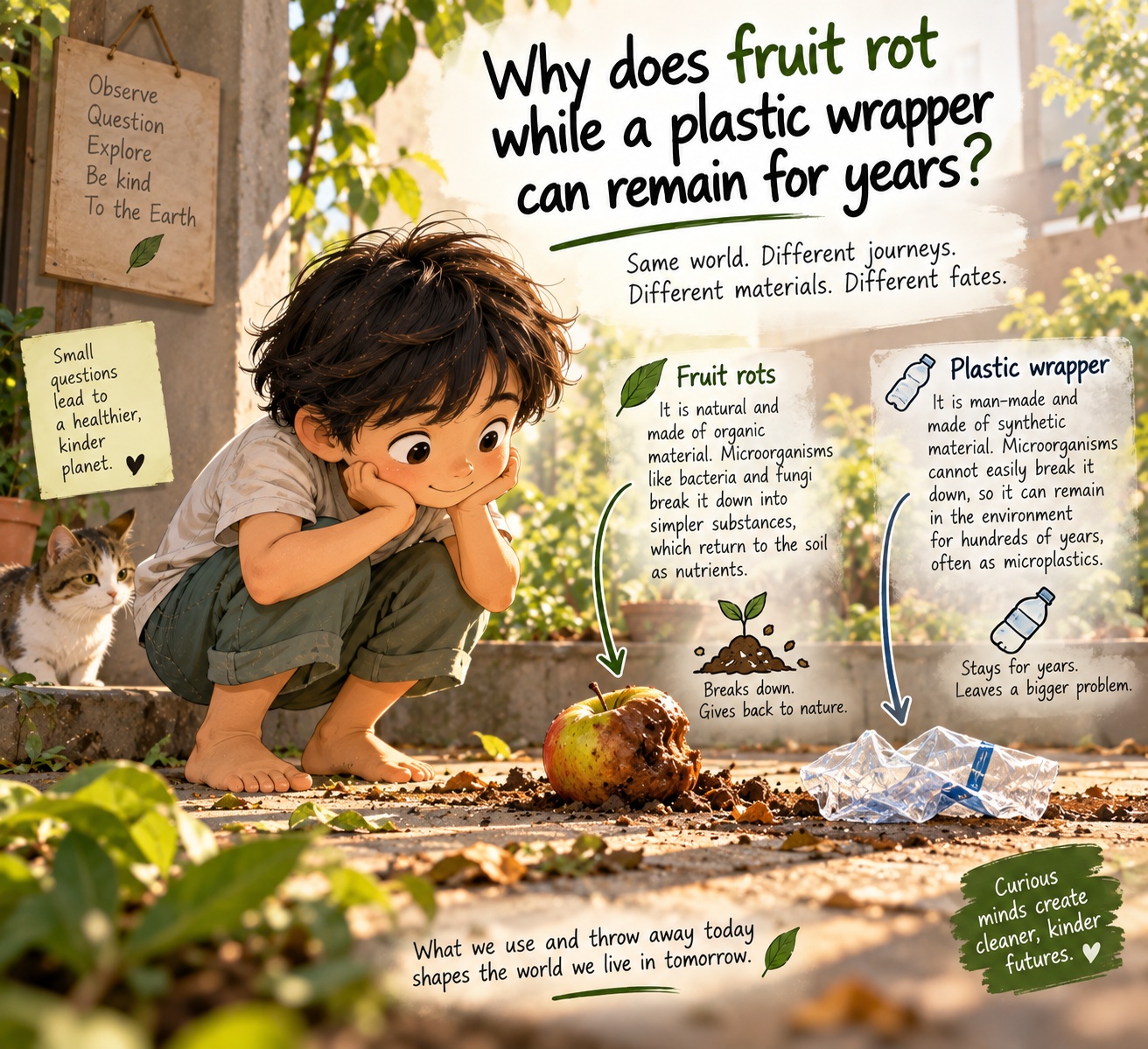
Both may enter the same bin, but their journeys are dramatically different.
Aha moment: Throwing two things “away” does not mean nature can process them in the same way.
The conceptual question remains:
Why does nature know what to do with some materials but struggle with others?
CONTENT — What am I learning?
Decomposition, microorganisms, organic material, polymers, biodegradability, waste and material life cycles.
Prompt:
What organisms and processes break down fruit, and why are many plastics much harder for natural decomposers to break apart?
CONCEPT — What bigger idea am I discovering?
Cycles + Materials + Sustainability
Prompt:
What happens when humans create materials that do not easily fit back into natural cycles?
The child discovers:
Making a useful material also creates responsibility for what happens after its usefulness ends.
CONTEXT — Why and where does this matter?
Local context:
What happens to the different kinds of waste produced in my home or school after they leave the bin?
Global context:
How do plastic waste, landfill, recycling and marine pollution affect environments in different parts of the world?
CONNECTION — Where else can this learning travel?
Biology: decomposers
Chemistry: material composition
Mathematics: waste audits
Geography: waste movement
Design: materials and circular design
Economics: consumption and waste systems
Connection prompt:
Should designing a product include designing what happens to it after we finish using it?
Quotients triggered
CQ: Why does one material disappear while another persists?
BQ: Can my choices reduce the waste I create?
AQ: What alternative material or system could work better?
ReQ: What happens after I throw something away?
RQ: Why do I think “out of my sight” means “gone”?
MQ: How does my everyday consumption connect with larger environmental systems?
ResQ: How can communities keep improving waste systems?
SoQ: Why does waste require collective responsibility?
ERQ: Can concern about waste become thoughtful action rather than anxiety?
Nature’s Lesson 13 — Why does food stay fresh longer inside a refrigerator?
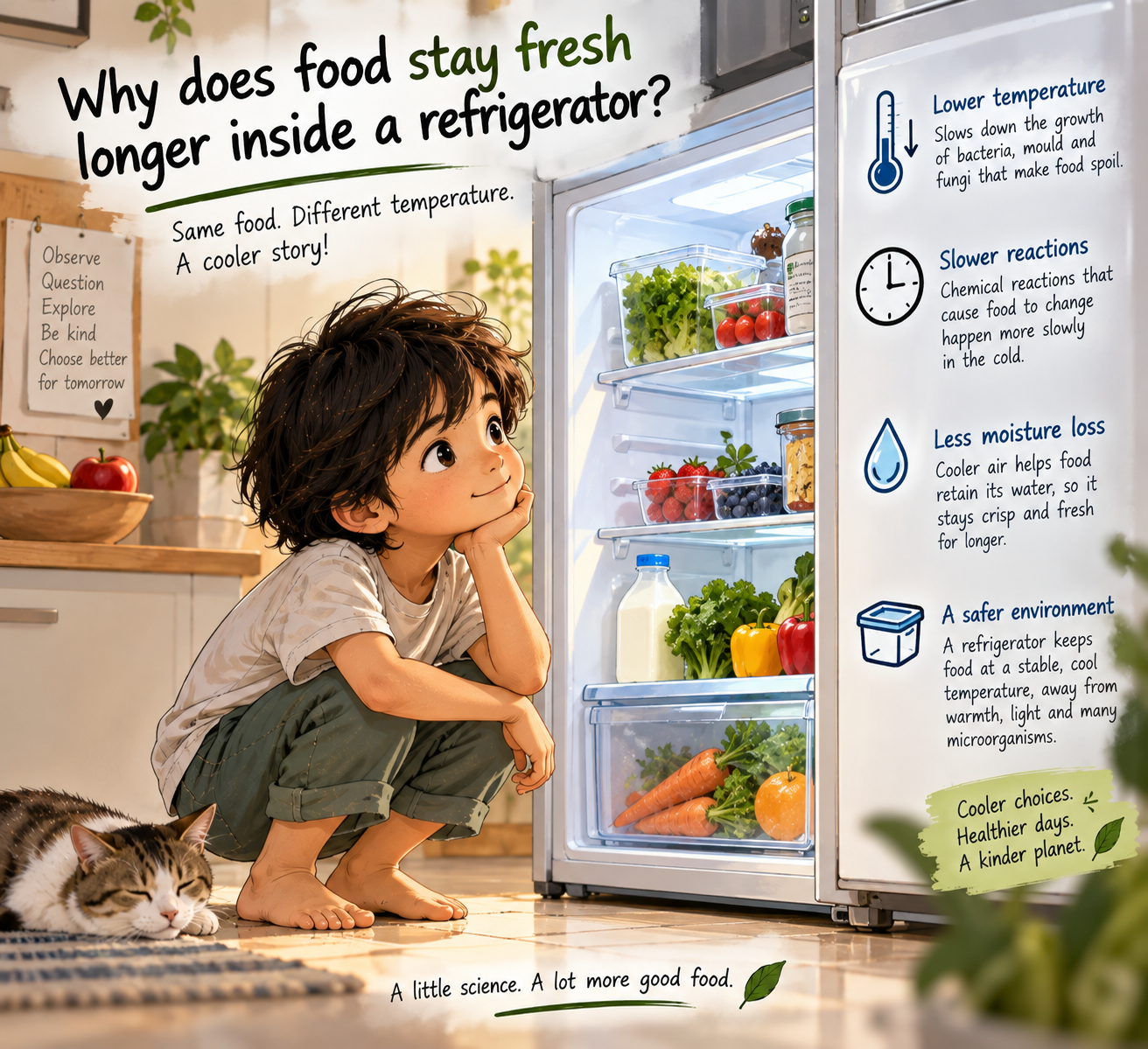
The food has only entered a different environment, yet its rate of change becomes different.
Aha moment: We can change the speed of a biological or chemical process by changing its conditions.
The larger idea remains:
How can changing conditions slow down a process without stopping it completely?
CONTENT — What am I learning?
Temperature, microorganisms, enzyme activity, chemical change, food spoilage and preservation.
Prompt:
How does lower temperature affect the processes and microorganisms that cause food to spoil?
CONCEPT — What bigger idea am I discovering?
Rate + Conditions + Change
Prompt:
Why can the same process happen at different speeds under different conditions?
The child discovers:
Changing a condition can change the rate of change without eliminating the process itself.
CONTEXT — Why and where does this matter?
Local context:
Which foods in my home require refrigeration and which do not? Why are they stored differently?
Global context:
Why is reliable refrigeration important for food supply, medicine, transport and reducing food waste around the world?
CONNECTION — Where else can this learning travel?
Biology: microorganisms
Chemistry: reaction rates
Mathematics: temperature and time
Design: refrigeration systems
Geography: food supply chains
Health: food safety
Connection prompt:
Where else can changing environmental conditions speed up or slow down a process?
Quotients triggered
CQ: Why does cold change how quickly food spoils?
BQ: Can I explain an everyday technology scientifically?
AQ: How can we preserve food when refrigeration is unavailable?
ReQ: What did I assume a refrigerator actually did?
RQ: Did I confuse “slower” with “stopped”?
MQ: How does food preservation affect my everyday life?
ResQ: How have humans found multiple ways to preserve food?
SoQ: How does safe storage protect communities?
ERQ: How does knowledge help me make calm, responsible food-safety decisions?
Nature’s Lesson 14 — Why can a spider’s web be so thin and yet hold something struggling inside it?
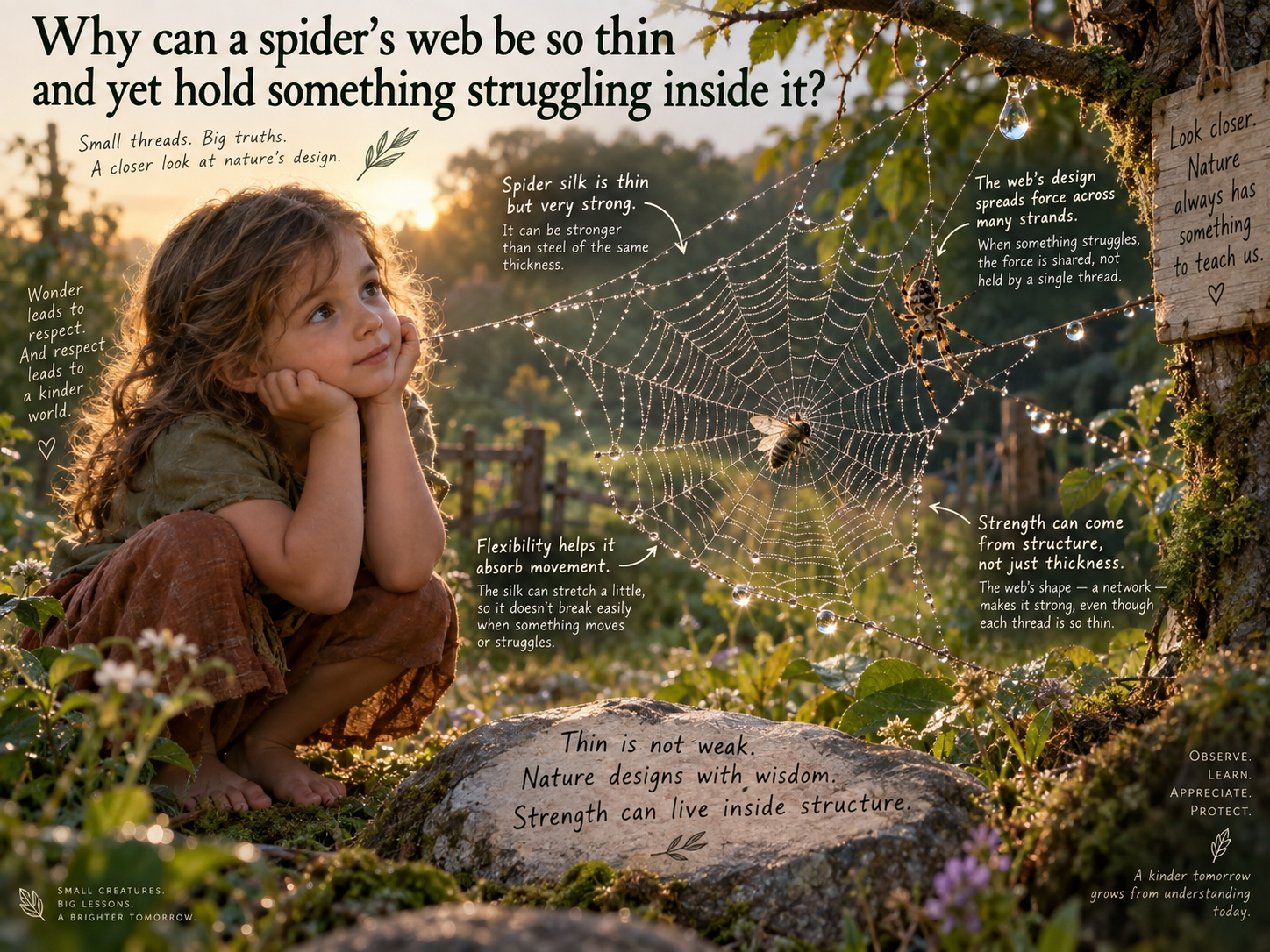
A web looks fragile, yet its structure performs a demanding task.
Aha moment: Strength does not depend only on how much material is used; structure and material properties matter.
The deeper inquiry remains:
Does strength always require more material, or can intelligent structure create strength?
CONTENT — What am I learning?
Spider silk, tensile strength, elasticity, force, tension, web structure and biomimicry.
Prompt:
How do the properties of spider silk and the arrangement of a web help distribute forces without requiring a thick structure?
CONCEPT — What bigger idea am I discovering?
Structure + Function + Design
Prompt:
How can the arrangement of material be as important as the amount of material?
The child discovers:
Good design can achieve strength through relationships between material, shape and structure.
CONTEXT — Why and where does this matter?
Local context:
Where can I find lightweight structures around my school or neighbourhood that achieve strength through design?
Global context:
How are scientists, architects and engineers studying biological structures to design lighter and more efficient materials?
CONNECTION — Where else can this learning travel?
Biology: spider behaviour and silk
Physics: force and tension
Mathematics: geometric patterns
Architecture: lightweight structures
Design: biomimicry
Art: symmetry and pattern
Connection prompt:
What could humans design differently if we learned from how nature achieves more with less material?
Quotients triggered
CQ: How can something so thin be so strong?
BQ: Can careful design overcome apparent limitations?
AQ: Can I redesign rather than simply add more material?
ReQ: What did I once think “strong” had to look like?
RQ: Why do I equate size or thickness with strength?
MQ: Where could efficient design improve my world?
ResQ: How does a structure cope with repeated stress?
SoQ: How do interconnected strands strengthen the whole?
ERQ: Can I remain flexible without becoming weak?
Nature’s Lesson 15 — Why do some seeds fly, some float and some stick to us?
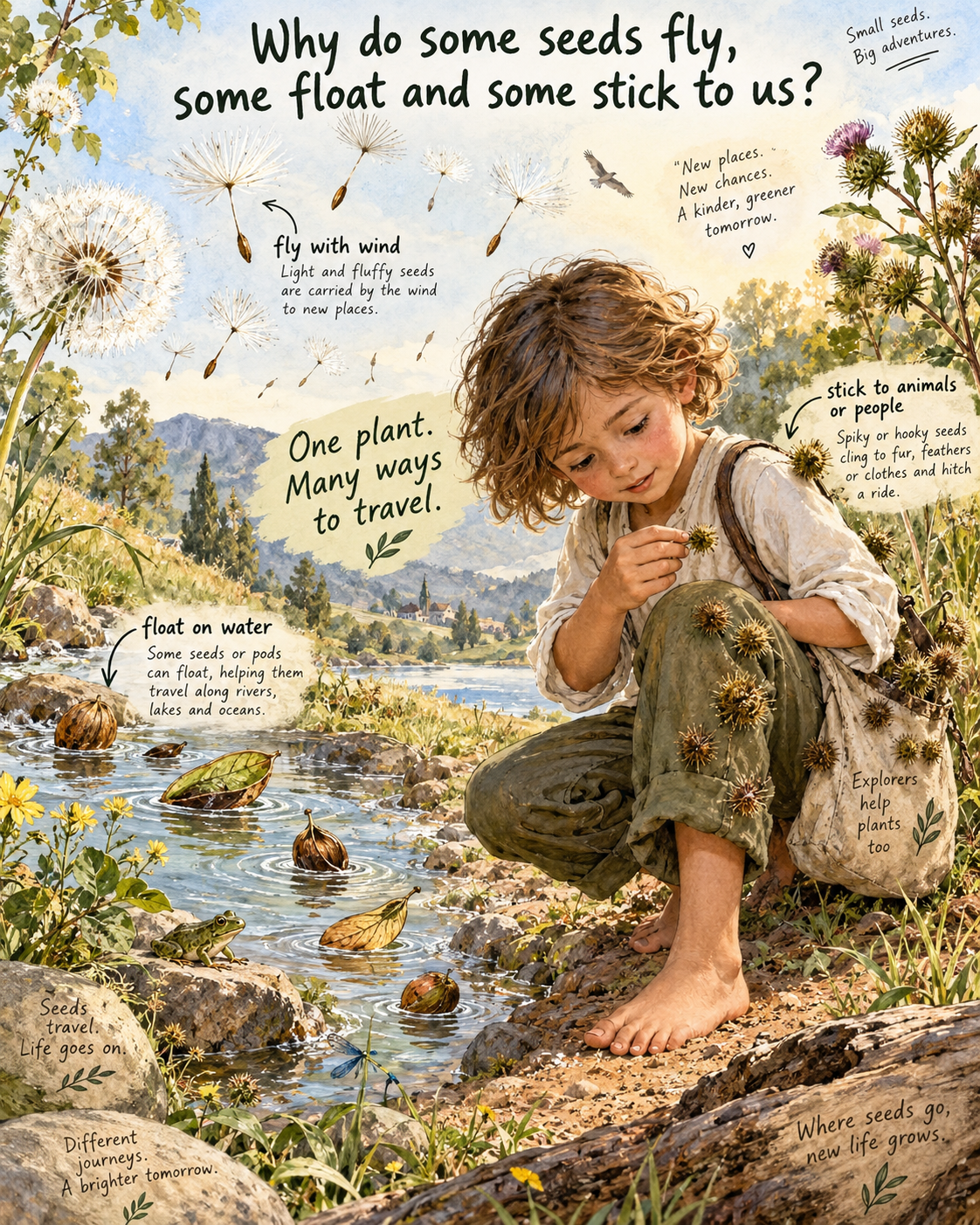
A plant cannot walk, yet its offspring may travel remarkable distances.
Aha moment: Living things can solve the problem of movement without moving in the way animals do.
The bigger question remains:
How can something that cannot move design a way to travel?
CONTENT — What am I learning?
Seed dispersal, wind, water, animals, hooks, wings, buoyancy, reproduction and adaptation.
Prompt:
How do the shape and structure of different seeds help them use wind, water or animals to move away from the parent plant?
CONCEPT — What bigger idea am I discovering?
Adaptation + Form and Function + Movement
Prompt:
How can structure allow an organism to use forces or other living things to do something it cannot do alone?
The child discovers:
Movement does not always require a mover; sometimes form allows the environment to provide the movement.
CONTEXT — Why and where does this matter?
Local context:
Which seeds can I find around my home or school, and what clues in their structure suggest how they travel?
Global context:
How do different climates, landscapes and animals shape seed-dispersal strategies around the world?
CONNECTION — Where else can this learning travel?
Biology: reproduction and adaptation
Physics: wind, drag and buoyancy
Mathematics: distance and distribution
Geography: plant distribution
Design: nature-inspired transport
Art: form and movement
Connection prompt:
Where else does something achieve a goal by using forces or systems already available around it?
Quotients triggered
CQ: How can a plant send its seeds away without walking?
BQ: Can limitations lead to creative solutions?
AQ: How do different seeds solve the same problem differently?
ReQ: Which seed design surprised me most?
RQ: Why did I assume travelling requires self-powered movement?
MQ: What can different solutions teach me about solving my own problems?
ResQ: How does spreading many seeds improve the chance that some survive?
SoQ: How do animals unknowingly help plants?
ERQ: Can I accept uncertainty when I cannot control exactly where my efforts land?
Nature’s Lesson 16 — Why do we hear our voice come back to us in some places?
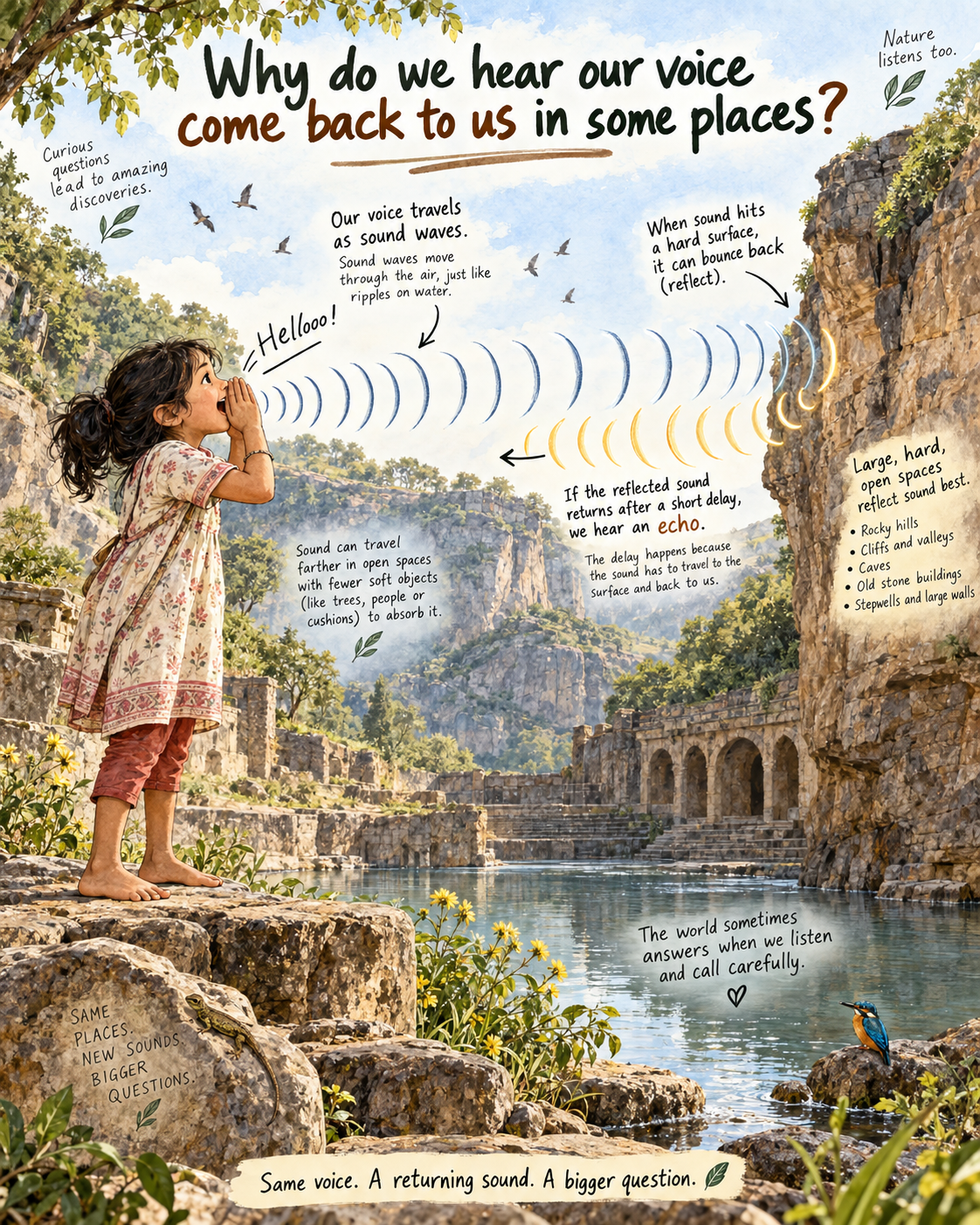
A tunnel, empty hall or cliff may appear to “answer.”
Aha moment: Sound can travel away from us, interact with a surface and return.
The conceptual inquiry remains:
How does the environment change what happens to a signal?
CONTENT — What am I learning?
Sound waves, vibration, reflection, echoes, distance, surfaces and absorption.
Prompt:
What happens to sound when it reaches different surfaces, and under what conditions can the reflected sound be heard separately as an echo?
CONCEPT — What bigger idea am I discovering?
Reflection + Interaction + Environment
Prompt:
How can a signal be changed by what it encounters on its journey?
The child discovers:
Communication depends not only on the signal but also on the environment through which it travels.
CONTEXT — Why and where does this matter?
Local context:
Which spaces around my school create echoes and which absorb sound? What is different about them?
Global context:
How do architects and engineers design concert halls, classrooms, stations and recording spaces to manage sound?
CONNECTION — Where else can this learning travel?
Physics: sound waves
Mathematics: distance, speed and time
Music: acoustics
Architecture: sound design
Biology: echolocation
Language: message and response
Connection prompt:
How does the space through which a message travels influence what eventually reaches the receiver?
Quotients triggered
CQ: Why does my voice sometimes return to me?
BQ: Can I investigate something invisible through its effects?
AQ: How can a space be changed to improve sound?
ReQ: What did my echo experiment reveal?
RQ: Do I assume that what I send is exactly what others receive?
MQ: Why does acoustics matter in places where people learn or communicate?
ResQ: Can I refine an experiment when sound measurements are difficult?
SoQ: How do spaces affect everyone’s ability to hear one another?
ERQ: How does sound affect my own concentration and calmness?
Nature’s Lesson 17 — Why can we see through a window but not through a wall?
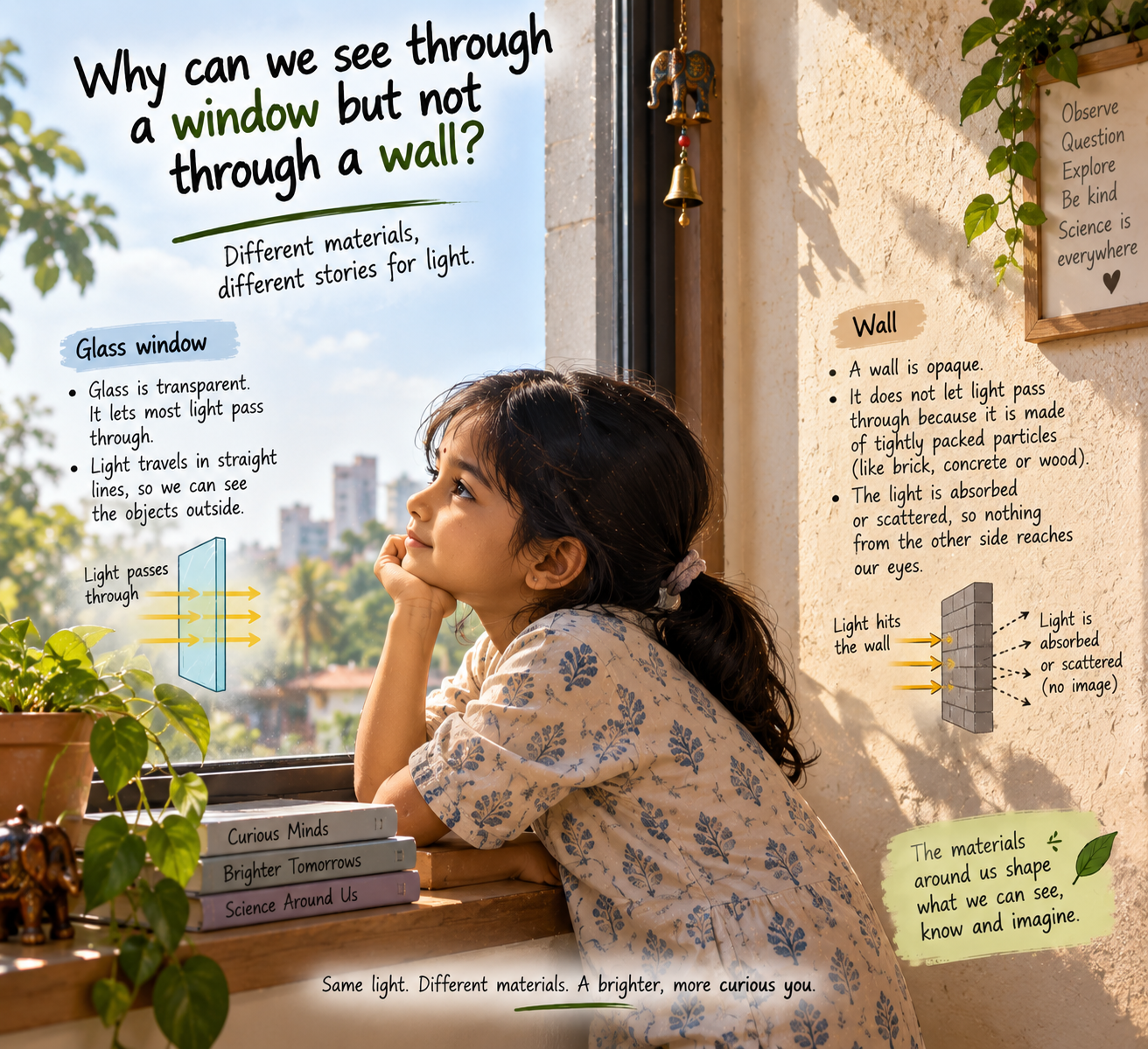
Both are solids, yet light behaves very differently when it reaches them.
Aha moment: Objects belonging to the same broad category can interact with light in very different ways.
The deeper question remains:
How can two things that belong to the same broad category behave very differently because of their internal properties?
CONTENT — What am I learning?
Light, transparent, translucent, opaque, transmission, absorption, reflection and material properties.
Prompt:
What happens to light when it meets glass compared with the materials in a wall?
CONCEPT — What bigger idea am I discovering?
Properties + Structure + Function
Prompt:
Why is knowing what something is made of sometimes more informative than simply knowing what category it belongs to?
The child discovers:
Objects can belong to the same category yet behave differently because their structures and properties differ.
CONTEXT — Why and where does this matter?
Local context:
Why are different materials used for windows, walls, sunglasses, curtains and screens around me?
Global context:
How do materials that control light affect buildings, energy use, communication and technology?
CONNECTION — Where else can this learning travel?
Physics: light
Chemistry: material properties
Design: choosing materials
Architecture: daylight
Art: transparency and opacity
Technology: optical materials
Connection prompt:
How should we decide which material is suitable for a purpose rather than simply which material is available?
Quotients triggered
CQ: Why does light pass through one solid but not another?
BQ: Can I investigate invisible interactions through observable effects?
AQ: How can different materials solve different design needs?
ReQ: Did I assume all solids should behave similarly?
RQ: How often do I judge something by category rather than properties?
MQ: Why do material choices matter in the spaces I use?
ResQ: Can I continue testing when materials behave unexpectedly?
SoQ: How can different observations improve material choices?
ERQ: Can I tolerate a result that contradicts my prediction?
Nature’s Lesson 18 — Why does soap remove something that water alone cannot?
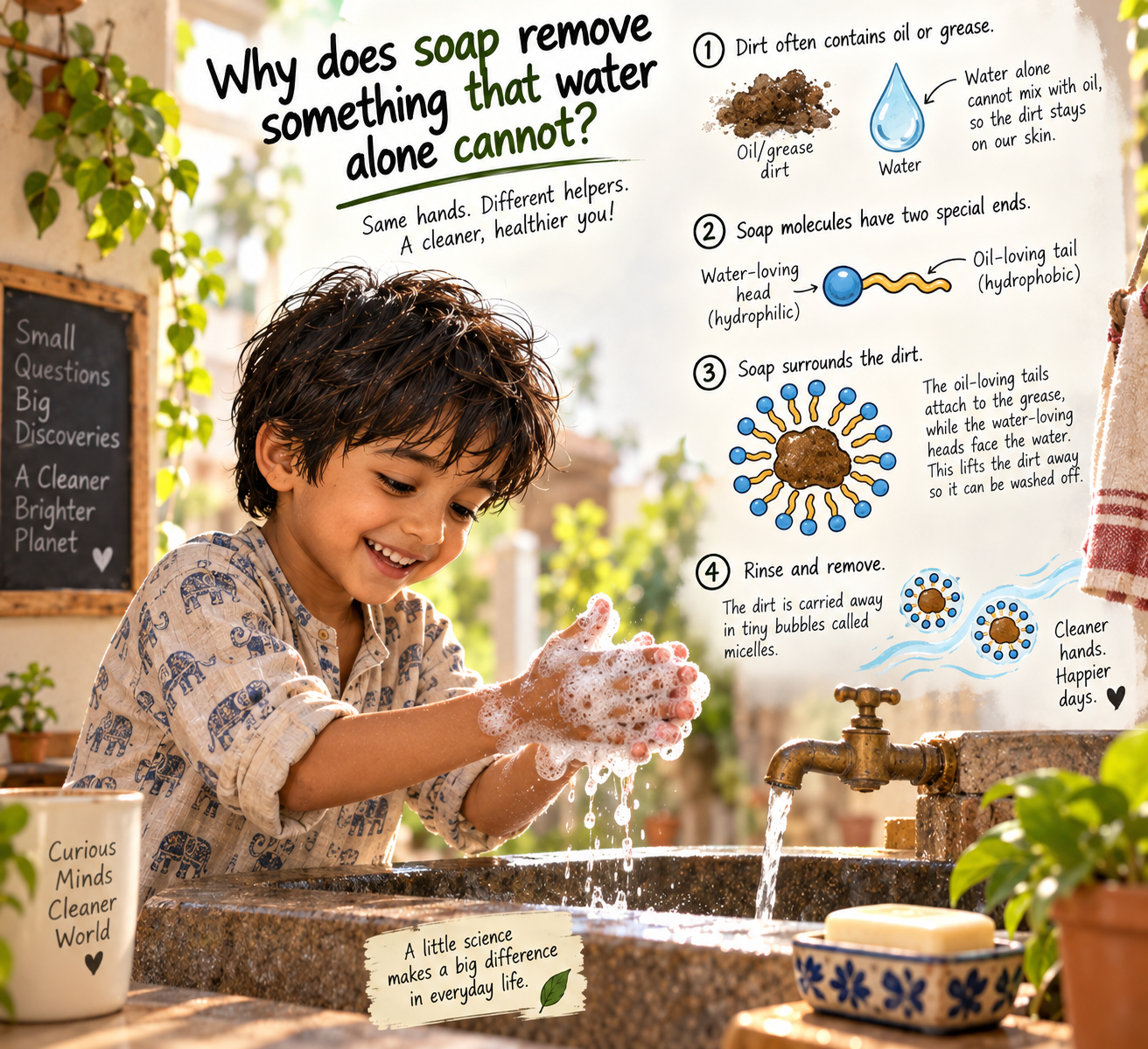
Soap is used every day, yet its chemistry is extraordinary.
Aha moment: Sometimes solving a problem requires a bridge between substances that normally do not interact easily.
The larger inquiry remains:
Why can solving a problem require something that connects two things which normally do not mix?
CONTENT — What am I learning?
Water, oils, fats, molecules, surfactants, hydrophilic and hydrophobic regions, micelles and cleaning.
Prompt:
How can a soap molecule interact with both water and oily substances and help water carry grease away?
CONCEPT — What bigger idea am I discovering?
Interaction + Compatibility + Connection
Prompt:
How can something that connects two otherwise incompatible substances create a new possibility?
The child discovers:
Some solutions work not by choosing one side, but by creating a connection between two different sides.
CONTEXT — Why and where does this matter?
Local context:
Which stains around my home wash away with water and which require soap or detergent? Why?
Global context:
How do soaps, detergents, hygiene, wastewater and access to clean water connect with health and environmental systems around the world?
CONNECTION — Where else can this learning travel?
Chemistry: molecular interaction
Biology: hygiene and microbes
Environmental science: detergents in waterways
Design: cleaning products
Health: handwashing
Metaphorical connection: bridging differences
Connection prompt:
Where else does a successful solution depend on creating a bridge between things that do not naturally work together?
Quotients triggered
CQ: Why can soap do what water cannot?
BQ: Can a difficult problem have a solution if I understand the interaction?
AQ: What changes when one method does not work and I introduce a connecting strategy?
ReQ: What did I previously think soap was doing?
RQ: Do I keep trying more of the same method when the problem actually requires a different mechanism?
MQ: Why does this simple chemistry matter for health?
ResQ: Can I keep searching for another mechanism when the first solution fails?
SoQ: What kinds of bridges help people work together despite differences?
ERQ: Can I respond flexibly rather than become frustrated when one approach fails?
Nature’s Lesson 19 — Why does an ice cube float when it is made from the same water beneath it?
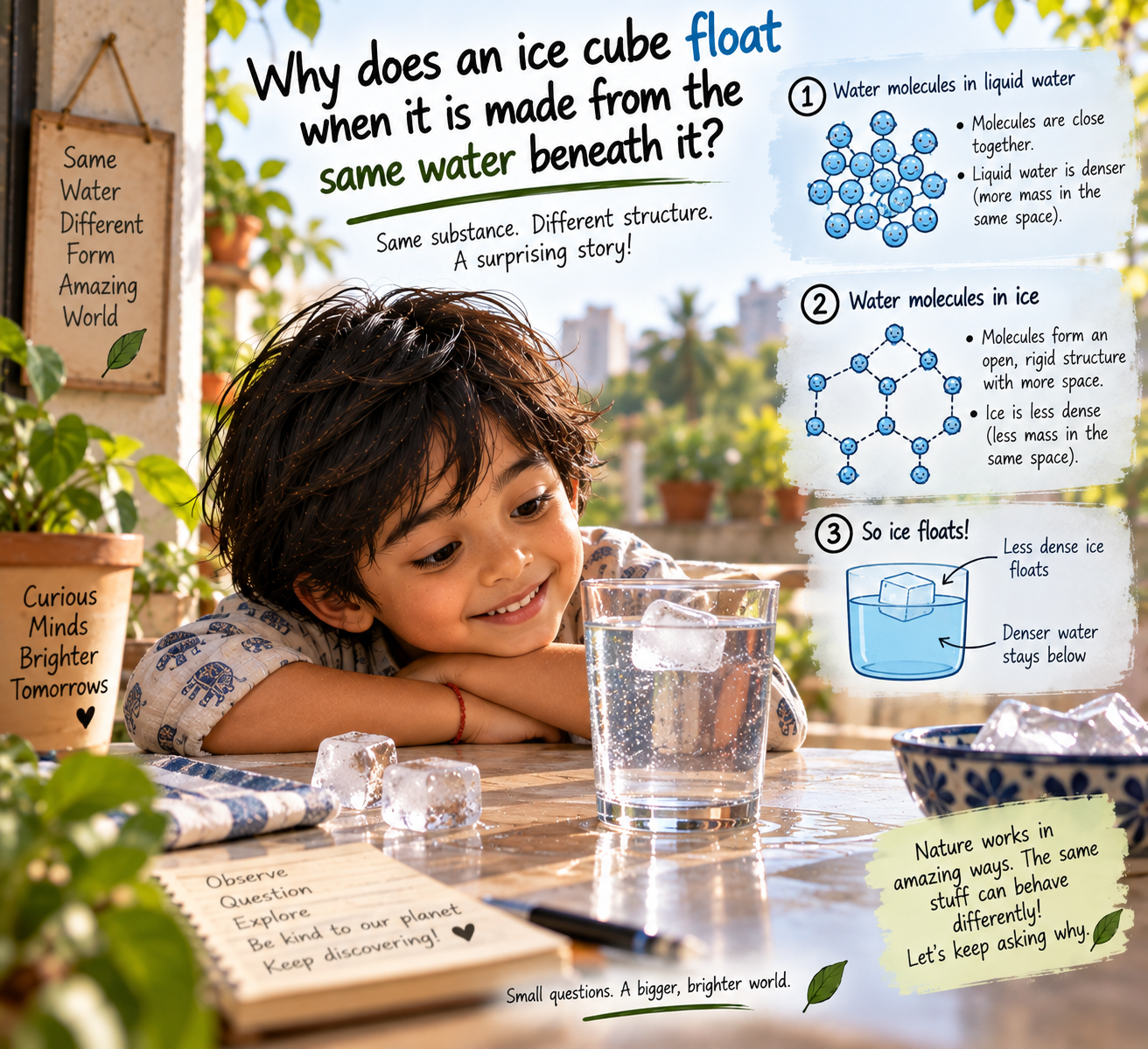
Same substance. Different state. Unexpected behaviour.
Aha moment: Changing how particles are arranged can change the behaviour of the material even when the substance remains water.
The conceptual question remains:
Can changing the arrangement of the same material change how it behaves?
CONTENT — What am I learning?
Solid and liquid states, density, particle arrangement, freezing, volume and buoyancy.
Prompt:
What changes in the arrangement of water molecules when water freezes, and why does this make ice less dense than liquid water?
CONCEPT — What bigger idea am I discovering?
Structure + Properties + Change
Prompt:
How can rearranging the same components produce different properties?
The child discovers:
Properties can emerge from arrangement, not merely from what something contains.
CONTEXT — Why and where does this matter?
Local context:
What can I observe when ice melts in a glass of water, and how could I test its behaviour?
Global context:
Why does floating ice matter to frozen lakes, polar environments, sea ice and organisms living beneath ice-covered water?
CONNECTION — Where else can this learning travel?
Physics: density and buoyancy
Chemistry: particle arrangement
Mathematics: mass, volume and density
Geography: polar regions
Biology: aquatic survival
Design: floating structures
Connection prompt:
Where else can the same components behave differently simply because they are arranged differently?
Quotients triggered
CQ: Why does solid water float on liquid water?
BQ: Can I understand something that initially seems contradictory?
AQ: Can I change my model when evidence challenges common expectations?
ReQ: What did I think solids usually did compared with liquids?
RQ: Why do I expect one general rule to apply to every substance?
MQ: How can one unusual property of water affect entire ecosystems?
ResQ: Can confusion become the beginning of deeper understanding?
SoQ: How can comparing explanations improve our model?
ERQ: Can I enjoy contradiction rather than feel threatened by it?
Nature’s Lesson 20 — Why does a crowded room feel warmer even when nobody has turned up the heater?
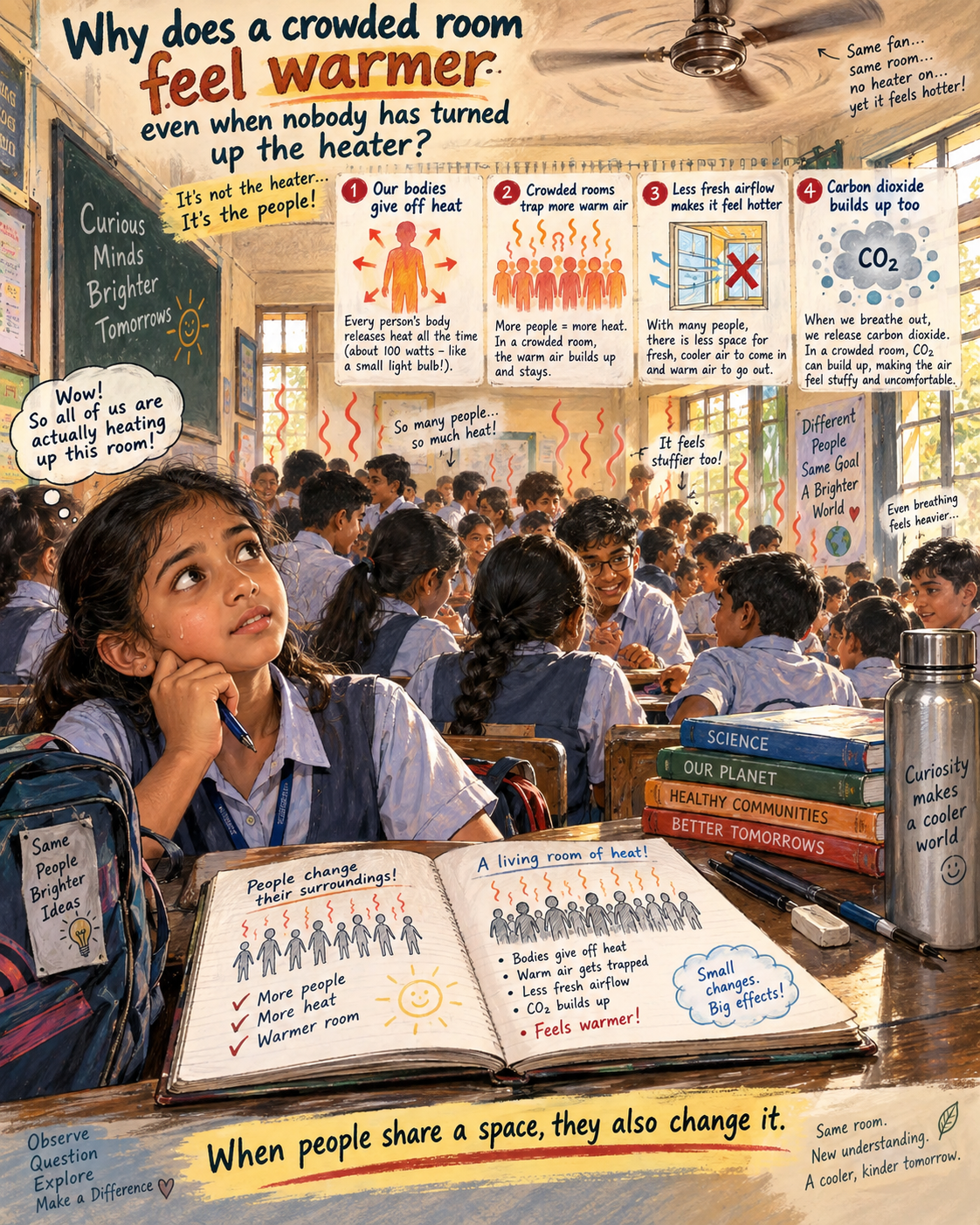
Every person in the room is affecting the physical environment.
Aha moment: People are not simply inside an environment; their bodies continuously exchange energy and matter with it.
The deeper question remains:
How should a classroom be designed if the environment itself affects how comfortably people can learn?
CONTENT — What am I learning?
Body heat, thermal energy, convection, ventilation, air movement, carbon dioxide, occupancy and building design.
Prompt:
How do human bodies and reduced air circulation change the temperature and air conditions inside a crowded room?
CONCEPT — What bigger idea am I discovering?
Systems + Interaction + Wellbeing
Prompt:
How can the people using a space change the very conditions of that space?
The child discovers:
A well-designed environment must respond to both physical conditions and the people occupying it.
CONTEXT — Why and where does this matter?
Local context:
Which rooms in my school become uncomfortable when crowded, and what roles do ventilation, windows, fans, shade and occupancy play?
Global context:
How do schools and buildings in different climates design ventilation, cooling and energy use differently?
CONNECTION — Where else can this learning travel?
Science: energy and air movement
Mathematics: occupancy and temperature data
Design: ventilation
Geography: climate-responsive buildings
Health: indoor air quality
Psychology: environment and concentration
Connection prompt:
How can a physical environment influence how well people think, feel and work?
Quotients triggered
CQ: Why does adding people change a room?
BQ: Can evidence from my environment lead to a better design?
AQ: How can a learning space adapt to changing numbers of people?
ReQ: When do I learn best physically?
RQ: Do I blame myself for losing concentration when the environment may also be contributing?
MQ: How does physical space affect my own learning?
ResQ: How can I adapt when conditions are temporarily uncomfortable?
SoQ: How does everyone’s presence affect everyone else’s environment?
ERQ: Which environmental conditions help me remain calm and focused?
Nature’s Lesson 21 — Why do we remember some smells long after we have forgotten other details?
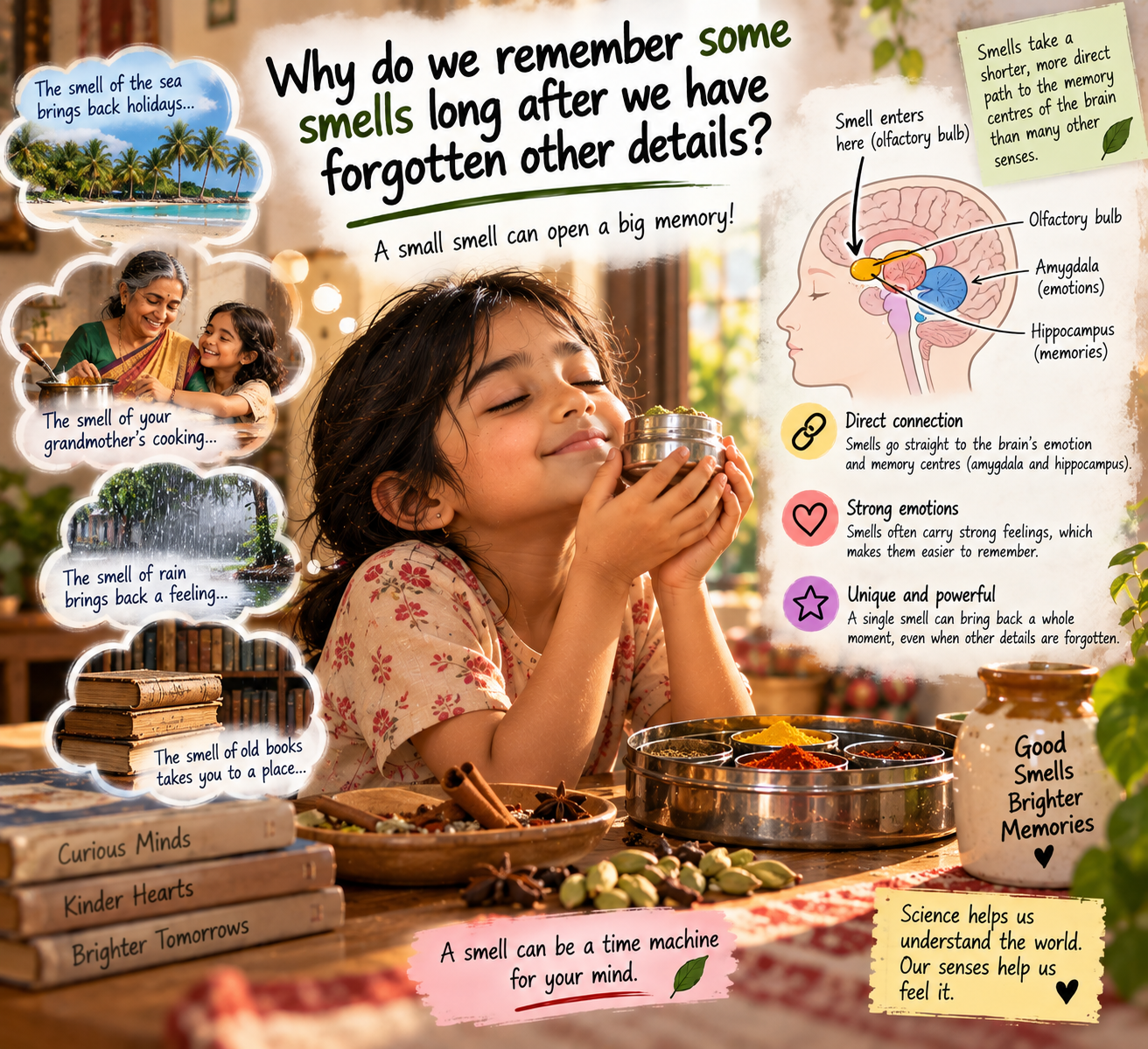
A smell from rain, food, a book or a place can suddenly unlock a vivid memory.
Aha moment: Something invisible can carry powerful personal meaning.
The larger inquiry remains:
Why can something invisible become such a powerful carrier of memory?
CONTENT — What am I learning?
Smell, sensory receptors, brain, memory, emotion, association and retrieval cues.
Prompt:
How does information from smell reach brain systems involved in emotion and memory, and why can a familiar smell trigger an old experience?
CONCEPT — What bigger idea am I discovering?
Memory + Association + Identity
Prompt:
How can sensory experiences become connected with the stories we remember about ourselves?
The child discovers:
Memory is not stored only as facts; experiences can become connected with sensations, emotions and places.
CONTEXT — Why and where does this matter?
Local context:
Which smells around my home, school or neighbourhood immediately remind me of particular people, places or experiences?
Global context:
How can food, spices, rain, plants, festivals and places carry different memories and meanings for people around the world?
CONNECTION — Where else can this learning travel?
Biology: senses and brain
Psychology: memory
Language: sensory writing
Art: representing memory
Culture: food and identity
History: personal and collective memory
Connection prompt:
How can the same smell be chemically similar yet emotionally mean something completely different to two people?
Quotients triggered
CQ: Why can a smell unlock a memory so quickly?
BQ: Can my experiences become valuable material for learning?
AQ: Can different sensory routes help me remember or understand?
ReQ: Which memory did this sensation bring back?
RQ: How does my past influence what I notice and feel now?
MQ: Which sensory experiences help shape my sense of home and identity?
ResQ: Can memories help me recognise how I have grown?
SoQ: How do other people’s memories differ from mine?
ERQ: How can a sensory cue change my emotional state, and how can I respond to it?
Nature’s Lesson 22 — Why does one person’s yawn make another person yawn?
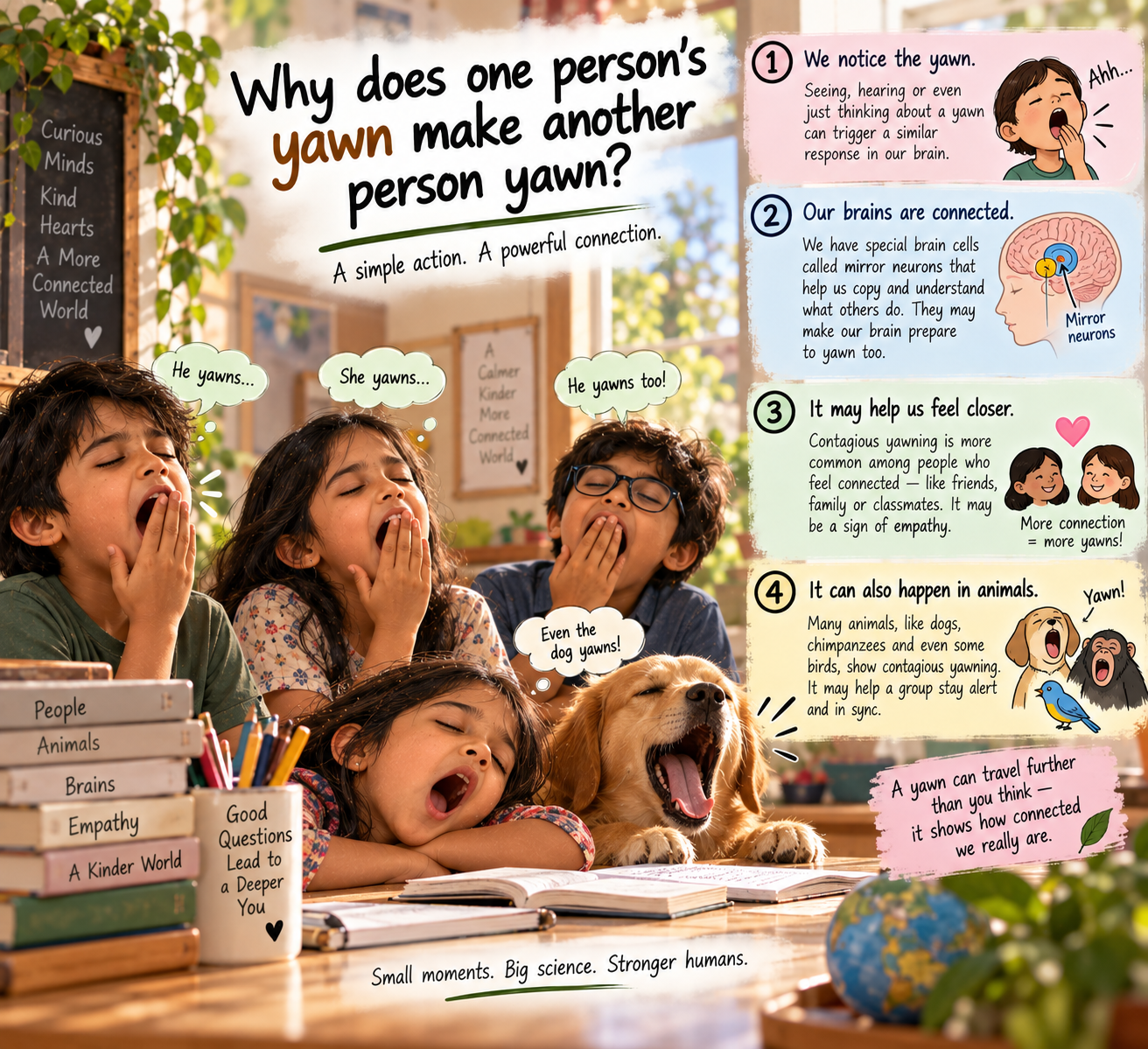
One person yawns and sometimes another soon follows.
Aha moment: Even apparently private bodily behaviours can be influenced by what we observe in other people.
The deeper inquiry remains:
If yawning can spread through a group, what else can spread—laughter, fear, confidence, kindness, panic?
CONTENT — What am I learning?
Yawning, observation, social behaviour, attention, imitation and the still-investigated mechanisms of contagious yawning.
Prompt:
What evidence suggests that seeing or hearing another person yawn can increase the likelihood of yawning, and what do scientists still not know about why this happens?
CONCEPT — What bigger idea am I discovering?
Influence + Connection + Behaviour
Prompt:
How can being around other people influence our behaviour even when nobody deliberately tells us what to do?
The child discovers:
Human behaviour emerges partly through interactions with other people, not only from isolated individual choices.
CONTEXT — Why and where does this matter?
Local context:
What behaviours, emotions or habits seem to spread within my classroom, friendship group or family?
Global context:
How can ideas, emotions and behaviours spread rapidly through large groups, communities and digital networks?
CONNECTION — Where else can this learning travel?
Biology: nervous system and behaviour
Psychology: social influence
Mathematics: patterns of spread
Language: communication
Digital studies: online behaviour
Health: emotional climates
Connection prompt:
If behaviour can influence behaviour, what responsibility do we have for what we contribute to a group?
Quotients triggered
CQ: Why do I sometimes yawn after seeing someone else yawn?
BQ: Can I influence a group positively through my own actions?
AQ: Can I choose a different response from the behaviour around me?
ReQ: What behaviours do I notice myself copying?
RQ: How much of what I do is influenced by the people around me without my noticing?
MQ: What kind of influence do I want to have?
ResQ: Can positive behaviours spread during difficult situations?
SoQ: How does a group’s behaviour affect each member?
ERQ: If fear or anxiety can spread, how might calm spread too?
Nature’s Lesson 23 — Why do people naturally create paths across grass even when a pavement already exists?
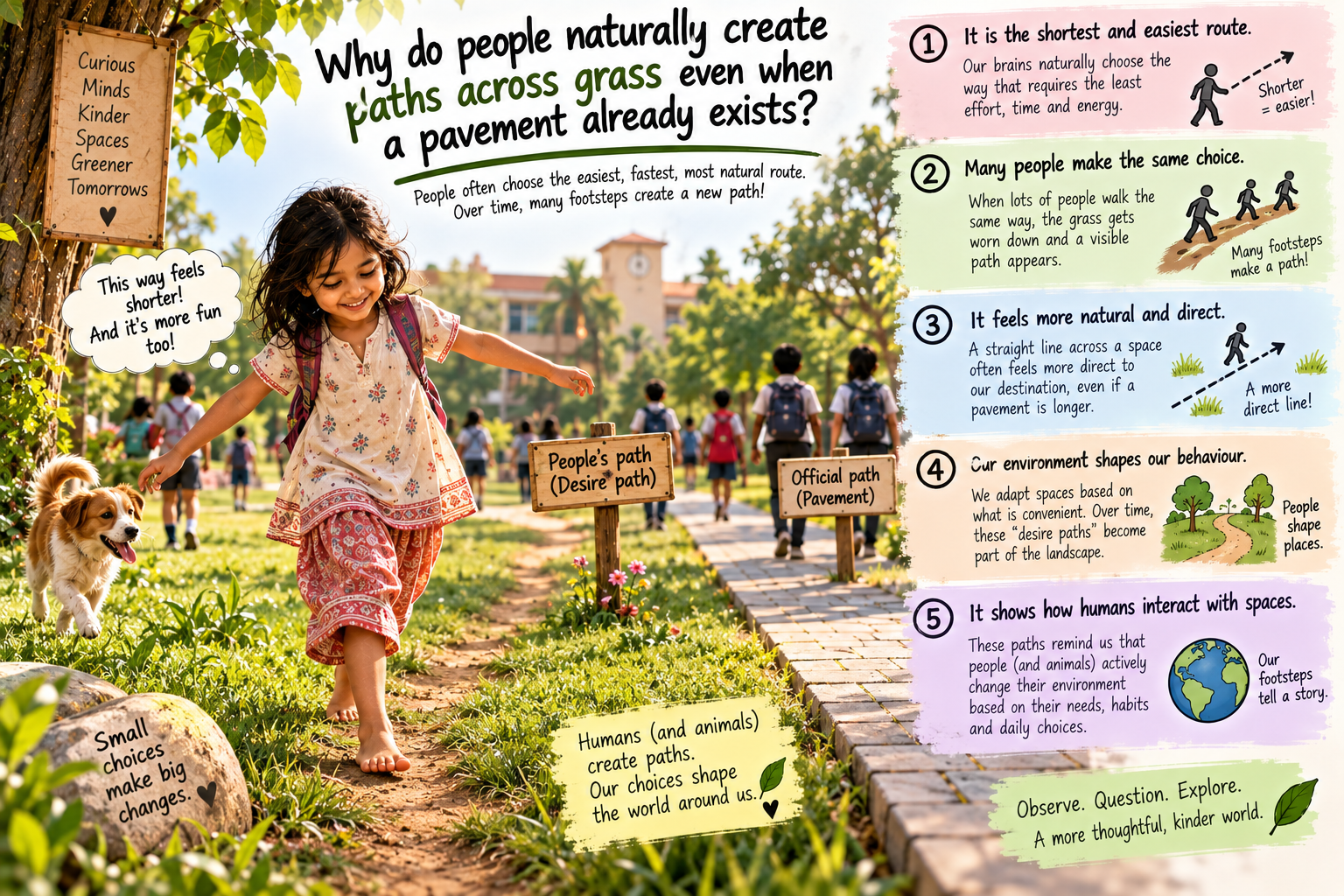
People sometimes create informal “desire paths” because the designed route and the route they actually want do not match.
Aha moment: A system can look well designed on paper yet fail to match the behaviour or needs of the people using it.
The conceptual question remains:
What happens when the system someone designs is different from the path people actually need?
CONTENT — What am I learning?
Human movement, desire paths, distance, efficiency, behaviour, planning, design and user needs.
Prompt:
What makes people choose an unofficial route rather than the path that was deliberately designed for them?
CONCEPT — What bigger idea am I discovering?
Systems + Design + Human Behaviour
Prompt:
Should good design tell people how to behave, or should observing people’s behaviour help improve the design?
The child discovers:
Good systems are strengthened when designers observe how people actually use them, not only how they were expected to use them.
CONTEXT — Why and where does this matter?
Local context:
Are there informal shortcuts around my school, park or neighbourhood? What do they reveal about the official design?
Global context:
How do architects, transport planners and designers around the world use evidence about human behaviour to create more usable spaces?
CONNECTION — Where else can this learning travel?
Geography: movement through space
Mathematics: shortest routes and distance
Design: user-centred design
Social Studies: public spaces
Psychology: decision-making
Environmental studies: impact on grass and soil
Connection prompt:
Where else might people create their own solution when the official system does not match their needs?
Quotients triggered
CQ: Why do people ignore the pavement?
BQ: Can my observation expose a design problem adults may have overlooked?
AQ: Should the people change or should the design change?
ReQ: Which route would I choose and why?
RQ: Do I assume that breaking the intended pattern always means the user is wrong?
MQ: How do the designs around me influence my choices every day?
ResQ: Can systems improve after people reveal their weaknesses?
SoQ: How should different users’ needs be considered together?
ERQ: Can I respond constructively when a system frustrates me?
Nature’s Lesson 24 — Why does traffic sometimes stop even when there has been no accident?
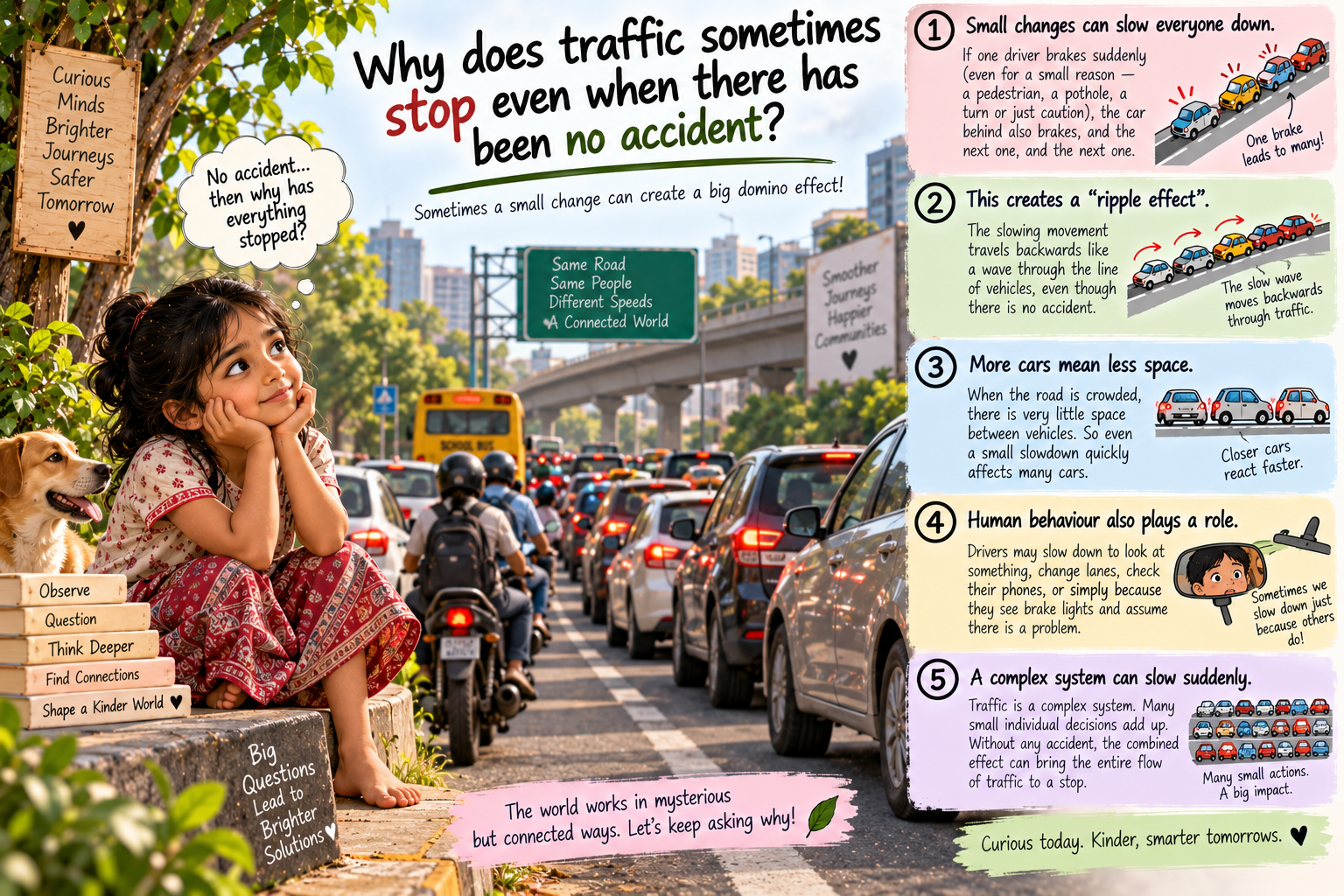
A line of vehicles may suddenly slow or stop without any visible obstacle.
Aha moment: A problem can emerge from the interaction of many individuals even when no single person intended to create it.
The deeper conceptual question remains:
Can many individually sensible actions together create a problem that nobody intended?
CONTENT — What am I learning?
Traffic flow, density, reaction time, braking, following distance, bottlenecks, waves and collective behaviour.
Prompt:
How can one small change in speed travel backwards through a line of vehicles and create a traffic jam even when the road ahead is clear?
CONCEPT — What bigger idea am I discovering?
Systems + Emergence + Cause and Effect
Prompt:
How can interactions between many small actions produce a large result that no individual planned?
The child discovers:
Some problems belong to the behaviour of the whole system rather than to one obvious cause.
CONTEXT — Why and where does this matter?
Local context:
Where and when does traffic build up around my school or neighbourhood, and what patterns can I observe besides accidents?
Global context:
How are cities around the world responding to congestion through public transport, road design, data, cycling, walking and different patterns of urban planning?
CONNECTION — Where else can this learning travel?
Physics: motion
Mathematics: rates, graphs and modelling
Geography: transport networks
Design: roads and mobility
Social Studies: public infrastructure
Environmental studies: emissions and congestion
Connection prompt:
Where else can many small individual choices combine to create a large collective outcome?
Quotients triggered
CQ: How can traffic exist without an obstacle?
BQ: Can I understand a complex system by looking for patterns?
AQ: How could changing one behaviour improve the whole system?
ReQ: Was I searching for one obvious cause when the cause was distributed?
RQ: Why do I naturally want to blame one person for a system-level problem?
MQ: How do my family’s travel choices contribute to larger patterns?
ResQ: How can systems recover after disruption?
SoQ: How can cooperation improve something everyone shares?
ERQ: How can understanding the system change the way I react when I am stuck in it?
Nature’s Lesson 25 — Why can two people standing in the same place notice completely different things?
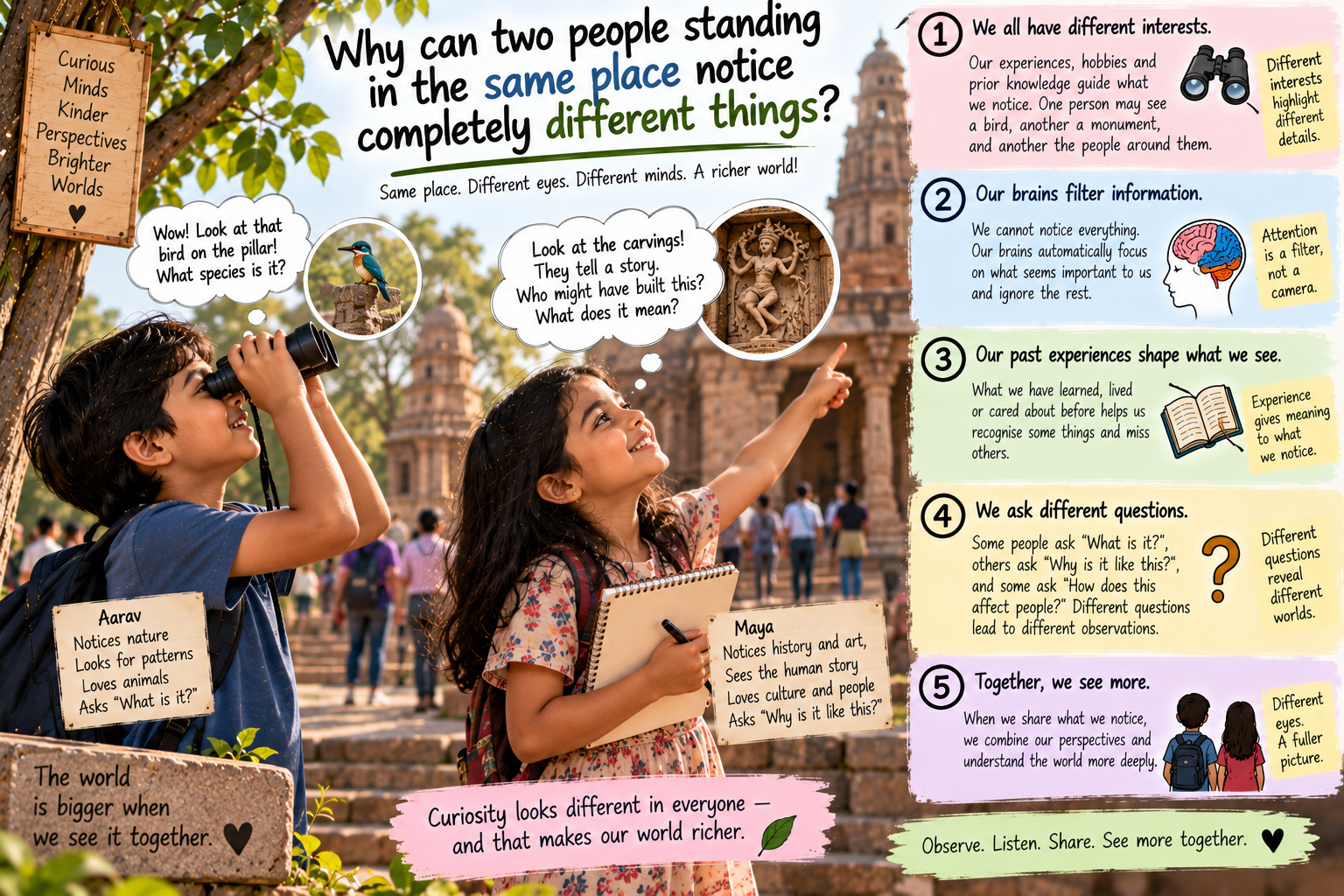
One child notices the bird. Another notices the building. Another notices the noise.
Aha moment: Looking at the same world does not guarantee noticing the same world.
The conceptual question remains:
Do we experience the world exactly as it is—or partly through what our minds are prepared to notice?
CONTENT — What am I learning?
Attention, perception, sensory information, prior knowledge, expectations, selective attention and perspective.
Prompt:
What determines which information our attention selects from everything happening around us at the same moment?
CONCEPT — What bigger idea am I discovering?
Perspective + Perception + Interpretation
Prompt:
How can two people experience the same event differently without either necessarily lying or being careless?
The child discovers:
What we notice is shaped not only by what is present, but also by where our attention, experience and expectations are directed.
CONTEXT — Why and where does this matter?
Local context:
If several learners observe the same school space for one minute, what does each person notice and what does each person miss? Why might their observations differ?
Global context:
Why can people from different experiences, professions, cultures or circumstances interpret the same event, place or problem differently?
CONNECTION — Where else can this learning travel?
Psychology: attention and perception
Science: observation and evidence
Language: narrator and viewpoint
Art: perspective
History: multiple accounts of an event
Media: framing and selection
Connection prompt:
If my perspective helps me see some things but may hide others, whose perspective could help me notice what I am missing?
Quotients triggered
CQ: What did another person notice that I completely missed?
BQ: Can I become a more careful observer?
AQ: Can I deliberately change my lens and look again?
ReQ: How did my first observation change after hearing someone else’s?
RQ: What in my own experience, interests or assumptions guided what I noticed?
MQ: Why does understanding perspective matter in my relationships and decisions?
ResQ: Can I continue thinking when another perspective unsettles my first conclusion?
SoQ: How can other people’s perspectives enlarge what I know?
ERQ: Can I hear a different interpretation without immediately becoming defensive?
“The ordinary becomes extraordinary the moment a child stops merely seeing the world and begins questioning it.”-Mindgle
How the 4C–Q Inquiry Compass Coheres with IB PYP Transdisciplinary Themes
1. What are PYP Transdisciplinary Themes?
In the IB PYP, the six transdisciplinary themes—Who We Are; Where We Are in Place and Time; How We Express Ourselves; How the World Works; How We Organize Ourselves; and Sharing the Planet—are broad lenses for exploring significant ideas that do not belong to only one subject. They help learners connect knowledge across disciplines, work with concepts, and investigate issues that have both local and global significance. IB examples show that a theme such as How the World Works may explore patterns, causation, change and human responses, while Sharing the Planet may explore connections between local and global issues, living things, environmental impact and responsibility.
2. Why does the 4C–Q Inquiry Compass cohere with this?
The 4C–Q Inquiry Compass is a Mindgle architecture, not an IB framework, but it fits naturally with transdisciplinary inquiry because it gives the learner a clear route into the kind of thinking the themes require. Content asks, What is actually happening and what knowledge do I need? Concept asks, What bigger transferable idea is hidden here? Context asks, Why does this matter, where does it matter and to whom does it matter—locally and globally? Connection asks, Where else can this learning travel across subjects, situations and perspectives? The Quotient Mirror then brings the inquiry back to the learner: What did this inquiry awaken, challenge or change in me? In other words, the transdisciplinary theme gives the learner the broad world-facing lens, while 4C–Q gives the learner a thinking route for travelling through that lens.
3. How do the real-life questions fit categorically into the themes?
Questions such as “Why does a puddle disappear?” “Why does a plant bend toward light?” “Why does ice float?” naturally sit within How the World Works because they investigate natural processes, causation, structure and change. Questions such as “Why do birds choose some gardens?” “Why does fruit rot while plastic remains?” and “Why does rain behave differently on soil and pavement?” connect strongly with Sharing the Planet because they involve habitats, resources, interdependence and environmental responsibility. “Why does one person’s yawn make another person yawn?” and “Why can two people in the same place notice different things?” can sit within Who We Are, as they explore behaviour, perception and relationships. “Why does traffic stop without an accident?” and “Why do people create paths across grass?” fit How We Organize Ourselves, because they reveal systems, design and collective behaviour. “Why do smells bring back memories?” and questions about sound, image and interpretation can open into How We Express Ourselves, while questions about how people use shadows, places, journeys and changing environments can connect with Where We Are in Place and Time. The power is that the question is not trapped inside one theme; the theme changes the lens, and the learner sees more.