Mindgle can be understood as a contemporary operationalisation of Rabindranath Tagore’s educational philosophy for the age of AI. Tagore resisted education that filled passive minds with second-hand information. He imagined learning as a living relationship among the learner, nature, culture, work, creativity, other people and the continuing pursuit of truth. Mindgle converts this philosophy into a visible inquiry architecture: lived experience creates a stimulus; the stimulus awakens wonder; wonder becomes a raw question; DISCOVER AI subjects that question to definition, evidence, assumptions, exceptions, silences, perspectives, scale and possibility; and the learner finally earns a Refined Inquiry Question. The RIQ is therefore not merely a finished question. It is evidence of how the learner has learned to know.
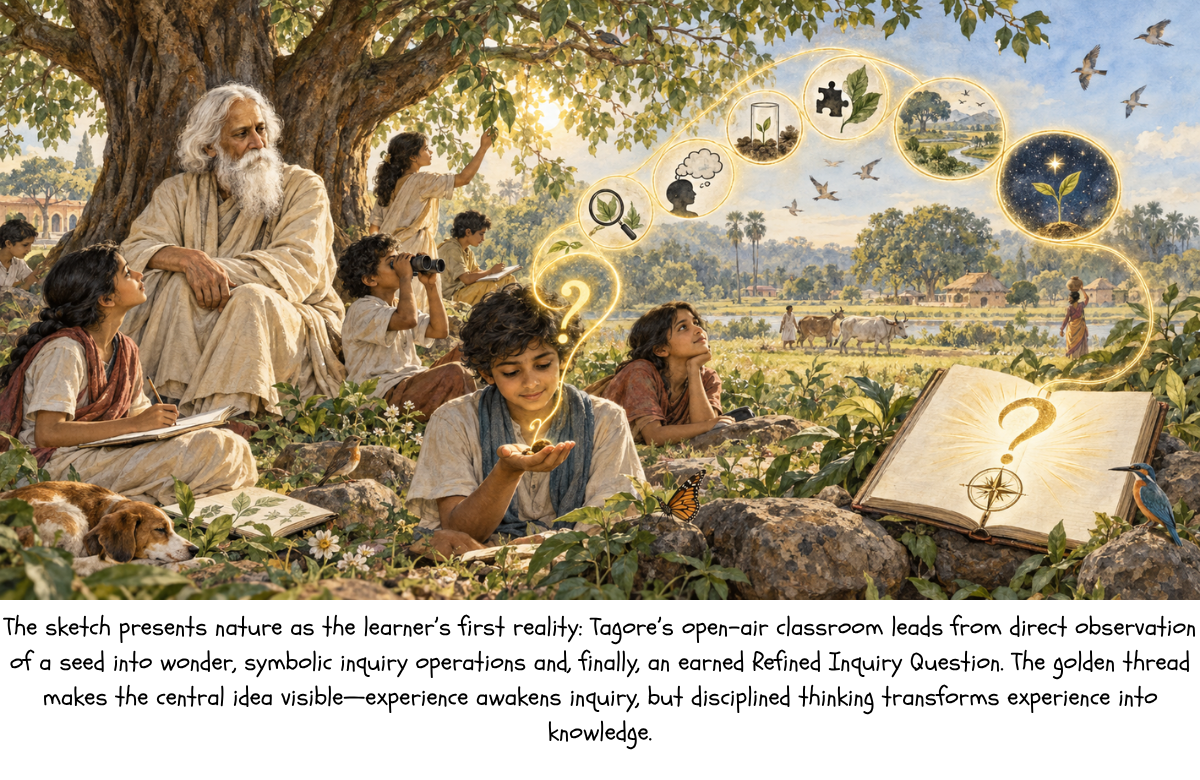
Tagore regarded nature not as scenery surrounding education, but as the learner’s first living reality—a world to be observed, felt, experienced and understood before it was reduced to information in a textbook. At Santiniketan, learning beneath trees, through seasons, art, movement, dialogue and community life dissolved the artificial wall between school and the world. Mindgle carries this Tagorean philosophy into a systematic inquiry architecture: the learner first encounters reality as a stimulus, notices a pattern, tension or surprise, and allows that experience to awaken wonder. DISCOVER AI then guides the learner to define language, examine what is actually happening, surface assumptions, test exceptions and reversals, expose what is missing, rotate perspectives and explore scale and possibility before earning a Refined Inquiry Question. Thus, nature and lived experience do not merely illustrate knowledge; they provoke its construction. Tagore returned the learner to reality, while Mindgle makes visible how the learner questions that reality until experience becomes disciplined inquiry.
Tagore did not use the modern terms Universal Design for Learning, metacognition or epistemic humility. UDL was developed by CAST many decades later. The academically accurate claim is that Tagore’s philosophy anticipated principles now expressed through these frameworks, while Mindgle makes those principles explicit, systematic and usable. CAST’s history of UDL
At Santiniketan and Sriniketan, Tagore refused to separate learning from living. Learners studied outdoors and learned through nature, music, painting, drama, festivals, craft, gardening, agriculture, community relationships and productive work. Visva-Bharati describes his belief that learning through activity is more real than learning confined to the written word and records how classroom study was connected with kitchens, gardens, weaving and everyday village life. Visva-Bharati’s educational ideas A brief history of Visva-Bharati
Mindgle begins in the same place: not with an assigned research question, but with something the learner observes, experiences, reads, hears, measures or finds troubling. However, Mindgle does not treat experience as automatic proof. A learner may experience something sincerely and still interpret it incompletely. DISCOVER AI therefore asks: What exactly happened? What am I assuming? Is there an exception? Could cause and effect run in reverse? Whose experience is missing? Would the pattern survive in another context? Experience supplies the raw material of inquiry; disciplined reflection transforms it into defensible knowledge.
Tagore recognised that learners do not encounter knowledge through words alone. He combined intellectual study with movement, music, visual art, performance, craft, nature, conversation and practical activity. He also valued the mother tongue, cultural context, sensory engagement and freedom of expression. These practices anticipated what UDL now formalises as multiple means of engagement, representation, and action and expression. CAST UDL Guidelines
Mindgle follows this principle through coherence without uniformity. Every learner travels through the same rigorous architecture, but the operations change authentically across disciplines, cultures, abilities and circumstances. For example, Expose the Silence may reveal missing voices and stakeholders in history, but in mathematics it may reveal missing units, domains, scales, conditions or representations. A learner may enter inquiry through a story, graph, object, conflict, experiment, image or lived experience and may make thinking visible through writing, dialogue, diagrams, models, performance or design. Thus, the intellectual destination remains rigorous while the routes into and through learning remain flexible.
Mindgle may therefore be described as UDL-aligned, but the inquiry architecture alone should not be presented as complete UDL implementation. Full UDL also requires proactive accessibility, barrier removal, suitable technologies and deliberately inclusive materials.
Tagore did not imagine the teacher as the final owner of truth. In An Eastern University, he wrote that “a teacher can never truly teach unless he is still learning himself.” He envisioned the educational institution as a community of seekers engaged in the continuing pursuit of truth and open to knowledge from other cultures. His ideal was neither the unquestioning acceptance of the West nor the defensive glorification of India, but reciprocal intellectual hospitality—a willingness to offer one’s knowledge and receive what others know. Tagore, Creative Unity: An Eastern University
Mindgle turns this humility from a desirable attitude into a repeatable intellectual practice:
Epistemic humility in Mindgle does not mean doubting everything or lacking confidence. It means having the intellectual courage to identify what one does not yet know, test what one thinks one knows and revise a question or claim when better evidence demands it. The RIQ remains open and evidence-ready because the learner has not pretended to know the answer before the inquiry begins.
Tagore criticised education that treated the mind like a shelf to be loaded with borrowed information. He viewed the mind as both receptive and productive: it receives the world but must also interpret, connect, create and express. Knowledge becomes alive when learners participate in its construction rather than merely repeating its authorised form.
Mindgle develops this into explicit metacognition. At every stage, the learner examines not only the subject but also their own process of knowing:
Why did this experience make me wonder? Which word shaped my first interpretation? What did I assume? What evidence changed my thinking? Which perspective had I overlooked? Why did my raw question need to be narrowed, widened or reconstructed?
Because the learner can trace the movement from stimulus to raw question and from raw question to RIQ, thinking becomes observable, discussable and revisable. The learner does not merely know more about the topic; the learner understands how their own knowing was produced, limited and improved.
This is where Tagore, Mindgle and heutagogy meet most powerfully. Tagore sought the freedom of mind; heutagogy places the learner in meaningful control of learning; and Mindgle provides the intellectual discipline that prevents learner freedom from becoming directionless activity. The teacher creates conditions, offers knowledge and challenges reasoning, but does not hand the learner a sophisticated question as a finished product. The learner identifies the knowledge gap, selects relevant lenses, recognises limitations, seeks evidence, monitors thinking and defends the final RIQ. Agency therefore means more than choosing a topic: it means accepting responsibility for how knowledge is constructed.
Tagore gives Mindgle its philosophical soil; Mindgle gives Tagore’s educational ideals a contemporary and auditable inquiry grammar. In the age of AI, the connection becomes especially significant: experience awakens the question, Natural Intelligence frames and tests it, AI extends its reach, and the learner remains the responsible author of knowing.
Tagore taught that knowledge must remain alive; Mindgle makes visible how learners keep it alive—by experiencing, questioning, testing, revising and finally owning it.