One thinking architecture across disciplines, places and learner realities
By the end of this module, Mindgleians will use Natural Intelligence and DISCOVER AI to construct, adapt and own purposeful RIQs across disciplines, grades, places and learner realities.
Mindgle: Inquiry Without Borders begins from the belief that the ability to ask a powerful question should not depend on a learner’s subject, location, language or access to a conventional classroom. Its single thinking architecture helps learners move from stimulus and wonder to a purposeful Refined Inquiry Question, while adapting the inquiry to the reality in which the learner is situated. Across disciplinary borders, the same question may be examined mathematically through patterns, scientifically through mechanisms, historically through causation, artistically through representation and ethically through consequences. Across geographical and educational borders, the architecture travels with refugee, nomadic, migrant and Indigenous learners without treating their knowledge, mobility or cultural identity as deficits. Natural Intelligence remains the starting point: learners observe, remember, question, connect and judge before AI helps widen the investigation. The architecture is therefore shared, but the inquiry is never standardised; its language, evidence, perspectives and purpose grow from each discipline and learner reality. One architecture creates coherence, while its adaptability ensures that every learner retains ownership of the question.
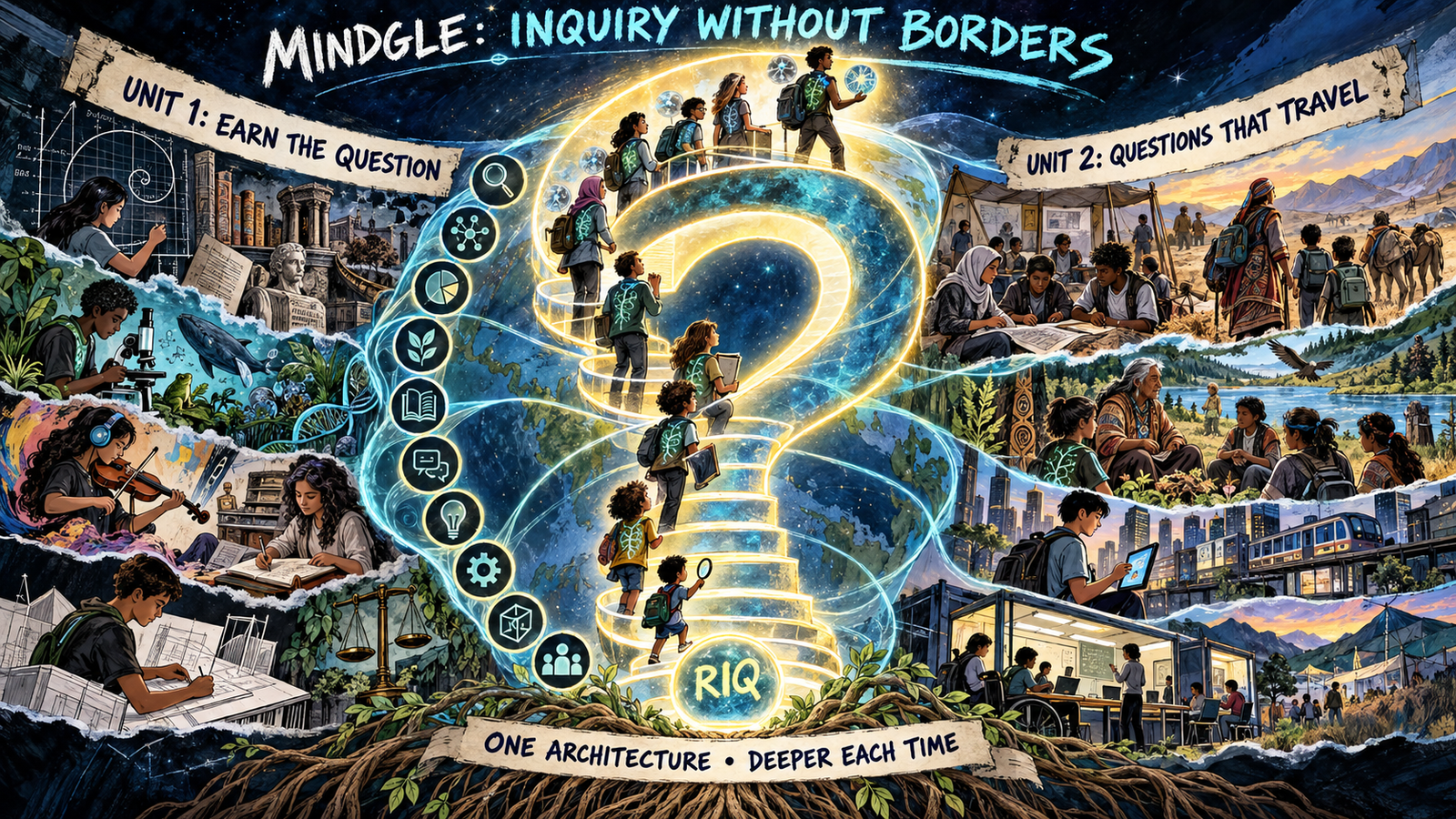
The central question-mark spiral represents one recognisable inquiry architecture revisited with increasing depth, autonomy, evidence and intellectual responsibility. Unit 1: Earn the Question carries learners across disciplinary borders, while Unit 2: Questions That Travel carries inquiry across mobility, displacement, Indigenous knowledge contexts and interrupted classrooms. The glowing RIQ remains rooted in each learner’s reality: the architecture stays, while the learner, context and depth evolve.
The module contains two connected units designed for review across grade levels rather than assignment to one fixed grade. Unit 1—Earn the Question revisits the complete Step 1 journey and shows how DISCOVER AI helps learners construct an RIQ across mathematics, sciences, humanities, languages, arts, design and interdisciplinary learning. Unit 2—Questions That Travel with the Learner applies the same architecture through adaptable prompts for learners experiencing mobility, displacement, dispossession, cultural marginalisation or interrupted schooling. The module remains grade-flexible because inquiry develops spirally: a younger learner may define a term, identify an observation and notice a missing voice, while an older learner can interrogate causality, compare disciplinary explanations, expose assumptions, evaluate ethical consequences and establish precise boundaries. Revisiting the architecture across grades does not mean repeating the same task; it means returning with greater knowledge, independence and intellectual responsibility. This continuity is especially important for learners whose education has been interrupted or distributed across different settings, because they can re-enter the inquiry journey without being treated as deficient. The architecture remains recognisable; the depth, evidence, autonomy and complexity evolve with the learner