Enter a space where peace begins not with agreement, but with the courage to question conflict narratives without surrendering evidence, human dignity or intellectual independence.
Every big idea ultimately leads to one enduring realisation
The Inner Ideas reveal the intellectual architecture beneath each Big Idea-Total 12 teaching hours
Build the Defences of Peace inside Your Inquiry
By the end of this module, Mindgleians will learn to transform emotionally loaded raw questions into humanising RIQs; distinguish people from governments and armed actors; detect dehumanisation and collective blame; verify and triangulate evidence; expose missing voices and power; test assumptions, counterclaims and alternative explanations; apply consistent ethical standards; and turn defensible knowledge into responsible peace action.
Recognise the narrative
See the system
Design and Humanise the inquiry
Construct Defensible Knowledge
Central Proposition
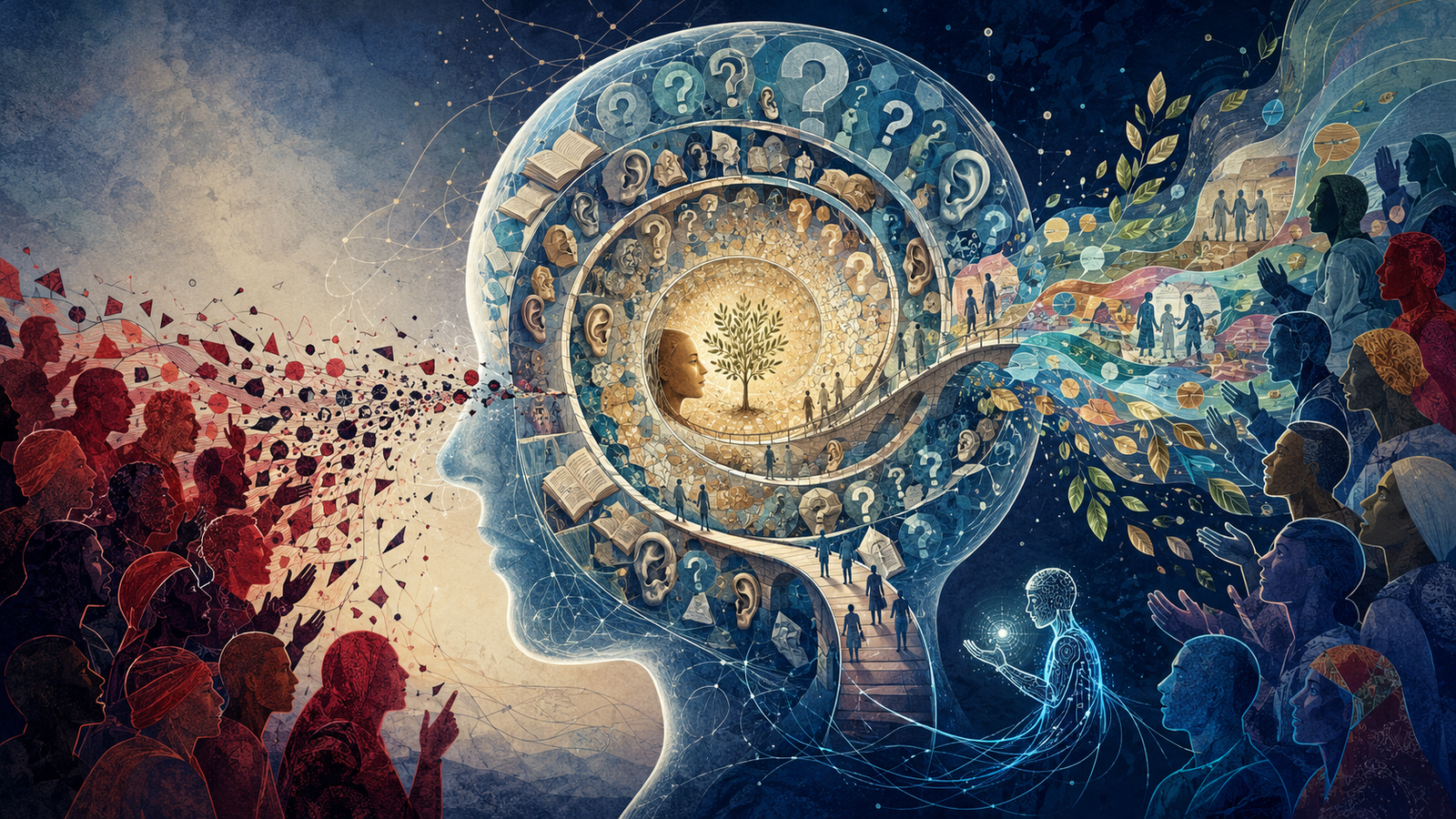
Peace education should not hand learners a political side or a conclusion to repeat; it should develop the intellectual courage, emotional steadiness and ethical judgement to question every narrative before fear turns difference into hatred—and another human being into an enemy.
When Inquiry Becomes Peace-Building: “Since wars begin in the minds of men, it is in the minds of men that the defences of peace must be constructed.” – Constitution of UNESCO
Before learners believe or share a conflict narrative, they should be able to ask:
What happened?
How do we know?
Who is making this claim?
What evidence supports it?
Which words influence how I feel?
Whose voice is present, and whose is missing?
What happened before this event?
Who holds power, and who experiences its consequences?
What remains uncertain?
What evidence could change my mind?
Peace is therefore more than the absence of war. It requires the continuing protection of human dignity, rights, truth, justice, safety, dialogue and the possibility of living together without violence or dehumanisation.
Afghanistan, Iraq, Iran and Israel–Palestine are introduced as different cases of disrupted peace. They must not be treated as identical conflicts or used to decide which population deserves greater sympathy. They help learners examine how history, identity, fear, power, intervention, resistance, propaganda, law, exclusion and lived experience interact differently within complex systems.
Mindgle gives learners the inquiry architecture for this work. Natural Intelligence must first frame the question, recognise assumptions, humanise the people involved and judge the evidence. Artificial Intelligence may then extend the investigation—but it must not decide what is true, ethical or worthy of belief for the learner.
Across Grades 7–10, learners will explore:
Grade 7 — Recognise the Narrative before you believe a conflict Narrative Peace, conflict and how narratives are constructed
Loaded-language, assumptions and bias audits
Dehumanisation, stereotyping and collective blame
Grade 8 — See the System Global cases of disrupted peace
Root causes, consequences and feedback loops
Missing voices, power, human rights and humanitarian ethics
Grade 9 — Design and Humanise the Inquiry Raw Question → Refined Inquiry Question
Source triangulation across evidence and perspectives
Responsible NI–AI collaboration through DISCOVER AI by questioning the conflict rigorously without losing sight of the human being inside it
Grade 10 — Construct Defensible Knowledge RIQ → Initial Knowledge Claim → Robust Knowledge Claim
Counterclaims, alternative explanations and knowledge evolution
Evidence-informed dialogue, ethical judgement and peace action
Related Learning
Similar Courses
Explore more courses related to this learning path.
Grade 7Teaching hrs=3
Module 3: Mindgle Peace Architecture- Unit 1- Before you build a Conflict Narrative
Focus-Inquiry Language and Readiness
Recognise the Narrative before You believe a Conflict Narrative
Essential Glossary: Peace, Conflict, Power, People, and Human Dignity