A human-centred framework designed for the age of Artificial Intelligence — strengthening the thinking, ethics, and wisdom that machines cannot replace.
""Natural Intelligence created Artificial Intelligence. Therefore, the human mind must remain the primary architect of inquiry.""
Mindgle is a human-centred inquiry framework designed for the age of Artificial Intelligence. Created to address one of the most pressing educational challenges of our time: how do we strengthen human thinking, agency, ethics, and reflection in a world where information is abundant and AI is increasingly capable?
Mindgle teaches learners to think before they search, reflect before they respond, and inquire before they conclude. Rather than treating AI as a replacement for thinking, Mindgle positions it as a collaborative partner — guided by disciplined human cognition, emotional intelligence, and ethical reasoning.
Inspired by UNESCO, OECD Learning Compass, NEP 2020, and Tagore’s Visva-Bharati philosophy, Mindgle is intentionally designed as a school-embedded framework — scalable, sustainable, and adaptable across diverse educational systems worldwide.
The true game changer in Mindgle is the inquiry incubation hub within the learner’s own mind, where the first raw question is slowed down, refined, challenged, and evolved through self-driven inquiry before being fed into the external research engine. If Mindgle remained only philosophical language like “think deeper” or “inquire meaningfully,” it would become inspirational but not operational. What gives it strength is that you are beginning to define the process structurally, almost computationally, through equations, variables, constraints, and optimization logic. That transforms the framework from motivational theory into a measurable cognitive model.
Mindgle converts meaningful inquiry from an abstract educational ideal into a structured cognitive optimization process with measurable inquiry variables.
The Mindgle framework can be understood as a Linear Programming Problem (LPP)-like cognitive optimization model operating under a stipulated time constraint.
The learner’s objective function is to maximise the robustness, coherence, ethical depth, contextual understanding, and validity of the final knowledge response rather than merely maximise the quantity of information retrieved.
Maximise:
Z = f (K + C + E + P + J − W)
Where:
Z = The degree of intellectually refined, coherent, ethical, empathetic, compassionate, justified, and contextually meaningful knowledge constructed by the learner. Z represents the learner’s optimized knowledge outcome — a response that is intellectually refined, logically coherent, ethically grounded, empathetically evaluated, compassionately aware, contextually meaningful, and justified through evidence and reasoning.
Subject to constraints:
The decision variables in this optimization process are:
The decision variables in the Mindgle Knowledge Optimization Model are the controllable cognitive and inquiry-based elements that directly influence the quality of the final response under time constraints.
The Mind Spider performs the internal optimization stage by refining and encoding the inquiry before the AI Spider begins external searching. The AI Spider then accelerates exploration, synthesis, comparison, and refinement based on the cognitively optimized inquiry generated by the learner.
Thus, the learner is not merely retrieving information but solving a constrained cognitive optimization problem where the aim is to generate the most intellectually refined response possible within real-world time limitations.
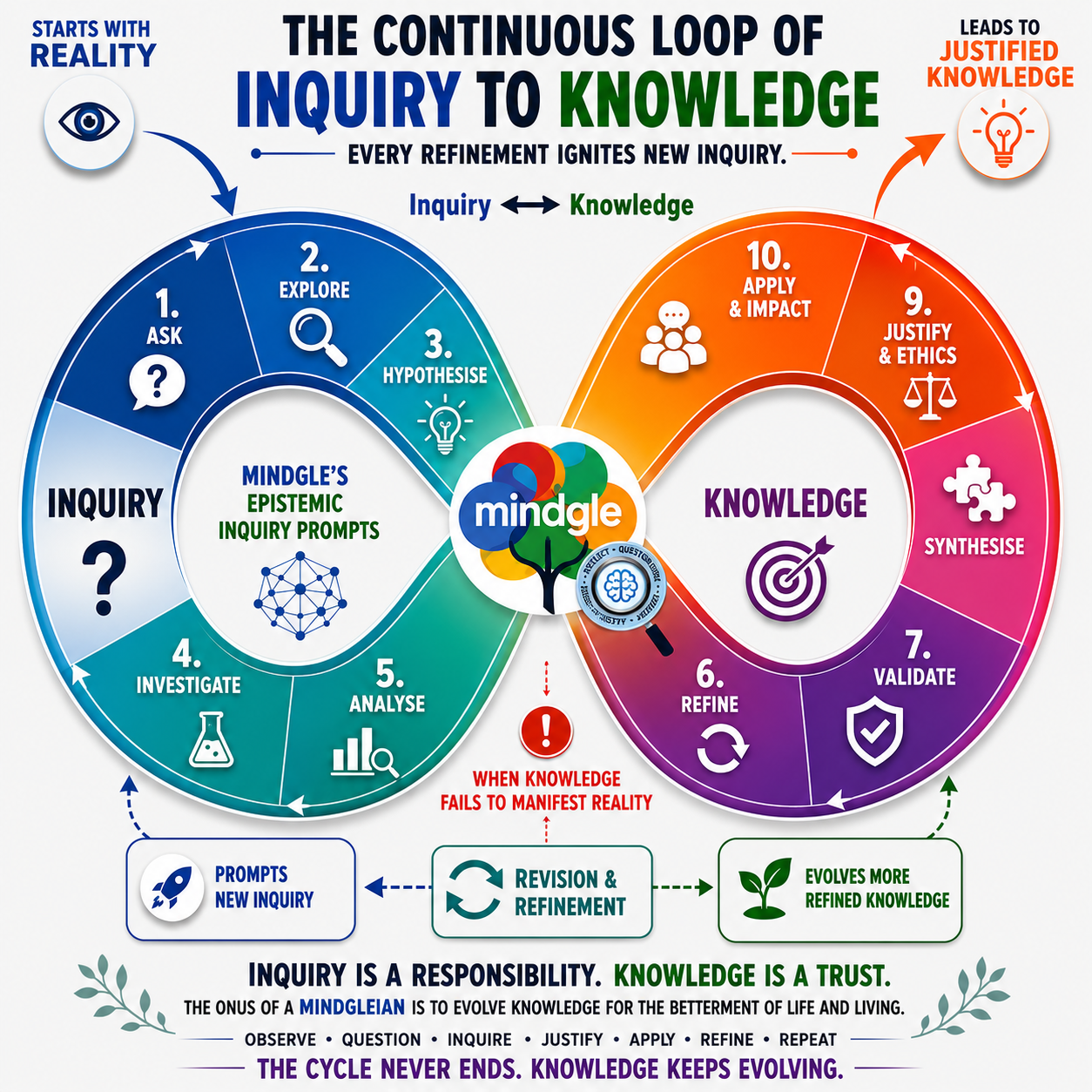
A conventional learner searches for answers. A Mindgleian develops a cognitive DNA of inquiry through the Theory of Inquiry (TOI), learning every concept with the mindset of a researcher rather than simply memorising conclusions. Guided by Mindgle’s Epistemic Inquiry Prompts, learners construct, question, justify, validate, and refine knowledge meaningfully—even within the time constraints of competitive examinations. Every inquiry progresses from reality through evidence, theory testing, ethical reflection, responsibility, and intellectual obligation to construct justified knowledge with real-world relevance. A Mindgleian recognises that knowledge is not merely to be acquired but to be evolved responsibly for the betterment of life, living, and society. As reality reveals new evidence, every refined understanding gives birth to new curiosities, deeper inquiries, and more trustworthy knowledge, making inquiry a lifelong responsibility.
Inquiry is the disciplined, systematic, and purposeful process of investigating reality to construct, justify, and refine trustworthy knowledge.
It begins with wonder, transforms curiosity into a meaningful and researchable question, systematically gathers and evaluates evidence, and develops evidence-based knowledge claims that are continuously tested, challenged, and refined until they represent the best current explanation of the phenomenon under investigation. Inquiry therefore goes beyond simply asking questions or collecting information—it is the cognitive journey through which humans move from uncertainty to understanding and from observation to robust knowledge.
Mindgle exists to nurture the human mind so that it can consciously and seamlessly activate the cognitive switch of inquiry.
Every human mind possesses the natural capacity to wonder, question, reason, and learn. However, these abilities often remain unstructured. Curiosity is frequently satisfied with the first available answer, automatic thinking replaces deliberate investigation, and information is mistaken for knowledge. Rather than teaching learners what to think, Mindgle teaches them how to inquire—transforming wonder into purposeful investigation through a systematic, evidence-informed pathway. By guiding learners from reality to wonder, from inquiry to knowledge claims, and from critical thinking to robust knowledge, Mindgle develops minds that do not merely consume information but consciously construct, justify, validate, and continually refine their understanding of reality.
Artificial Intelligence has made information abundant, but independent thinking increasingly scarce. Learners today are becoming faster at retrieving answers while gradually losing the ability to construct knowledge through their own inquiry, reflection, conceptual reasoning, and ethical judgement. The challenge for schools and organisations is therefore no longer simply teaching students how to use AI, but ensuring they continue to think as humans in an AI-enabled world.
Mindgle addresses this challenge by teaching learners to think before they prompt. Instead of treating inquiry as an educational buzzword, Mindgle transforms it into a structured, teachable, and measurable cognitive process. Through the Mentelix (Mind Spider), learners master step-by-step frameworks for recognising meaningful issues, identifying research gaps, refining Research Questions, evaluating evidence, challenging assumptions, integrating perspectives, and constructing robust knowledge before engaging with AI. Inquiry therefore becomes a practical intellectual discipline rather than an abstract educational ideal.
For schools and organisations, Mindgle strengthens existing curricula by developing the human capabilities that technology cannot replace—critical inquiry, metacognition, adaptive thinking, learner agency, ethical reasoning, systems thinking, complexity navigation, reflective intelligence, and responsible AI interaction. Rather than preparing learners merely to generate faster answers, Mindgle prepares them to ask better questions, think more deeply, and continuously adapt in an increasingly complex world. It is not simply an AI literacy programme; it is a future-ready human intelligence framework designed to ensure that as artificial intelligence becomes more powerful, human thinking becomes even more powerful alongside it.
Each pillar represents a conscious shift from passive information consumption to active, ethical, and reflective knowledge construction.
Activate internal inquiry before turning to external sources. Mentelix must run first — the internal spider always precedes the external one.
Not mere prompt engineering. Consciously coordinate ethics, perspectives, logic, emotion, and evidence before interacting with AI.
Facts and data are inputs. Knowledge emerges only through interpretation, contextualisation, ethical reflection, and justified reasoning.
Every question carries hidden ethical tensions. A Mindgleian surfaces and examines them before drawing conclusions or seeking external answers.
AI is not the enemy, nor the oracle. It is an accelerated research collaborator — powerful only when guided by refined human inquiry.
Learners consciously design, regulate, and evolve their own inquiry journeys. Theories of learning belong to the learner, not just the institution.
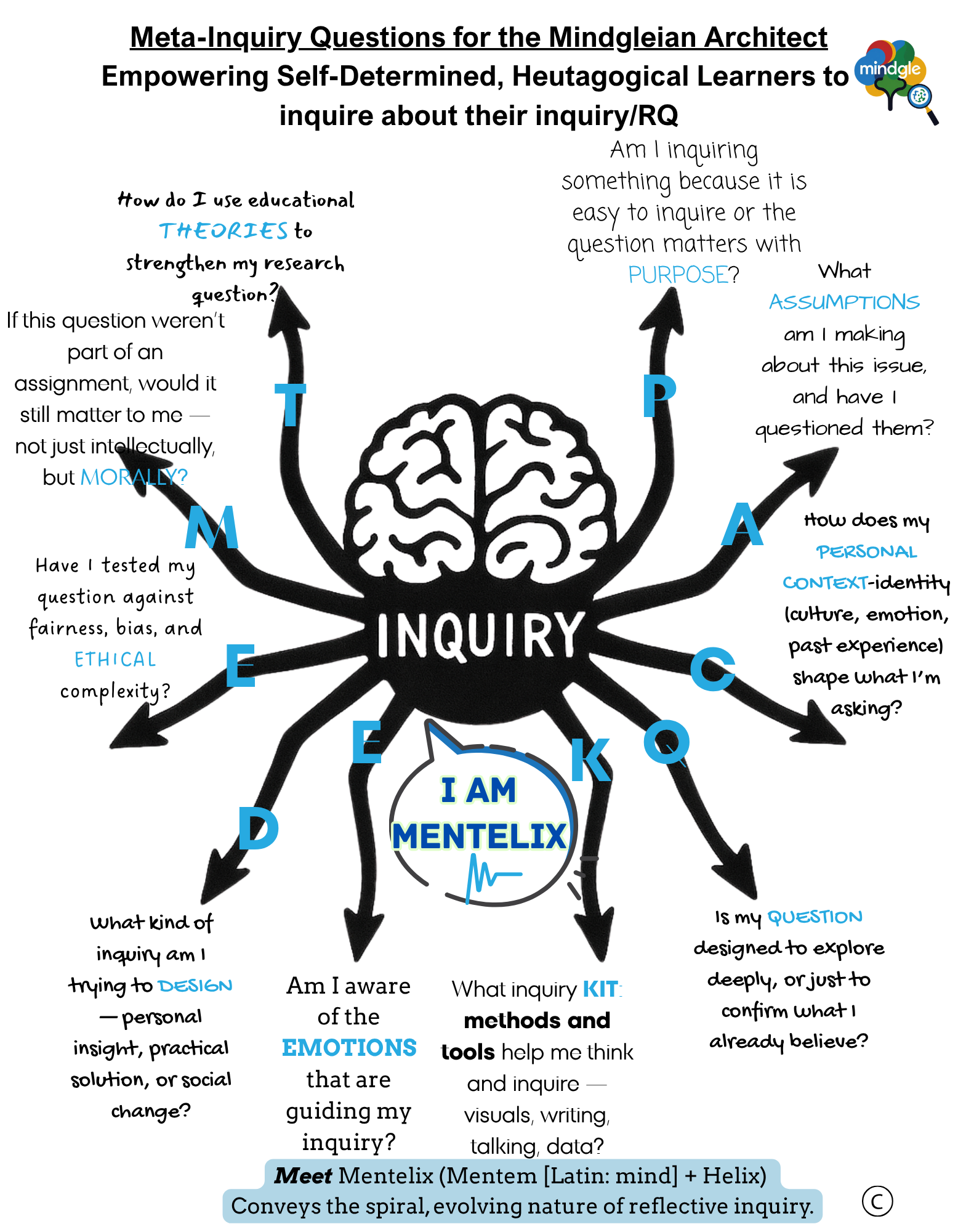
At the centre of Mindgle lies Mentelix — the internal inquiry spider of the learner’s mind. Before any external AI begins searching, the learner first activates Mentelix internally, stretching cognitive threads across multiple dimensions of human understanding.
Mindgle is not a rejection of Socratic questioning; it preserves the Socratic impulse to probe language, assumptions, evidence and consequences, but transforms that often teacher-led dialogue into a learner-owned, systematic, discipline-responsive and auditable inquiry architecture. Where conventional instruction may tell learners to “choose a question,” “think critically,” “consider perspectives,” “challenge assumptions,” “use evidence” and “refine the question,” Mindgle makes the intellectual work inside each instruction visible through ten precise DISCOVER AI (acronym) operations: learners define controlling language, identify the reality, surface and test assumptions, crack complex concepts, search for exceptions, verify reversals, expose silences, rotate lenses, amplify scale and imagine impossible worlds. Perspectives are therefore examined by asking whose perspective is present, why it differs and what evidence it contributes; assumptions must be explicitly named and tested by removing or reversing them; and evidence is examined not only for what supports an emerging idea, but also for what is required, absent or capable of contradicting it. The result is not a sophisticated question handed to the learner, but a traceable journey from raw curiosity to a bounded, purposeful, open, researchable and evidence-ready RIQ—a question the learner can defend because they can show exactly how they defined, tested, unsettled, humanised and ultimately earned it.
“The mind that reflects before it searches will always outpace the mind that searches before it reflects.”
The same AI tool. Radically different outcomes — depending on the quality of the human thinking that comes before the prompt.
Mindgle views inquiry not merely as an academic process, but as a human responsibility capable of influencing well-being, ethical leadership, social harmony, and collective progress.
By nurturing emotional intelligence, resilience, and self-awareness, Mindgle supports the mental and emotional flourishing of learners.
Transforming passive learners into self-directed inquiry architects through a school-embedded, scalable framework that elevates learning everywhere.
A framework adaptable across cultures, languages, and contexts — ensuring powerful inquiry skills are not the privilege of the few.
Ethical reasoners and compassionate thinkers build stronger, more just communities and contribute to peaceful, humane societies.
To cultivate a generation of learners who are not merely knowledgeable, but self-directed, compassionate, ethical, emotionally aware, and deeply engaged in meaningful inquiry. Learners who inquire with purpose and integrity, and consciously design their own pathways toward deeper knowledge and human understanding.
Mindgle empowers learners to become self-aware and self-directed inquiry architects. The framework teaches students that theories of learning and cognition belong to them — to be consciously used, adapted, and evolved. The ultimate purpose is contributing meaningfully toward healthier communities, compassionate systems, peaceful societies, and sustainable futures.
Seven carefully designed learning pathways — each one a complete journey from curiosity to critical mastery.