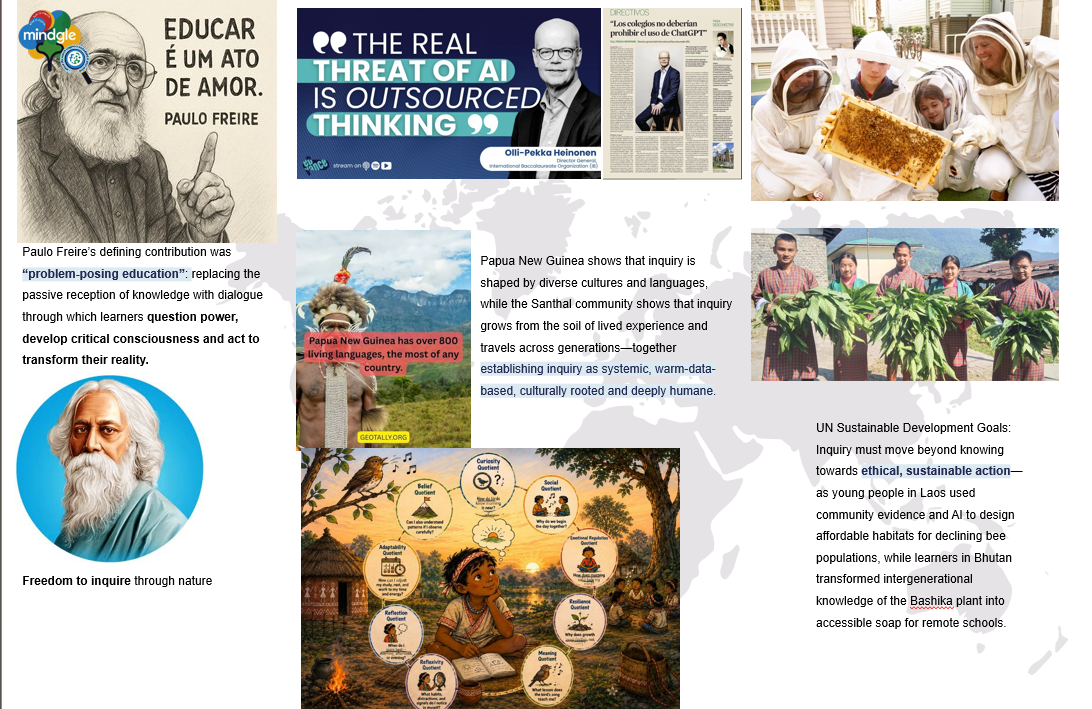
Indigenous communities around the world highlight an educational challenge that is becoming increasingly important in the modern era: the risk that learners may become highly connected to global information while gradually becoming disconnected from their own culture, community wisdom, language, environment, identity, and lived realities. In many education systems, knowledge is often presented as something that exists primarily in textbooks, examinations, formal institutions, or digital platforms. As a result, learners may unintentionally begin to view local traditions, oral histories, community practices, ecological knowledge, and cultural narratives as less valuable forms of knowing.
The Santhal community in India serves as a powerful example of why this matters. For generations, knowledge within Santhal society has been transmitted through storytelling, music, community participation, close relationships with nature, agricultural practices, collective memory, and lived experience. Such knowledge may not always appear in formal curricula, yet it carries deep insights about identity, resilience, sustainability, community, and human relationships. The challenge is not whether one form of knowledge is superior to another, but how learners can learn to respect, examine, and connect multiple ways of knowing.
Mindgle responds to this challenge by encouraging inquiry that begins not only from books and search engines, but also from people, places, communities, cultures, experiences, and the natural world. Learners are encouraged to investigate local stories, community practices, indigenous wisdom, and lived realities alongside scientific, historical, technological, and global perspectives. In doing so, Mindgle helps learners become globally aware without becoming culturally uprooted. It seeks to nurture individuals who can engage confidently with the future while remaining deeply connected to their heritage, identity, humanity, and sense of belonging.
Mindgle also draws inspiration from the philosophy of Binapani Ashram , particularly its emphasis on inner awakening, simplicity, reflective living, self-realisation, spiritual grounding, harmony with nature, and the cultivation of consciousness beyond purely material or performative success. The Ashram’s deeper orientation toward silence, awareness, compassion, inner balance, and human connectedness strongly resonated with the Mindgleian belief that meaningful learning cannot emerge only through information accumulation, academic acceleration, or technological efficiency. Inquiry must also remain connected with introspection, emotional depth, ethical awareness, stillness, humanity, and the learner’s inner world.
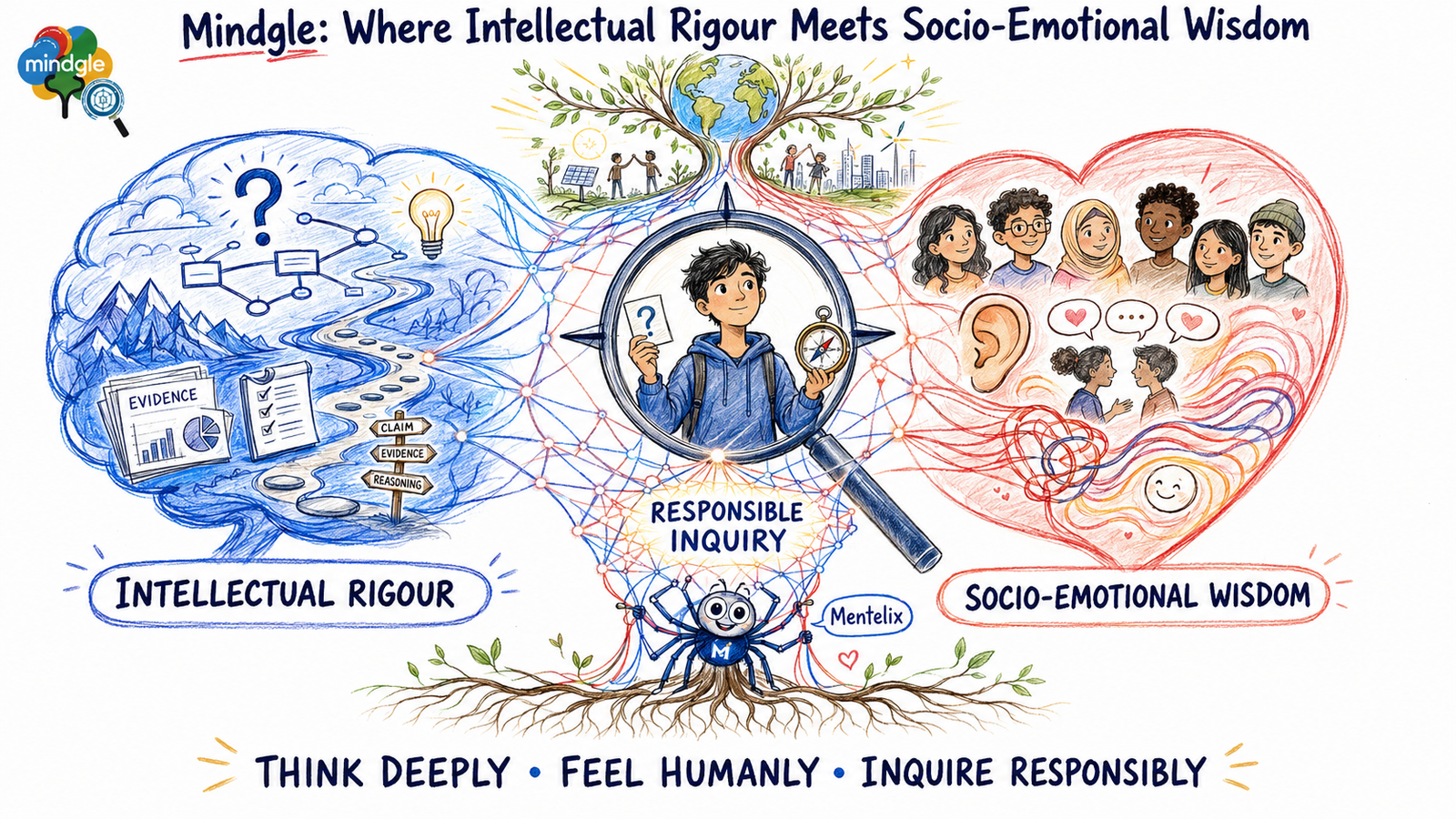
This inspiration particularly shaped Mindgle’s understanding that some of the most transformative research questions do not arise only from textbooks, examinations, or algorithmic searches, but from attentive encounters with life itself — with nature, relationships, suffering, contradiction, curiosity, identity, uncertainty, and lived human experience. In the Mindgleian framework, inquiry therefore begins not merely with external searching, but through internal observation and reflective awareness. This directly influenced the development of *Mentelix*, the internal inquiry spider, where the learner first weaves together:
* emotional resonance,
* lived experience,
* ethical reflection,
* observation,
* systems thinking,
* cultural understanding,
* and intuitive curiosity
before external AI systems are activated.
Only after this inward inquiry incubation process does the external AI Spider begin collaborating with the learner. In this way, Artificial Intelligence does not replace thinking; it amplifies inquiry already shaped through human consciousness, reflection, emotional intelligence, and meaningful observation. This balance between inner awareness and technological collaboration reflects one of the deepest philosophical connections between Binapani-inspired reflective learning and the Mindgleian approach to future-ready inquiry.
The influence of Binapani Ashram also reinforced Mindgle’s belief that education should not produce intellectually efficient yet emotionally fragmented individuals. Instead, learning should help human beings become more aware, grounded, compassionate, reflective, resilient, ethically conscious, and deeply connected with both themselves and the wider world around them. In many ways, this inspiration helped shape Mindgle’s attempt to preserve the human soul of inquiry in an age increasingly dominated by speed, automation, distraction, and cognitive outsourcing.
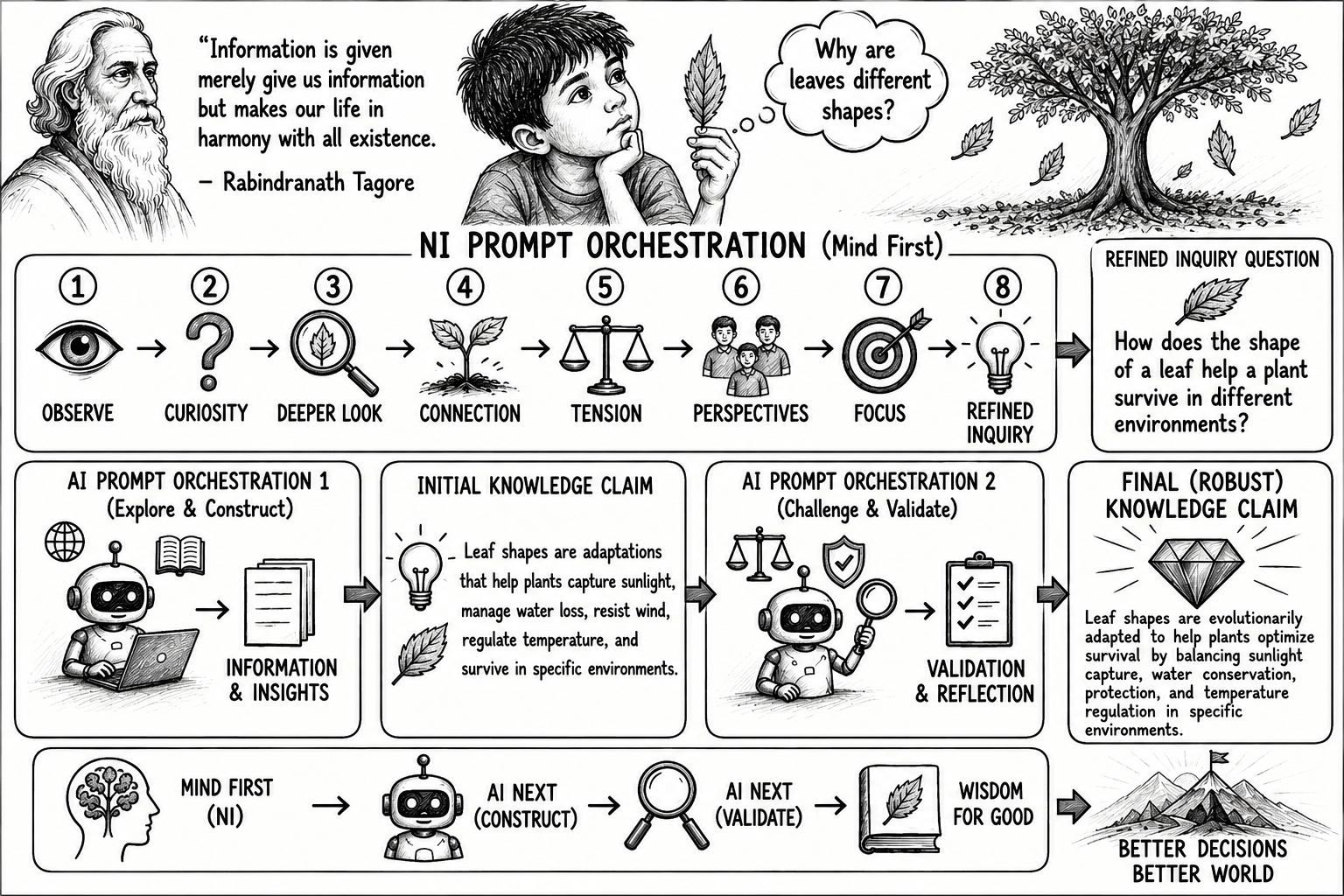
Mindgle was also deeply inspired by the educational philosophy of Visva-Bharati University founded by Rabindranath Tagore, particularly its belief that education should remain profoundly human, relational, reflective, culturally rooted, and connected with the wider world rather than becoming mechanically examination-driven. Tagore’s vision of learning moved beyond rigid classroom instruction and instead viewed education as a living process shaped through curiosity, nature, dialogue, creativity, ethics, emotional sensitivity, intercultural understanding, and freedom of thought. This deeply resonated with the Mindgle philosophy that inquiry should not become reduced to information retrieval or performative academic production, especially in an AI-driven world increasingly dominated by speed, automation, and cognitive outsourcing.
One of the deepest influences Visva-Bharati had on Mindgle was the idea that meaningful inquiry often emerges through a living collaboration between the learner, nature, culture, emotion, silence, observation, and human experience itself. Tagore believed that some of the most powerful questions are not artificially imposed through rigid systems, but quietly generated when learners remain deeply attentive to the world around them. This strongly shaped the Mindgleian belief that authentic research questions often emerge through reflective encounters with life itself — a tree, a village conversation, a river changing course, social inequality, human emotion, climate anxiety, silence, music, or lived contradictions within society. Inquiry therefore becomes relational rather than mechanically academic.
This philosophical influence directly shaped the architecture of *Mentelix* within Mindgle. Before learners activate external AI systems, Mentelix — the internal inquiry spider — first begins weaving cognitive threads through:
* observation,
* emotional resonance,
* prior knowledge,
* ethics,
* systems thinking,
* lived experience,
* imagination,
* culture,
* and reflective awareness.
The learner first collaborates with the surrounding world and with the internal mind before collaborating with Artificial Intelligence. Only after this reflective inquiry incubation process does the external AI Spider become active. AI is therefore not treated as the origin of inquiry, but as an accelerated collaborator guided by human cognition, emotional intelligence, ethical reasoning, and culturally grounded meaning-making.
Visva-Bharati’s idea of creating a space “where the world makes a home in a single nest” also strongly influenced Mindgle’s emphasis on perspective-taking, compassionate inquiry, global-local balance, and culturally grounded knowledge construction. Tagore believed learners should not merely accumulate information, but develop harmony between intellect, emotion, imagination, humanity, ethics, creativity, and lived experience. This directly shaped Mindgle’s integration of:
* metacognition,
* ethical inquiry,
* emotional intelligence,
* reflective learning,
* systems thinking,
* and cognitively and affectively balanced inquiry.
The Visva-Bharati philosophy further reinforced Mindgle’s belief that education should preserve the learner’s humanity rather than produce intellectually efficient but emotionally disconnected individuals. In many ways, Mindgle carries forward a similar concern for the modern AI era:
> How do we ensure that technological advancement does not weaken the deeply human dimensions of inquiry, imagination, ethics, compassion, reflection, and meaningful learning?
Mindgle therefore draws inspiration from Tagore’s educational vision by attempting to create inquiry spaces where learners remain intellectually curious, emotionally aware, ethically grounded, culturally sensitive, creatively expressive, and deeply connected with both humanity and the world around them — while allowing Artificial Intelligence to amplify, rather than replace, deeply human inquiry.
India inspired Mindgle to address an important educational tension: while learners often develop strong academic discipline through examinations, coaching cultures, and competitive pathways, they may receive fewer opportunities to slow down, reflect, design their own questions, explore their identities, and take ownership of their learning. Mindgle seeks to complement academic achievement with learner agency, inquiry, reflection, and self-discovery, helping learners move from simply answering questions set by others to confidently asking meaningful questions of their own.
India’s National Education Policy (NEP) 2020 strongly resonated with the philosophy behind Mindgle, particularly its emphasis on experiential learning, critical thinking, multidisciplinary exploration, competency-based education, flexibility, creativity, and learner-centred pedagogy. NEP recognises that education must move beyond rote memorisation and examination performance to nurture curiosity, inquiry, problem-solving, reflection, ethical reasoning, and lifelong learning. Mindgle seeks to operationalise these aspirations by providing learners and mentors with a structured inquiry architecture that helps transform curiosity into meaningful questions, thoughtful investigation, reflective learning, and responsible knowledge construction. In many ways, Mindgle represents a practical pathway for helping learners become active participants in their own learning journey rather than passive recipients of information.
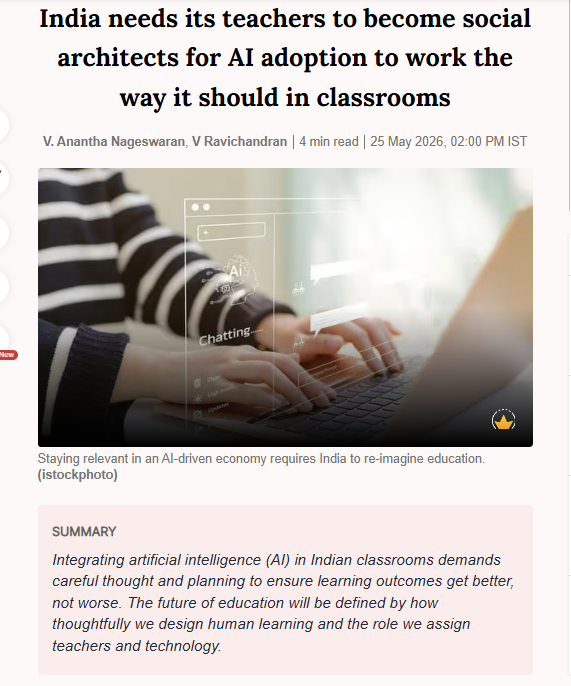
The future of education will not be determined by how much Artificial Intelligence enters classrooms, but by how intentionally schools preserve and strengthen the uniquely human capacities that AI cannot replace. As information becomes abundant and answers become instantaneous, education must shift its focus from content delivery toward inquiry, attention, reflection, judgment, collaboration, ethical reasoning, and wisdom. Teachers must evolve into social architects who design learning environments that cultivate these capacities. Success in the AI era will depend not on how quickly students access answers, but on how thoughtfully they question, evaluate, interpret, and use them.
Mindgle was significantly inspired by the article “India Needs Social Architects to Shape AI Adoption in Classrooms” by Dr. V. Anantha Nageswaran and Dr. S. V. Ravichandran. The article argues that the future of education should not be defined by how much Artificial Intelligence enters classrooms, but by how intentionally schools preserve and strengthen uniquely human capacities such as attention, judgment, reflection, collaboration, ethical reasoning, and wisdom. The authors caution that while AI can accelerate access to information, it may also encourage the outsourcing of cognitive processes that education is meant to develop. This concern resonates deeply with the philosophy of Mindgle. Rather than positioning AI as either a threat or a solution, Mindgle seeks to strengthen the human architecture that must precede technology. Through Mentelix, the TOI–TOK inquiry cycle, cognitive bias awareness, reflection pathways, learner agency frameworks, and My Learning Ladder (MLL), Mindgle encourages learners to pause before searching, question before accepting, reflect before concluding, and evaluate before believing. In many ways, Mindgle attempts to operationalise the article’s central message: that education in the AI era must move beyond information acquisition and deliberately cultivate judgment, wisdom, attention, ethical thinking, and the capacity to construct meaningful knowledge. While AI may assist learning, Mindgle aims to ensure that the learner remains the architect of thinking rather than becoming dependent on automated cognition.
https://www.pressreader.com/india/mint-delhi/20260530/281917369744201
The article’s central argument is that children are often the most affected stakeholders in education, yet they remain the least consulted. It questions whether ideas such as learner agency, student voice, freedom of choice, and democratic participation are genuinely embedded in educational systems or merely used as attractive educational buzzwords. Through examples from students, educators, and schools, the author argues that meaningful education should move beyond rigid, examination-driven structures and actively involve learners in shaping what, how, and why they learn. The article advocates for exploration, curiosity, choice, experiential learning, student participation in decision-making, and learning environments that nurture well-being, creativity, and self-discovery rather than simply producing examination outcomes.
This connects profoundly with Mindgle because Mindgle is built upon the belief that learners should become architects of inquiry rather than passive recipients of instruction. The article’s call for student agency, democratic participation, exploration, and learner voice mirrors Mindgle’s emphasis on heutagogy, inquiry ownership, learner autonomy, and co-construction of knowledge. Through Mentelix, the TOI–TOK cycle, learner-designed inquiries, and My Learning Ladder (MLL), Mindgle attempts to operationalise exactly what the article advocates: an educational culture where curiosity is valued alongside achievement, where learners help shape their own learning journeys, and where mentors and students become collaborative inquirers rather than occupants of fixed teacher-student hierarchies. In many ways, the article describes the educational conditions that Mindgle seeks to create systematically and sustainably.
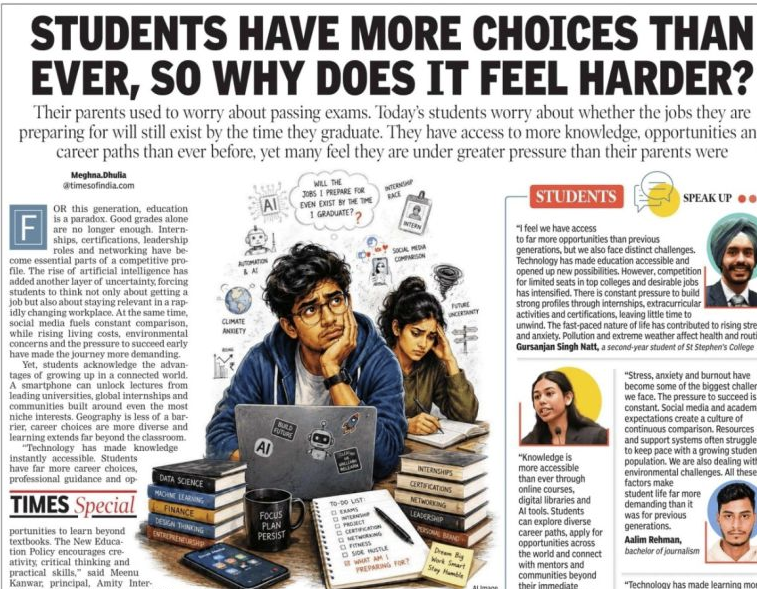
The article argues that previous generations largely worried about passing examinations and securing jobs. Today’s students face a much more complex reality. Along with academics, they are navigating Artificial Intelligence, social media comparison, internships, leadership profiles, university admissions, climate anxiety, economic uncertainty, networking expectations, skill development, and rapidly changing career landscapes.
The illustration of the student sitting in front of a laptop surrounded by books, certificates, internships, AI, social media, future uncertainty, and to-do lists symbolises cognitive overload. The student is not suffering from a lack of opportunities but from an abundance of opportunities.
The ideas presented in this section emerged through engagement with OECD publications, the OECD Future of Education and Skills 2030 initiative, the OECD Learning Compass 2030, and broader educational research examining learner agency, equity, inclusion, well-being, systems thinking, and future-ready learning across diverse educational contexts, including Brazil, Afghanistan, Papua New Guinea, South Africa, and other OECD and partner countries. These contexts served as reflective learning lenses that helped shape Mindgle’s understanding of inquiry, learner agency, human-centred learning, and the responsible integration of Artificial Intelligence.
Mindgle was strongly influenced by the OECD Future of Education and Skills 2030 framework, particularly its vision of learner agency, co-agency, systems thinking, adaptability, and future-ready competencies. The OECD Learning Compass challenged a long-standing assumption that education should primarily prepare learners to navigate existing systems. Instead, it proposed that learners should develop the capacity to shape, redesign, and improve those systems responsibly. This deeply resonates with the Mindgleian belief that learners should not remain passive consumers of knowledge, technology, or educational structures. Through inquiry, reflection, ethical reasoning, perspective-taking, and evidence-conscious thinking, Mindgle seeks to cultivate individuals who can navigate complexity, make informed judgments, collaborate meaningfully with others, and contribute thoughtfully to a rapidly changing world. In many ways, Mindgle operationalises the OECD vision by helping learners move from simply acquiring knowledge to consciously constructing, questioning, applying, and transforming it.
Brazil inspired one of Mindgle’s strongest convictions: meaningful inquiry cannot flourish if learners first have to prove that they belong. In many educational systems, opportunities are not distributed equally. Differences in socioeconomic background, language, confidence, access to quality education, and exposure to resources can quietly shape who participates, who remains invisible, and who believes their ideas matter. The challenge is not simply helping learners acquire knowledge; it is helping every learner feel capable of contributing to knowledge.
This influenced Mindgle’s belief that inquiry should not begin with answers, performance, or polished expression. It should begin with curiosity, belonging, and the confidence to ask questions. Through structured inquiry pathways, reflection tools, learner agency frameworks, and mentor-supported exploration, Mindgle helps learners gradually find their voice, examine multiple perspectives, and engage meaningfully with complex issues. Brazil also reinforced another important lesson for the AI era: learners must learn not only how to access information, but how to question it. Who created this information? Whose experiences are represented? What perspectives are missing? By encouraging learners to ask such questions, Mindgle seeks to ensure that Artificial Intelligence supports human judgment rather than replacing it.
Afghanistan highlights a reality often overlooked in educational reform: learners cannot engage deeply with inquiry when they are struggling with fear, uncertainty, exclusion, interrupted learning, or a lack of psychological safety. Before learners can become critical thinkers, they often need confidence, dignity, belonging, resilience, and hope. Mindgle responds by recognising that inquiry is not merely a cognitive process; it is also a human process. Through reflective learning, emotional awareness, resilience attributes, compassionate inquiry, and mentor-supported growth, Mindgle helps create conditions where learners feel safe enough to ask questions, express ideas, and gradually take ownership of their learning journey.
Papua New Guinea highlights another educational challenge facing many societies: the risk that modern education may unintentionally disconnect learners from their cultural identities, local knowledge systems, languages, and community wisdom. When education values only formal or global knowledge, learners may begin to see their own experiences and traditions as less important. Mindgle responds by treating inquiry as something that can begin from lived experiences, community realities, local stories, indigenous wisdom, and cultural identity. Learners are encouraged to investigate both local and global perspectives, helping them become globally aware without losing connection to their roots.
South Africa highlights the challenge of learning within societies marked by inequality, diverse identities, historical divisions, and competing narratives. In such contexts, education cannot simply focus on content acquisition; learners must also learn how to listen, disagree respectfully, understand multiple perspectives, and navigate complex social realities. Mindgle responds through perspective-aware inquiry, cognitive bias awareness, ethical reasoning, and reflective dialogue. It helps learners examine not only what they think, but why they think it, whose voices are represented, whose voices are missing, and how knowledge itself can be shaped by history, power, and lived experience.
Mindgle was inspired by several globally respected educational initiatives that share a common concern: how do we prepare learners not merely to accumulate information, but to think deeply, act ethically, adapt intelligently, and contribute meaningfully in a rapidly changing world? While Mindgle remains an independent framework, several international educational movements helped shape its philosophy, architecture, and vision.
One of the strongest influences on Mindgle came from UNICEF’s Life Skills and Citizenship Education (LSCE) Framework. The LSCE framework argues that education should move beyond the transmission of academic content and help learners develop critical thinking, problem-solving, self-awareness, empathy, communication, collaboration, citizenship, and lifelong learning capabilities. This philosophy resonated deeply with Mindgle because it recognises that future-ready learners require far more than subject knowledge. The development of Mentelix, the Reflection Quotient, Reflexivity Quotient, Curiosity Quotient, cognitive bias awareness modules, and the broader Mindgleian identity architecture was inspired by a similar belief: that learners must consciously understand themselves, regulate their thinking, question assumptions, empathise with others, and participate responsibly in society. Mindgle therefore extends this vision by helping learners actively design and orchestrate their own inquiry journeys rather than merely receiving information passively.
Mindgle was also influenced by UNICEF’s Reimagine Education initiative, which seeks to prepare young people for a future characterised by uncertainty, technological change, shifting career pathways, and increasing complexity. UNICEF repeatedly emphasises resilience, adaptability, digital readiness, agency, and learning-to-learn as essential capacities for future generations. This aligns closely with Mindgle’s heutagogical foundation, where learners are encouraged to become self-directed inquiry architects capable of adapting their learning strategies, navigating ambiguity, reflecting on their growth, and continuously redesigning their own learning pathways. Rather than preparing students for a single career or static body of knowledge, Mindgle seeks to cultivate learners who can learn, unlearn, relearn, and adapt throughout life.
Another powerful influence came from UNICEF’s work on adolescent development and participation. UNICEF advocates for young people not merely as recipients of educational services but as active participants in shaping their own learning, communities, and futures. This philosophy strongly influenced the core Mindgleian belief that students should become architects of inquiry rather than consumers of instruction. Many educational systems still position learners as passive recipients of knowledge, whereas Mindgle encourages learners to take ownership of questioning, investigating, reflecting, evaluating evidence, and constructing meaning. Through inquiry design, reflection pathways, and learner-led knowledge construction, Mindgle seeks to honour the adolescent voice and strengthen learner agency in a way that is both intellectually rigorous and personally meaningful.
Mindgle was also influenced by UNICEF’s growing concern regarding the global learning crisis. UNICEF’s research increasingly highlights that many learners can decode text, memorise content, and perform procedural tasks, yet struggle with deeper meaning-making, transfer of knowledge, reasoning, problem-solving, and real-world application. This observation resonates strongly with one of the central motivations behind Mindgle. The framework was developed in response to the growing gap between information access and meaningful understanding. Through inquiry architecture, research question design, cognitive bias awareness, reflection, prompt orchestration, and evidence-conscious thinking, Mindgle seeks to strengthen precisely those capacities that transform information into understanding and understanding into wisdom.
The UNESCO Futures of Education Report became one of the most significant philosophical inspirations behind Mindgle. UNESCO argues that education must remain deeply human in a world increasingly shaped by technology, uncertainty, environmental challenges, social fragmentation, and global complexity. Concepts such as “learning to become,” collective well-being, ethical futures, social transformation, human dignity, and preserving humanity within technological societies strongly influenced the Mindgle framework. Mindgle shares UNESCO’s belief that education should not merely prepare learners for employment or examinations, but help them become thoughtful, compassionate, reflective, ethically responsible, and socially conscious human beings. The framework’s emphasis on emotional intelligence, ethical inquiry, empathy, systems thinking, reflective learning, and meaningful knowledge construction reflects this broader human-centred educational vision.
Together, these global initiatives reinforced one of Mindgle’s deepest convictions:
In a world where Artificial Intelligence can increasingly generate answers, the future of education depends on strengthening the uniquely human capacities that give knowledge meaning — curiosity, reflection, empathy, ethics, agency, wisdom, and the ability to ask better questions.