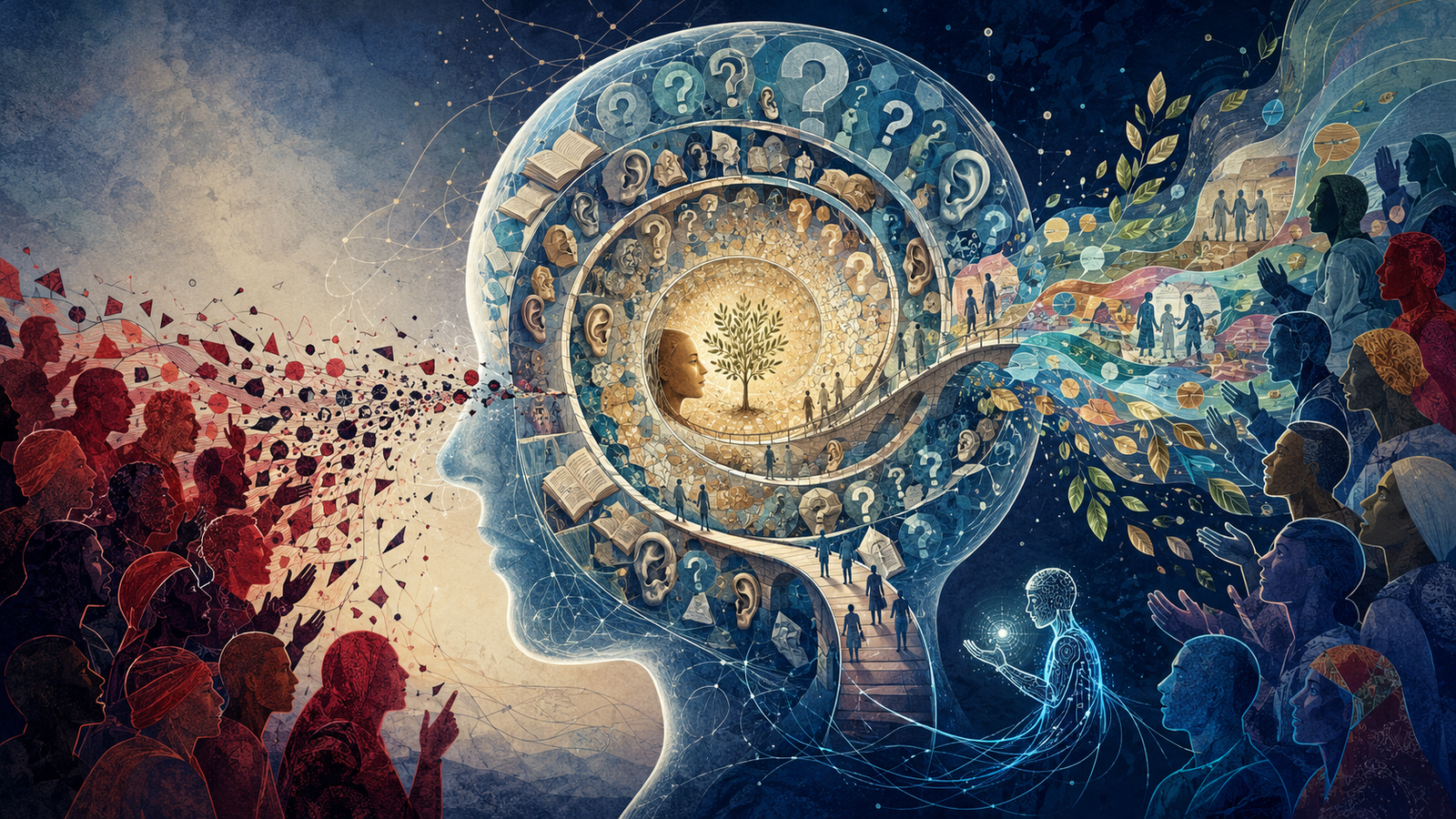
Mindgle transforms peace education from a ceremonial theme into a disciplined way of thinking through difference—before judgement becomes prejudice and prejudice becomes dehumanisation.
“Since wars begin in the minds of men, it is in the minds of men that the defences of peace must be constructed.”
— Constitution of UNESCO
I keep returning to one deeply uncomfortable question:
What if the opposite of peace is not war? What if it is dehumanisation?
We speak endlessly about preparing children for the future. We teach algebra, coding, science, economics and languages. We celebrate academic rigour, innovation and competitive success. But what is the value of producing extraordinarily capable minds if those minds have never learnt what to do with difference?
A learner may analyse Shakespeare yet fail to recognise prejudice concealed inside a joke. They may interrogate scientific evidence yet unquestioningly forward a video designed to provoke hatred. They may speak several languages and still lack the language to say:
“I disagree with you, but I refuse to dehumanise you.”
Perhaps education has become exceptionally good at preparing young people to compete, while remaining underdeveloped in preparing them to coexist without requiring sameness.
Dehumanisation begins before Violence
Wars do not suddenly begin when someone picks up a weapon. Long before physical violence, language often begins doing the psychological work:
Us and them. Normal and abnormal. Deserving and undeserving. Civilised and uncivilised.
First, a person becomes a category. The category becomes a stereotype; the stereotype becomes a threat. Gradually, a name, face and personal story disappear until another person’s suffering feels distant enough to ignore and their dignity negotiable enough to violate.
That is dehumanisation.
Education’s peace-building responsibility is therefore not merely to condemn hatred after it becomes visible, but to help learners recognise the intellectual journey towards it before it becomes normal.
Peace Education Must Not Prescribe What to Think
Peace education cannot mean telling learners what to think about every conflict. That would risk becoming indoctrination disguised as education.
It must do something far more demanding: teach learners how to think when emotions, identities, loyalties, algorithms and competing claims make thinking uncomfortable.
This is where Mindgle enters—not by choosing a learner’s conclusions, but by constructing a disciplined pause between provocation and judgement.
Before reacting, forwarding, rejecting or asking AI for an instant answer, the learner activates their Natural Intelligence and asks:
We often call these critical-thinking questions.
Mindgle recognises that they are also peace-building questions.
DISCOVER AI: An Inquiry Architecture for Peace
Mindgle’s DISCOVER AI process gives this humane inquiry a systematic and systemic structure.
Define the Word asks learners to clarify terms such as enemy, justice, freedom, terrorism, civilisation or security before emotionally charged language begins deciding the conclusion.
Identify the Reality separates what is known from what is claimed, edited, inferred or emotionally amplified.
Surface the Assumption reveals untested beliefs about communities, identities, motives and intentions.
Crack the Concept breaks an apparently simple issue into its historical, political, economic, cultural, emotional and ethical dimensions.
Observe the Exception searches for people and cases that disrupt stereotypes and prevent an entire group from being reduced to one narrative.
Verify the Reversal asks whether the learner would apply the same moral judgement if identities, loyalties or positions were exchanged.
Expose the Silence restores missing voices, absent evidence and experiences that dominant accounts may leave unheard.
Rotate the Lens requires learners to represent another perspective accurately without being forced to accept it.
Amplify the Scale examines how one statement, rumour, algorithm or policy may affect individuals, communities and future generations.
Imagine the Impossible World removes one assumed condition—nationality, religion, race, gender or inherited loyalty—to reveal whether the learner’s judgement still remains defensible.
The learner then converts a reactive raw question into a Refined Inquiry Question capable of guiding evidence-based, compassionate and ethically responsible investigation.
From Winning Arguments to Understanding People
Imagine redesigning a school debate. Instead of rewarding only the learner who destroys the opposition’s argument, each learner must first explain the opposing position so accurately and fairly that the person holding it can say:
“Yes. You understood me.”
Only then may the rebuttal begin.
Such a classroom teaches learners to listen before judging, separate a person from an argument, recognise complexity, revise beliefs when evidence changes and hold conviction without surrendering humility.
It also makes space for sentences that presently receive too little applause:
“I was wrong.”
“I had not considered that.”
“I still disagree, but now I understand why you think that.”
“There may be another explanation.”
“I need more evidence.”
“I do not know enough yet to hold an informed opinion.”
In a culture of instant opinions, algorithmic outrage and performative certainty, these are not weak sentences. They may be among the strongest sentences an educated human being can learn to say.
Intellectual humility is not the absence of conviction. It is the refusal to confuse conviction with infallibility.
Making Young Minds harder to recruit into Hatred
Peace education becomes real when disagreement does not require disrespect; when a stereotype is interrupted by a question; when a rumour stops because one learner requests the source; when a student defends someone absent from the room; and when changing one’s mind is experienced as intellectual growth rather than defeat.
This is the deeper Mindgle proposition: AI may extend an investigation, but Natural Intelligence must govern what deserves inquiry, whose humanity must remain visible and which conclusions can be responsibly defended.
Schools must certainly develop mathematicians, scientists, technologists and leaders. But they must also ask whether those mathematicians will refuse to manipulate numbers, whether those scientists will respect evidence over ideology, whether those technologists will question what their algorithms amplify, and whether those leaders will exercise power without stripping dignity from disagreement.
Academic education determines much of what a learner becomes capable of doing.
Peace education may determine what they choose to do with that capability.
So perhaps the most important question on tomorrow’s report card will never carry a grade:
Did education make this young mind harder to manipulate into hatred?
If the answer is yes, we have taught something far greater than another subject.
We have strengthened one small defence of peace inside a human mind.